
Who watches the highway cameras? The privacy and governance questions around AI surveillance
AI-powered cameras are transforming India’s highways by detecting accidents, traffic violations and potential hazards in real time. But as surveillance becomes more automated, questions around footage access, data retention, privacy and accountability are becoming increasingly important.
- Oct 14, 2026,
- Updated Oct 14, 2026 1:30 AM IST
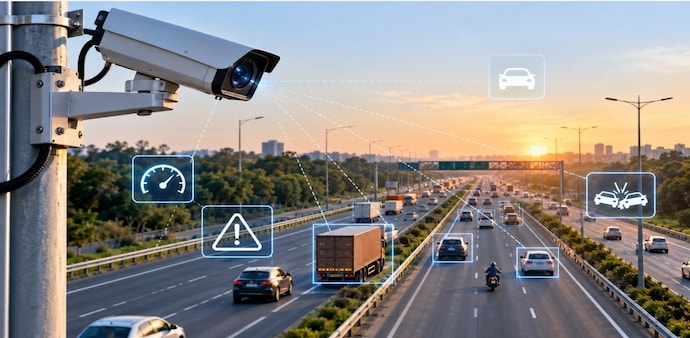
India’s highways are increasingly being equipped with cameras that do more than record traffic. Powered by artificial intelligence (AI), these systems can analyse live video feeds, flag suspected traffic violations and detect accidents, stalled vehicles and other hazards. But as cameras become capable of interpreting road activity automatically, a critical question emerges: who controls the data, and how is its use kept accountable?
India’s national highway network expanded to 1,46,572 km in March 2026, from 91,287 km in FY14, according to a Press Information Bureau backgrounder released in August 2026. As technology-enabled monitoring expands, data retention, access controls and safeguards against misuse are becoming important considerations for highway authorities.
From recording to automated decisions
Traditional CCTV systems primarily record events for later review. AI-powered video analytics can identify patterns, flag suspected violations and generate alerts in real time. While this can help authorities respond faster, automated systems also raise questions about the accuracy of detection and the consequences of mistaken identification. A flagged incident is not necessarily proof of a violation. Clear procedures for human verification and challenging disputed penalties are therefore important to maintaining public trust.
Anoop G Prabhu, Co-Founder and CTO of Vehant Technologies, said AI-powered monitoring was changing how authorities identify and respond to road incidents. “The real potential of AI on highways lies not merely in monitoring what is happening, but in using real-time video intelligence to detect, interpret and respond to incidents as they unfold. A stalled vehicle, collision, overspeeding, wrong-way driving, sudden obstruction or abnormal traffic build-up can escalate into a safety risk within seconds,” Prabhu said.
He added that AI-powered video analytics could continuously process live camera feeds, identify anomalous events, classify incidents and generate alerts with relevant context. This enables authorities to move beyond passive surveillance towards intelligent incident detection, helping response teams assess the situation faster and initiate the appropriate intervention with minimal delay.”
While these capabilities can strengthen road safety, they also underline the importance of clear accountability for how automated systems operate. Authorities need to establish who can access surveillance footage, how long recordings are retained and how alerts are verified before they trigger enforcement action.
Who can access the footage?
Road and Highway surveillance footage can only be accessed by authorised government authorities, ensuring that access remains restricted and controlled. Defined protocols should govern data storage, access permissions, and the documentation of instances where footage is viewed, transferred, or used for enforcement purposes.
Data retention policies also matter. Keeping footage indefinitely may increase privacy and security risks, while deleting it too quickly could undermine accident investigations or legitimate enforcement proceedings. Retention periods should reflect clearly defined operational and legal requirements.
Accountability must accompany automation
As AI-driven surveillance becomes increasingly integrated into highway monitoring and enforcement, balancing road safety with safeguards for people using highways is essential. Systems should distinguish between an automated alert and a verified violation, with human review available when enforcement decisions are disputed. Clear accountability measures can help ensure that the use of AI supports accurate, fair and transparent enforcement.
“The combination of edge computing, AI-powered video analytics, real-time data processing and integrated command centres can create a far more responsive road ecosystem. The focus now needs to move beyond simply detecting incidents to enabling instant action, understanding patterns and delivering the right intelligence to authorities at the right time, Prabhu adds.
The technology deployments described for corridors such as the Bengaluru–Mysuru highway demonstrate the growing role of intelligent traffic management. However, the available material does not establish the specific data-retention policies, access protocols or independent audit arrangements followed by these deployments.
As AI surveillance expands, transparent rules on data use, independent oversight, documented audit trails and accessible grievance mechanisms will be essential. The success of intelligent highways will depend not only on how quickly systems detect incidents, but also on whether their decisions are accurate, explainable and accountable.
India’s highways are increasingly being equipped with cameras that do more than record traffic. Powered by artificial intelligence (AI), these systems can analyse live video feeds, flag suspected traffic violations and detect accidents, stalled vehicles and other hazards. But as cameras become capable of interpreting road activity automatically, a critical question emerges: who controls the data, and how is its use kept accountable?
India’s national highway network expanded to 1,46,572 km in March 2026, from 91,287 km in FY14, according to a Press Information Bureau backgrounder released in August 2026. As technology-enabled monitoring expands, data retention, access controls and safeguards against misuse are becoming important considerations for highway authorities.
From recording to automated decisions
Traditional CCTV systems primarily record events for later review. AI-powered video analytics can identify patterns, flag suspected violations and generate alerts in real time. While this can help authorities respond faster, automated systems also raise questions about the accuracy of detection and the consequences of mistaken identification. A flagged incident is not necessarily proof of a violation. Clear procedures for human verification and challenging disputed penalties are therefore important to maintaining public trust.
Anoop G Prabhu, Co-Founder and CTO of Vehant Technologies, said AI-powered monitoring was changing how authorities identify and respond to road incidents. “The real potential of AI on highways lies not merely in monitoring what is happening, but in using real-time video intelligence to detect, interpret and respond to incidents as they unfold. A stalled vehicle, collision, overspeeding, wrong-way driving, sudden obstruction or abnormal traffic build-up can escalate into a safety risk within seconds,” Prabhu said.
He added that AI-powered video analytics could continuously process live camera feeds, identify anomalous events, classify incidents and generate alerts with relevant context. This enables authorities to move beyond passive surveillance towards intelligent incident detection, helping response teams assess the situation faster and initiate the appropriate intervention with minimal delay.”
While these capabilities can strengthen road safety, they also underline the importance of clear accountability for how automated systems operate. Authorities need to establish who can access surveillance footage, how long recordings are retained and how alerts are verified before they trigger enforcement action.
Who can access the footage?
Road and Highway surveillance footage can only be accessed by authorised government authorities, ensuring that access remains restricted and controlled. Defined protocols should govern data storage, access permissions, and the documentation of instances where footage is viewed, transferred, or used for enforcement purposes.
Data retention policies also matter. Keeping footage indefinitely may increase privacy and security risks, while deleting it too quickly could undermine accident investigations or legitimate enforcement proceedings. Retention periods should reflect clearly defined operational and legal requirements.
Accountability must accompany automation
As AI-driven surveillance becomes increasingly integrated into highway monitoring and enforcement, balancing road safety with safeguards for people using highways is essential. Systems should distinguish between an automated alert and a verified violation, with human review available when enforcement decisions are disputed. Clear accountability measures can help ensure that the use of AI supports accurate, fair and transparent enforcement.
“The combination of edge computing, AI-powered video analytics, real-time data processing and integrated command centres can create a far more responsive road ecosystem. The focus now needs to move beyond simply detecting incidents to enabling instant action, understanding patterns and delivering the right intelligence to authorities at the right time, Prabhu adds.
The technology deployments described for corridors such as the Bengaluru–Mysuru highway demonstrate the growing role of intelligent traffic management. However, the available material does not establish the specific data-retention policies, access protocols or independent audit arrangements followed by these deployments.
As AI surveillance expands, transparent rules on data use, independent oversight, documented audit trails and accessible grievance mechanisms will be essential. The success of intelligent highways will depend not only on how quickly systems detect incidents, but also on whether their decisions are accurate, explainable and accountable.