
FICCI President visited China's corporate giants, including BYD. His 3 biggest takeaways
China is like a no-frills fighting ring. Extremely competitive, says FICCI President
- Jun 22, 2026,
- Updated Jun 22, 2026 5:36 PM IST
FICCI President Anant Goenka has shared his observations from a recent CEO delegation visit to China, describing the country's business environment as an intensely competitive ecosystem shaped by aggressive market-share battles, heavy investments in research and development, and extensive state support.
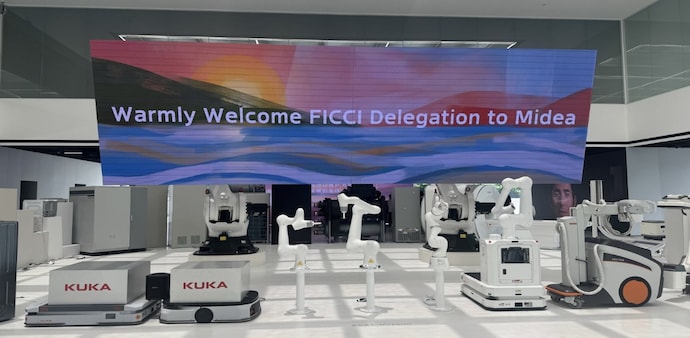
In a post on social media on Monday, Goenka said he led a FICCI CEO delegation to China and visited major companies including BYD, Geely, Midea and Mindray.
Drawing from the visit, he outlined what he described as his three key takeaways from China's industrial and corporate landscape.
'A no-frills fighting ring'
Goenka said China operates as an exceptionally competitive market where companies are willing to sacrifice profitability in pursuit of scale and market dominance.
"China is like a no-frills fighting ring. Extremely competitive. Businesses operate at margins (2-3%), and global boards would never approve. Only market share matters, and there is no concept of ROI. The few who survive are the toughest and the best," he wrote.
According to Goenka, the intensity of competition creates an environment where only the strongest companies emerge as long-term winners.
Long-term bets on R&D and automation
The FICCI chief said one of the most striking features of the companies he visited was their commitment to long-term investment in innovation and manufacturing efficiency.
"R&D and automation are at the highest levels. The scale of automation and R&D investment at these companies is built for a 10-year time horizon, not a quarterly one. They celebrate innovators, have walls of patents and dark factories with unmatched efficiency," he said.
His remarks highlighted what he viewed as a sustained focus on technological advancement and future-oriented industrial planning.
‘The state is a silent shareholder everywhere’
Goenka also pointed to the role of state support in shaping China's industrial competitiveness, arguing that access to low-cost capital and policy backing significantly alters business economics.
“The state is a silent shareholder everywhere. Cheap capital, land, power, and policy support at a scale that fundamentally changes unit economics. As long as you service interest (@ only 2-3%), debt doesn’t have to be paid back. This isn’t a level playing field,” he wrote.
The comments come amid growing debate over global manufacturing competitiveness and the role of government support in industrial growth.
Reacting to Goenka's observations, former Army Commander Raj Shukla called for a broader strategic response from India. "We need a national-level policy response to this," Shukla wrote.
The remarks have added to ongoing discussions on how India can strengthen its manufacturing ecosystem and compete with China's scale, technology investments, and state-backed industrial model.
FICCI President Anant Goenka has shared his observations from a recent CEO delegation visit to China, describing the country's business environment as an intensely competitive ecosystem shaped by aggressive market-share battles, heavy investments in research and development, and extensive state support.
In a post on social media on Monday, Goenka said he led a FICCI CEO delegation to China and visited major companies including BYD, Geely, Midea and Mindray.
Drawing from the visit, he outlined what he described as his three key takeaways from China's industrial and corporate landscape.
'A no-frills fighting ring'
Goenka said China operates as an exceptionally competitive market where companies are willing to sacrifice profitability in pursuit of scale and market dominance.
"China is like a no-frills fighting ring. Extremely competitive. Businesses operate at margins (2-3%), and global boards would never approve. Only market share matters, and there is no concept of ROI. The few who survive are the toughest and the best," he wrote.
According to Goenka, the intensity of competition creates an environment where only the strongest companies emerge as long-term winners.
Long-term bets on R&D and automation
The FICCI chief said one of the most striking features of the companies he visited was their commitment to long-term investment in innovation and manufacturing efficiency.
"R&D and automation are at the highest levels. The scale of automation and R&D investment at these companies is built for a 10-year time horizon, not a quarterly one. They celebrate innovators, have walls of patents and dark factories with unmatched efficiency," he said.
His remarks highlighted what he viewed as a sustained focus on technological advancement and future-oriented industrial planning.
‘The state is a silent shareholder everywhere’
Goenka also pointed to the role of state support in shaping China's industrial competitiveness, arguing that access to low-cost capital and policy backing significantly alters business economics.
“The state is a silent shareholder everywhere. Cheap capital, land, power, and policy support at a scale that fundamentally changes unit economics. As long as you service interest (@ only 2-3%), debt doesn’t have to be paid back. This isn’t a level playing field,” he wrote.
The comments come amid growing debate over global manufacturing competitiveness and the role of government support in industrial growth.
Reacting to Goenka's observations, former Army Commander Raj Shukla called for a broader strategic response from India. "We need a national-level policy response to this," Shukla wrote.
The remarks have added to ongoing discussions on how India can strengthen its manufacturing ecosystem and compete with China's scale, technology investments, and state-backed industrial model.