
Why government jobs are disappearing even as millions of Indians chase them
As millions of young Indians chase the security of government jobs, sanctioned posts are shrinking, vacancies remain high and the state is increasingly turning to contractual labour.
Sindhu Bhattacharya
- Aug 17, 2026,
- Updated Aug 20, 2026 1:31 PM IST
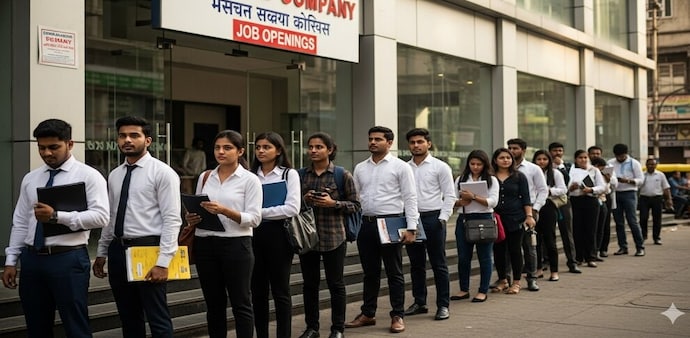
A government job in India has never been just an employment opportunity. It has historically been about social mobility, job security for life, a guarantee of pension after retirement and of course, a matter of societal status, especially for marriages in rural areas. As millions of youth enter the job market each year, thanks to India’s peak demographic dividend, the demand for government jobs has been growing exponentially. When the Railway Recruitment Board advertised 32,438 vacancies for Group D positions (assistant pointsman, technical assistants) last year, nearly 15.6 lakh people applied, about 48 applicants to a seat.
Advertisement
As for employment in the private sector, corporate India has mostly been viewed as a mercurial employer, hiring and firing frequently. The recently introduced new Labour Codes have only strengthened this perception, since they allow private employers with less than 300 employees to bypass government nod for sackings or closures. In a survey published by the International Labour Organisation, of the 1,920 respondents asked about white collar jobs, nearly 27% was keen to get a government job in India.
Against this background, it is pertinent to understand that the ongoing student protests in Jharkhand (and earlier ones in some other states) showcase how administrative delays in recruitment for government jobs increasingly frustrate educated youth looking for a gateway to secure employment. Getting a government job is a long process, as state recruitment boards sometimes take 3-4 years to complete a single recruitment cycle, by which time many candidates become ineligible as they breach the age limit.
Advertisement
Development economist Jean Dreze said India needs more public jobs, while dismissing the common perception in the country about a bloated public sector. Highlighting the example of Jharkhand where 40% of government primary schools operate with a single teacher, he noted several government departments face severe shortage of manpower. “There are many reasons for manpower shortages. Mostly, governments are constrained in hiring permanent staff because Pay Commission payouts, pensions etc raise the wage bill. They then prefer getting workers on contractual basis”.
The impact of the Seventh Pay Commission, implemented in 2016, expected to equal an increase of 0.65 percentage points in the ratio of expenditure on (pay + allowances + pension) to GDP at over Rs 1 lakh crore.
Advertisement
That explains why the government jobs pie has been shrinking over the years. The number of sanctioned government posts has been decreasing even as the government’s wage bill keeps rising. And the state has begun to not just cut back on positions, but also to increasingly rely on outsourcing work to contractual labour.
India’s total workforce (including those working in agriculture, non-agriculture, organised and unorganised sectors) was about 610 million in 2024, according to Santosh Mehrotra, former professor of Economics at Jawaharlal Nehru University. And total government jobs (states, Centre, public sector units and public sector banks, paramilitary but excluding defence) were around 25 million. Thus, the government accounted for just about 4% of total employment, excluding the defence sector.
The share of government jobs is much higher in other countries, pointed out Mehrotra. It could be as high as 40-50% in some countries, Dreze said
Data on actual number of posts sanctioned across various ministries and departments of the Central government is scattered, and in many instances, missing. But as per the latest Annual Report on Pay & Allowances of Central Government Civilian Employees, prepared by the Expenditure Department of the Finance Ministry, the number of sanctioned posts decreased every year for five years till March 2024. In 2020, the number of sanctioned posts was 40,77,687. By March 2024, this fell to 40,03,140, down by nearly 75,000 sanctioned posts.
Advertisement
The same report of the Finance Ministry showed that by March 2024, nearly 8.5 lakh sanctioned posts were lying vacant. In other words, nearly every fifth central government post was vacant, with just 31,57,362 people employed. Significantly, the share of sanctioned posts lying vacant in 2024 was the lowest in the five-year period at 21.1%, against 24.2% in the immediate previous year and 21.8% in 2020. Data for subsequent years has not been published by the ministry. But from the 2026-27 Union Budget documents, it becomes clear that by March 2025, the actual headcount of the Central government was 33,02,539. Data on the number of vacancies could not be ascertained as the total number of sanctioned posts beyond 2024 has not been published.
The Indian Railways remains the biggest employer within the Central government, with the Ministry of Home coming up a close second. In fact, three in four jobs anywhere in the Central government are offered either with the Railways or with the Home Ministry. The Defence (Civil) operations account for roughly 10% and department of Post for 6% of sanctioned jobs.
Advertisement
Jobs in the government are categorised as Group A, B, C and D. In 2024, Group C (clerical, supervisory, public-facing roles such as upper/lower division clerks (UDC/LDC), postmen, typists) had the highest number of sanctioned posts, accounting for nearly 9 out of 10 sanctioned posts, as per the finance ministry data. As many as 34,46,938 posts were sanctioned in this category in 2024. But nearly 20% of Group C post remained vacant in that year. In the same year, there were 29,6182 non-gazetted Group B posts (middle-management officers, section heads, and senior technical staff such as income tax inspectors, assistant section officers) but about 30% posts in this category remained vacant.
So why are the number of government jobs shrinking, sanctioned posts not getting filled and reliance on contractual labour increasing? Mehrotra said that across the world, the higher the per capita income, the bigger is the size of the state. “This is a systematic relationship. But the tax to GDP ratio in India has remained constant for 35 years at 17-17.5% despite per capita income growth. Somehow the state thinks that the economy can keep growing but the state doesn’t have to match that growth in terms of staffing”. The size of the state (number of government jobs) can expand only when the tax:GDP ratio grows. “Else, if public expenditure grows without tax:GDP growth, then rising debt will be the result,” he added.
Advertisement
The Government e-Marketplace (GeM) was launched in 2016 by the Ministry of Commerce & Industry as an online platform for end-to-end public procurement. While initially built for purchasing physical goods (like laptops and office furniture), it expanded into services in FY 2019–20. Now, GeM Manpower Outsourcing operates as an Amazon-like portal for hiring human resources. Central ministries, public sector undertakings (PSUs), autonomous institutions and state bodies issue digital tenders for personnel. More than 30,000 registered staffing vendors/contractors bid on the tenders, based on minimum wage norms and fixed remuneration methods. The GeM automates procurement of roles ranging from Unskilled/Semi-Skilled (multi-tasking staff, sanitation workers, security guards, horticulture staff) to Skilled/Professional (Data Entry Operators, IT assistants, facility management, and project consultants). In FY25, more than a million people were hired by the government for various roles through the GeM.
The total Central expenditure on pay and allowances has grown steadily over the last ten years. Expenditure rose from Rs 1.40 lakh crore in 2014-15 to Rs 2.96 lakh crore in 2023-24. The most significant annual spike occurred in 2016-17, with a 21.65% increase (or by more than a fifth) due to the implementation of the 7th Central Pay Commission. But in Parliament, the government has been wary of acknowledging increasing use of contractual labour. In a written reply, (starred question number 13, on July 20th), Labour Minister Mansukh Mandavia did not directly reply if there was a rise in the number of contractual employees compared to regular appointments over the last few years but said contractual and outsourced employees are engaged by ministries/departments and PSUs based on their administrative and operational requirements. He also did not reveal the numbers of such employees for the previous five years.
In a reply in 2023, however, the labour ministry had shown contractual employees in the ‘Central Sphere’ had more than doubled in four years, between 2019 and September 2022 to nearly 29 lakh. The share of contractual and casual workers in Central Public Sector Enterprises (CPSEs) has been rising exponentially in fact over 10 years, from 2015-16 to 2025-26. As per data from Public Enterprises Surveys, about one in six workers across CPSEs was either a casual or a contract worker in FY16 but by FY26, this had reached nearly 50%.
A government job in India has never been just an employment opportunity. It has historically been about social mobility, job security for life, a guarantee of pension after retirement and of course, a matter of societal status, especially for marriages in rural areas. As millions of youth enter the job market each year, thanks to India’s peak demographic dividend, the demand for government jobs has been growing exponentially. When the Railway Recruitment Board advertised 32,438 vacancies for Group D positions (assistant pointsman, technical assistants) last year, nearly 15.6 lakh people applied, about 48 applicants to a seat.
Advertisement
As for employment in the private sector, corporate India has mostly been viewed as a mercurial employer, hiring and firing frequently. The recently introduced new Labour Codes have only strengthened this perception, since they allow private employers with less than 300 employees to bypass government nod for sackings or closures. In a survey published by the International Labour Organisation, of the 1,920 respondents asked about white collar jobs, nearly 27% was keen to get a government job in India.
Against this background, it is pertinent to understand that the ongoing student protests in Jharkhand (and earlier ones in some other states) showcase how administrative delays in recruitment for government jobs increasingly frustrate educated youth looking for a gateway to secure employment. Getting a government job is a long process, as state recruitment boards sometimes take 3-4 years to complete a single recruitment cycle, by which time many candidates become ineligible as they breach the age limit.
Advertisement
Development economist Jean Dreze said India needs more public jobs, while dismissing the common perception in the country about a bloated public sector. Highlighting the example of Jharkhand where 40% of government primary schools operate with a single teacher, he noted several government departments face severe shortage of manpower. “There are many reasons for manpower shortages. Mostly, governments are constrained in hiring permanent staff because Pay Commission payouts, pensions etc raise the wage bill. They then prefer getting workers on contractual basis”.
The impact of the Seventh Pay Commission, implemented in 2016, expected to equal an increase of 0.65 percentage points in the ratio of expenditure on (pay + allowances + pension) to GDP at over Rs 1 lakh crore.
Advertisement
That explains why the government jobs pie has been shrinking over the years. The number of sanctioned government posts has been decreasing even as the government’s wage bill keeps rising. And the state has begun to not just cut back on positions, but also to increasingly rely on outsourcing work to contractual labour.
India’s total workforce (including those working in agriculture, non-agriculture, organised and unorganised sectors) was about 610 million in 2024, according to Santosh Mehrotra, former professor of Economics at Jawaharlal Nehru University. And total government jobs (states, Centre, public sector units and public sector banks, paramilitary but excluding defence) were around 25 million. Thus, the government accounted for just about 4% of total employment, excluding the defence sector.
The share of government jobs is much higher in other countries, pointed out Mehrotra. It could be as high as 40-50% in some countries, Dreze said
Data on actual number of posts sanctioned across various ministries and departments of the Central government is scattered, and in many instances, missing. But as per the latest Annual Report on Pay & Allowances of Central Government Civilian Employees, prepared by the Expenditure Department of the Finance Ministry, the number of sanctioned posts decreased every year for five years till March 2024. In 2020, the number of sanctioned posts was 40,77,687. By March 2024, this fell to 40,03,140, down by nearly 75,000 sanctioned posts.
Advertisement
The same report of the Finance Ministry showed that by March 2024, nearly 8.5 lakh sanctioned posts were lying vacant. In other words, nearly every fifth central government post was vacant, with just 31,57,362 people employed. Significantly, the share of sanctioned posts lying vacant in 2024 was the lowest in the five-year period at 21.1%, against 24.2% in the immediate previous year and 21.8% in 2020. Data for subsequent years has not been published by the ministry. But from the 2026-27 Union Budget documents, it becomes clear that by March 2025, the actual headcount of the Central government was 33,02,539. Data on the number of vacancies could not be ascertained as the total number of sanctioned posts beyond 2024 has not been published.
The Indian Railways remains the biggest employer within the Central government, with the Ministry of Home coming up a close second. In fact, three in four jobs anywhere in the Central government are offered either with the Railways or with the Home Ministry. The Defence (Civil) operations account for roughly 10% and department of Post for 6% of sanctioned jobs.
Advertisement
Jobs in the government are categorised as Group A, B, C and D. In 2024, Group C (clerical, supervisory, public-facing roles such as upper/lower division clerks (UDC/LDC), postmen, typists) had the highest number of sanctioned posts, accounting for nearly 9 out of 10 sanctioned posts, as per the finance ministry data. As many as 34,46,938 posts were sanctioned in this category in 2024. But nearly 20% of Group C post remained vacant in that year. In the same year, there were 29,6182 non-gazetted Group B posts (middle-management officers, section heads, and senior technical staff such as income tax inspectors, assistant section officers) but about 30% posts in this category remained vacant.
So why are the number of government jobs shrinking, sanctioned posts not getting filled and reliance on contractual labour increasing? Mehrotra said that across the world, the higher the per capita income, the bigger is the size of the state. “This is a systematic relationship. But the tax to GDP ratio in India has remained constant for 35 years at 17-17.5% despite per capita income growth. Somehow the state thinks that the economy can keep growing but the state doesn’t have to match that growth in terms of staffing”. The size of the state (number of government jobs) can expand only when the tax:GDP ratio grows. “Else, if public expenditure grows without tax:GDP growth, then rising debt will be the result,” he added.
Advertisement
The Government e-Marketplace (GeM) was launched in 2016 by the Ministry of Commerce & Industry as an online platform for end-to-end public procurement. While initially built for purchasing physical goods (like laptops and office furniture), it expanded into services in FY 2019–20. Now, GeM Manpower Outsourcing operates as an Amazon-like portal for hiring human resources. Central ministries, public sector undertakings (PSUs), autonomous institutions and state bodies issue digital tenders for personnel. More than 30,000 registered staffing vendors/contractors bid on the tenders, based on minimum wage norms and fixed remuneration methods. The GeM automates procurement of roles ranging from Unskilled/Semi-Skilled (multi-tasking staff, sanitation workers, security guards, horticulture staff) to Skilled/Professional (Data Entry Operators, IT assistants, facility management, and project consultants). In FY25, more than a million people were hired by the government for various roles through the GeM.
The total Central expenditure on pay and allowances has grown steadily over the last ten years. Expenditure rose from Rs 1.40 lakh crore in 2014-15 to Rs 2.96 lakh crore in 2023-24. The most significant annual spike occurred in 2016-17, with a 21.65% increase (or by more than a fifth) due to the implementation of the 7th Central Pay Commission. But in Parliament, the government has been wary of acknowledging increasing use of contractual labour. In a written reply, (starred question number 13, on July 20th), Labour Minister Mansukh Mandavia did not directly reply if there was a rise in the number of contractual employees compared to regular appointments over the last few years but said contractual and outsourced employees are engaged by ministries/departments and PSUs based on their administrative and operational requirements. He also did not reveal the numbers of such employees for the previous five years.
In a reply in 2023, however, the labour ministry had shown contractual employees in the ‘Central Sphere’ had more than doubled in four years, between 2019 and September 2022 to nearly 29 lakh. The share of contractual and casual workers in Central Public Sector Enterprises (CPSEs) has been rising exponentially in fact over 10 years, from 2015-16 to 2025-26. As per data from Public Enterprises Surveys, about one in six workers across CPSEs was either a casual or a contract worker in FY16 but by FY26, this had reached nearly 50%.
Read more!