
Can the proposed International Container Transhipment Port lure shipping lines away from established regional hubs?
Can the proposed International Container Transhipment Port lure shipping lines away from established regional hubs?
India hopes the proposed International Container Transhipment Port at Great Nicobar will establish it as a maritime power near the Strait of Malacca. But can it lure shipping lines away from established regional hubs?
Richa Sharma
- Aug 19, 2026,
- Updated Aug 19, 2026 4:45 PM IST
Nearly 75% of India's transshipment cargo is routed through foreign ports, resulting in an annual foreign exchange outflow of about $200 million. Reducing this dependence, along with leveraging the strategic location of Great Nicobar Island near the Strait of Malacca, are among the reasons the government has cited for the proposed Rs 99,000 crore International Container Transshipment Port (ICTP) at Galathea Bay.
Advertisement
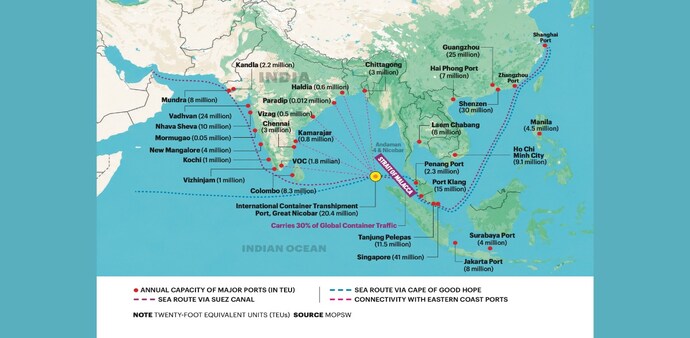
The ICTP, with a proposed capacity of 20.4 million Twenty-Foot Equivalent Units (TEUs), a standardised unit used to measure the capacity of shipping containers and ports, is likely to be completed over the next 35 years and is expected to take on established transshipment hubs such as Singapore, which has an operational capacity of 41 million TEUs and is equipped with some of the world’s most advanced port technologies.
The port is one of the country’s biggest infrastructure projects, along with an international airport, a power plant and a township on the island. A project of this size and scale in a protected forest within the Great Nicobar Biosphere Reserve, a UNESCO-recognised site covering 85% of the island, will have an environmental impact as well.
Advertisement
The government plans to clear approximately one million trees from this tropical rainforest, with compensatory afforestation in Haryana and Madhya Pradesh. Concerns have also been raised about the rights and interests of Particularly Vulnerable Tribal Groups (PVTGs), including the Shompen and Nicobari communities, which are also being affected by the opening up of the protected area.
The bigger question is whether it will put India on the global maritime map by becoming a major transhipment hub? There are differing views, including on whether it will compete against Adani-run Vizhinjam International Port, another transshipment port located on the international trade route.
Global Trade Flows
Advertisement
The project enjoys a strategic advantage because it is located close to the main East-West international shipping route, making it an ideal hub for global trade. Former shipping secretary Gopal Krishna says India has struggled with transshipment for the last three decades. Most transshipment takes place through Singapore, Port Klang (Malaysia) and Colombo on the east coast and Salalah (Oman) and Jebel Ali (Dubai) on the west.
“About 5 million TEUs get transshipped (both import and export) through foreign ports, and of this, three million TEUs are transshipped through the east. It makes a lot of sense to build ICTP, Galathea Bay, if you see from this perspective that three million TEUs is a big number,” he tells Business Today.
The Kamarajar Port Ltd (KPL) is the implementing agency for the ICTP project, which is expected to be completed in two phases.
Port Push
The project leverages a highly strategic geopolitical and geographic advantage and is positioned 40 nautical miles from the Malacca Strait, which is one of the world’s busiest international shipping routes through which nearly 35% of global seaborne trade passes annually.
With natural water depths of 20-30 metres, the location offers a significant opportunity to develop a world-class deep-draft transshipment terminal capable of handling next-generation mainline vessels.
Advertisement
The project is being constructed in two phases. According to the project documents, Phase-II constitutes the primary revenue-generating phase of the project for the concessionaire. During Phase-I, the concessionaire is expected to largely achieve financial break-even.
Being built as a joint venture, the project will have a minimum 55% shareholding by an Indian-Owned and Controlled entity.
Galathea Bay is geographically closer than Port Klang and Singapore, enabling both mother vessels and feeder vessels to achieve logistics cost savings if transshipment activities are shifted from these established foreign hubs to Galathea Bay, according to the Ministry of Shipping, Ports and Waterways (MoSPW).
ICTP’s strategic location near the Strait of Malacca, positions it well to strengthen India’s play in the global container shipping network serving trade across other countries.
-RAVI JAKHAR,Director, Strategy and Group CFO, Allcargo Group
“The proposed ICTP at Galathea Bay is a significant milestone in India’s long-term maritime infrastructure journey. Its strategic location near the Strait of Malacca, one of the world’s busiest shipping corridors, positions it well to strengthen India’s play in the global container shipping network serving not only Indian trade but also trade across other countries,” said Ravi Jakhar, Director, Strategy and Group CFO, Allcargo Group.
Advertisement
However, he argues that there will be no gateway cargo as Galathea Bay Port does not have any catchment area.
“Containers will come from Kolkata, Paradeep and Chennai to this place and then another mother ship will carry them to their final destinations. Now, Vizhinjam Port has become operational, and it is big enough to take care of the transhipment load of the country. This port could end up competing for traffic with Vizhinjam,” he explains.
India is also building new deep-water terminals at existing ports in Chennai, Odisha and Gujarat to capture transshipment traffic now routed through foreign ports.
Strategic importance
The proposed project at Galathea Bay has high strategic importance from both defence and commercial perspectives, particularly in the context of neighbouring countries continuously enhancing their port infrastructure and defence capabilities in the Indian Ocean region.
Defence experts say it would improve India’s ability to monitor maritime trade and military movements in the region. The Strait of Malacca is the primary chokepoint in Asia and Oceania and the world’s largest oil transit chokepoint by volume, with about 29% of global maritime oil flowing through the strait, according to the US Energy Information Administration.
Advertisement
We are crucially dependent on the sea for economic well-being. Sea lanes are important for strategic stability. Safety and stability at sea cannot be taken for granted.
-ADMIRAL SWAMINATHAN,Indian Navy Chief
Speaking at the BT Mindrush in March this year, Indian Navy Chief Admiral Swaminathan said that India is a maritime nation straddling the Indian Ocean, where much of the world's international trade passes and key trade lanes crisscross.
“Inimical countries or mountain ranges block our linkages to the north. We are crucially dependent on the sea for economic well-being. Sea lanes are important for strategic stability. Safety and stability at sea cannot be taken for granted. Sea lanes and security of sea lanes—if they are threatened by any conflict, there will be spillover effects,” said Swaminathan.
Experts further point out that nearly 80% of China’s oil imports and a significant share of its cargo pass through the Malacca Strait. “India requires a strong economic and military base in Great Nicobar amid China’s growing naval presence in the Indian Ocean Region,” says former Air Chief Marshal RKS Bhadauria.
The island’s strategic location near the Malacca Strait is a chokepoint after the Strait of Hormuz.
Competitiveness
Ports such as Vizhinjam, Visakhapatnam and Vadhavan are also targeting transshipment traffic. The Department of Economic Affairs (DEA), during a meeting of the Public Private Partnership Appraisal Committee (PPPAC), flagged whether Galathea Bay will compete with these projects.
The document accessed by BT of the PPPAC appraisal meeting held on March 19 this year shows the DEA also questioning its competitiveness with international ports on the east coast.
The shipping ministry said that although India has operational deep-draft ports, besides the under-development Vadhvan, none of the east coast facilities is an international transhipment port close to major shipping routes. Galathea Bay’s location near the East-West shipping corridor gives it a competitive edge.
The government is of the view that Vizhinjam is expected to primarily cater to transshipment of the west coast traffic and compete with established hubs such as Port of Colombo. In contrast, the proposed Galathea Bay ICTP is strategically located near the Malacca Strait and is expected to cater to traffic from the east coast of India, Southeast Asia, and east-bound shipping routes.
The committee also questioned how the proposed project, given its proximity to established transshipment hubs such as Colombo, Singapore, and Port Klang, will remain competitive enough to attract shipping lines.
The ministry says it has done a detailed tariff benchmarking exercise against major competing ports during the OPR (owner project requirement) stage.
Based on current terminal handling charges for FY26, tariffs are estimated at $65-70 per TEU at Singapore and $45-55 per TEU at Colombo and Port Klang.
“Accordingly, a competitive tariff has been adopted in the project. A competitive tariff structure supplemented by a strong port ecosystem plays a critical role in attracting and sustaining transshipment traffic,” it says.
Allcargo’s Jakhar says as India’s trade volumes continue to grow, world-class transshipment infrastructure can enhance the competitiveness of Indian trade and reinforce India’s emergence as a globally competitive maritime hub.
Investments
The project will be implemented through a joint venture, with select major ports holding an aggregate equity stake of 45%, with the remaining 55% equity held by the private sector.
J P Irene Cynthia, MD, KPL, says the project has sector-specific as well as location-specific issues, and hence is structured as a JV. Capital-intensive common infrastructure, such as dredging, reclamation and breakwaters, has been included within the scope of the concessionaire, unlike the usual practice of such infrastructure being developed by the authority.
“It has been included within the scope of the JV to provide the private partner greater flexibility in design and implementation, aligned with its operational requirements and cost estimation. This approach also ensures that the private partner has full ownership and accountability from the outset, thereby promoting efficiency and long-term commitment to the project. Further, a VGF support is proposed to be given in the first phase to the project,” says the shipping ministry.
However, former shipping secretary Gopal Krishna opines that it will be best to leave it to a private operator and the government should limit the investment to some infrastructure development and port connectivity.
Despite these risks and the ecological damage, the location and strategic relevance of the project underscore its importance, the government says, as it proceeds to change the face of the Great Nicobar Island.
@richajourno
Nearly 75% of India's transshipment cargo is routed through foreign ports, resulting in an annual foreign exchange outflow of about $200 million. Reducing this dependence, along with leveraging the strategic location of Great Nicobar Island near the Strait of Malacca, are among the reasons the government has cited for the proposed Rs 99,000 crore International Container Transshipment Port (ICTP) at Galathea Bay.
Advertisement
The ICTP, with a proposed capacity of 20.4 million Twenty-Foot Equivalent Units (TEUs), a standardised unit used to measure the capacity of shipping containers and ports, is likely to be completed over the next 35 years and is expected to take on established transshipment hubs such as Singapore, which has an operational capacity of 41 million TEUs and is equipped with some of the world’s most advanced port technologies.
The port is one of the country’s biggest infrastructure projects, along with an international airport, a power plant and a township on the island. A project of this size and scale in a protected forest within the Great Nicobar Biosphere Reserve, a UNESCO-recognised site covering 85% of the island, will have an environmental impact as well.
Advertisement
The government plans to clear approximately one million trees from this tropical rainforest, with compensatory afforestation in Haryana and Madhya Pradesh. Concerns have also been raised about the rights and interests of Particularly Vulnerable Tribal Groups (PVTGs), including the Shompen and Nicobari communities, which are also being affected by the opening up of the protected area.
The bigger question is whether it will put India on the global maritime map by becoming a major transhipment hub? There are differing views, including on whether it will compete against Adani-run Vizhinjam International Port, another transshipment port located on the international trade route.
Global Trade Flows
Advertisement
The project enjoys a strategic advantage because it is located close to the main East-West international shipping route, making it an ideal hub for global trade. Former shipping secretary Gopal Krishna says India has struggled with transshipment for the last three decades. Most transshipment takes place through Singapore, Port Klang (Malaysia) and Colombo on the east coast and Salalah (Oman) and Jebel Ali (Dubai) on the west.
“About 5 million TEUs get transshipped (both import and export) through foreign ports, and of this, three million TEUs are transshipped through the east. It makes a lot of sense to build ICTP, Galathea Bay, if you see from this perspective that three million TEUs is a big number,” he tells Business Today.
The Kamarajar Port Ltd (KPL) is the implementing agency for the ICTP project, which is expected to be completed in two phases.
Port Push
The project leverages a highly strategic geopolitical and geographic advantage and is positioned 40 nautical miles from the Malacca Strait, which is one of the world’s busiest international shipping routes through which nearly 35% of global seaborne trade passes annually.
With natural water depths of 20-30 metres, the location offers a significant opportunity to develop a world-class deep-draft transshipment terminal capable of handling next-generation mainline vessels.
Advertisement
The project is being constructed in two phases. According to the project documents, Phase-II constitutes the primary revenue-generating phase of the project for the concessionaire. During Phase-I, the concessionaire is expected to largely achieve financial break-even.
Being built as a joint venture, the project will have a minimum 55% shareholding by an Indian-Owned and Controlled entity.
Galathea Bay is geographically closer than Port Klang and Singapore, enabling both mother vessels and feeder vessels to achieve logistics cost savings if transshipment activities are shifted from these established foreign hubs to Galathea Bay, according to the Ministry of Shipping, Ports and Waterways (MoSPW).
ICTP’s strategic location near the Strait of Malacca, positions it well to strengthen India’s play in the global container shipping network serving trade across other countries.
-RAVI JAKHAR,Director, Strategy and Group CFO, Allcargo Group
“The proposed ICTP at Galathea Bay is a significant milestone in India’s long-term maritime infrastructure journey. Its strategic location near the Strait of Malacca, one of the world’s busiest shipping corridors, positions it well to strengthen India’s play in the global container shipping network serving not only Indian trade but also trade across other countries,” said Ravi Jakhar, Director, Strategy and Group CFO, Allcargo Group.
Advertisement
However, he argues that there will be no gateway cargo as Galathea Bay Port does not have any catchment area.
“Containers will come from Kolkata, Paradeep and Chennai to this place and then another mother ship will carry them to their final destinations. Now, Vizhinjam Port has become operational, and it is big enough to take care of the transhipment load of the country. This port could end up competing for traffic with Vizhinjam,” he explains.
India is also building new deep-water terminals at existing ports in Chennai, Odisha and Gujarat to capture transshipment traffic now routed through foreign ports.
Strategic importance
The proposed project at Galathea Bay has high strategic importance from both defence and commercial perspectives, particularly in the context of neighbouring countries continuously enhancing their port infrastructure and defence capabilities in the Indian Ocean region.
Defence experts say it would improve India’s ability to monitor maritime trade and military movements in the region. The Strait of Malacca is the primary chokepoint in Asia and Oceania and the world’s largest oil transit chokepoint by volume, with about 29% of global maritime oil flowing through the strait, according to the US Energy Information Administration.
Advertisement
We are crucially dependent on the sea for economic well-being. Sea lanes are important for strategic stability. Safety and stability at sea cannot be taken for granted.
-ADMIRAL SWAMINATHAN,Indian Navy Chief
Speaking at the BT Mindrush in March this year, Indian Navy Chief Admiral Swaminathan said that India is a maritime nation straddling the Indian Ocean, where much of the world's international trade passes and key trade lanes crisscross.
“Inimical countries or mountain ranges block our linkages to the north. We are crucially dependent on the sea for economic well-being. Sea lanes are important for strategic stability. Safety and stability at sea cannot be taken for granted. Sea lanes and security of sea lanes—if they are threatened by any conflict, there will be spillover effects,” said Swaminathan.
Experts further point out that nearly 80% of China’s oil imports and a significant share of its cargo pass through the Malacca Strait. “India requires a strong economic and military base in Great Nicobar amid China’s growing naval presence in the Indian Ocean Region,” says former Air Chief Marshal RKS Bhadauria.
The island’s strategic location near the Malacca Strait is a chokepoint after the Strait of Hormuz.
Competitiveness
Ports such as Vizhinjam, Visakhapatnam and Vadhavan are also targeting transshipment traffic. The Department of Economic Affairs (DEA), during a meeting of the Public Private Partnership Appraisal Committee (PPPAC), flagged whether Galathea Bay will compete with these projects.
The document accessed by BT of the PPPAC appraisal meeting held on March 19 this year shows the DEA also questioning its competitiveness with international ports on the east coast.
The shipping ministry said that although India has operational deep-draft ports, besides the under-development Vadhvan, none of the east coast facilities is an international transhipment port close to major shipping routes. Galathea Bay’s location near the East-West shipping corridor gives it a competitive edge.
The government is of the view that Vizhinjam is expected to primarily cater to transshipment of the west coast traffic and compete with established hubs such as Port of Colombo. In contrast, the proposed Galathea Bay ICTP is strategically located near the Malacca Strait and is expected to cater to traffic from the east coast of India, Southeast Asia, and east-bound shipping routes.
The committee also questioned how the proposed project, given its proximity to established transshipment hubs such as Colombo, Singapore, and Port Klang, will remain competitive enough to attract shipping lines.
The ministry says it has done a detailed tariff benchmarking exercise against major competing ports during the OPR (owner project requirement) stage.
Based on current terminal handling charges for FY26, tariffs are estimated at $65-70 per TEU at Singapore and $45-55 per TEU at Colombo and Port Klang.
“Accordingly, a competitive tariff has been adopted in the project. A competitive tariff structure supplemented by a strong port ecosystem plays a critical role in attracting and sustaining transshipment traffic,” it says.
Allcargo’s Jakhar says as India’s trade volumes continue to grow, world-class transshipment infrastructure can enhance the competitiveness of Indian trade and reinforce India’s emergence as a globally competitive maritime hub.
Investments
The project will be implemented through a joint venture, with select major ports holding an aggregate equity stake of 45%, with the remaining 55% equity held by the private sector.
J P Irene Cynthia, MD, KPL, says the project has sector-specific as well as location-specific issues, and hence is structured as a JV. Capital-intensive common infrastructure, such as dredging, reclamation and breakwaters, has been included within the scope of the concessionaire, unlike the usual practice of such infrastructure being developed by the authority.
“It has been included within the scope of the JV to provide the private partner greater flexibility in design and implementation, aligned with its operational requirements and cost estimation. This approach also ensures that the private partner has full ownership and accountability from the outset, thereby promoting efficiency and long-term commitment to the project. Further, a VGF support is proposed to be given in the first phase to the project,” says the shipping ministry.
However, former shipping secretary Gopal Krishna opines that it will be best to leave it to a private operator and the government should limit the investment to some infrastructure development and port connectivity.
Despite these risks and the ecological damage, the location and strategic relevance of the project underscore its importance, the government says, as it proceeds to change the face of the Great Nicobar Island.
@richajourno
Read more!