
Drones v/s Jets: Is it financially prudent to spend billions on manned platforms?
Drones v/s Jets: Is it financially prudent to spend billions on manned platforms?
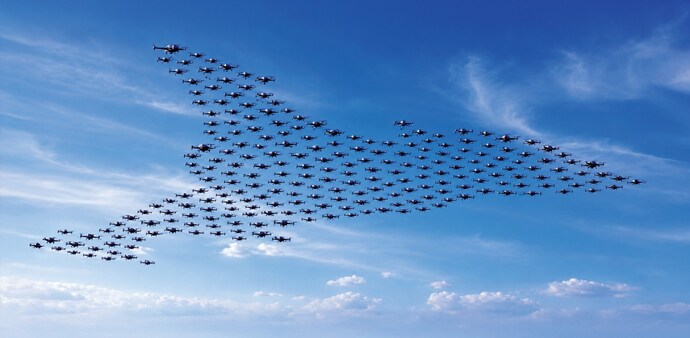
While drones are now a critical part of the battlefield, questions are being asked about whether it is financially prudent to spend billions on manned platforms, when the recent global conflicts have demonstrated the havoc unmanned platforms can cause.
Ritu Sharma
- May 29, 2026,
- Updated May 30, 2026 2:13 PM IST
When Nazi Germany launched V-1 flying bombs in 1944 across the English Channel, towards Britain, it fundamentally challenged the prevalent economics of warfare. Inexpensive, unmanned, and crude, these ‘buzz bombs’ were technologically inferior to the fighter aircraft dominating the skies during World War II.
But what they did was make Britain spend more on intercepting incoming missiles than the Germans spent on producing them.
Advertisement
Eighty-two years later, relatively cheaper unmanned systems are once again rewriting the economics of warfare. Whether in Ukraine, the Red Sea, or West Asia, drones costing a few thousand dollars are increasingly threatening military assets worth millions. In several cases, countries are deploying expensive air defence systems to neutralise these low-cost attacks.
The debate is no longer merely about whether drones can complement fighter jets. The larger question is economic: how should India allocate its limited defence resources at a juncture when cheaper, unmanned technologies are challenging the business of warfare itself?
India’s geographical location, with two nuclear-armed neighbours, places it in a formidable situation. In the face of China’s industrial capacity, an equal amount of military spending might not be the best option. “India has disputed borders with two adversaries with strong air forces, and combat air power is part of their military strategy. They will deploy their air forces against us,” says Air Marshal Diptendu Choudhury (Retd), an air power scholar.
Advertisement
Drones or Jets?
The challenge for India would be to get maximum military advantage for every rupee spent, without overcommitting to platforms that could become too expensive to sustain in heavily contested conflicts.
“Drone technology and software algorithms will need to go through rigorous testing to reach that maturity of robust, consistent decision making.”
-DIPESH GUPTA ,MANAGING DIRECTOR, VEDA AERONAUTICS
The cheaper long-range vectors and drones preserve the most expensive and irreplaceable asset—the trained pilot. “The (recent global) conflicts have demonstrated that surface-launched systems can achieve kill rates against aircraft that make conventional air operations near the front line prohibitively expensive,” says former Indian Air Force (IAF) Vice Chief Air Marshal Anil Khosla (retired). The capabilities of fighter jets, as of today, surpass those of a drone. Moreover, the human-in-the-loop is crucial for certain combat decisions. “Drone technology and software algorithms will need to go through rigorous testing to reach that maturity of robust, consistent decision making,” says Dipesh Gupta, Managing Director, VEDA Aeronautics.
Advertisement
VEDA Aeronautics has been contracted to supply Smart-Unmanned Munitions System for the Indian Air Force (IAF). The Noida-based start-up is also developing Air Dropped Canisterised Swarm drones for the IAF, allowing transport aircraft such as the Boeing C-17 Globemaster III, Lockheed Martin C-130J Super Hercules and Airbus C295 to undertake long-range strike missions.
The debate over the efficacy of drones over fighter jets comes at a time when the IAF has received Acceptance of Necessity from the government for purchase of 114 Rafale fighter jets at an estimated cost of `3.25 trillion (around $36 billion). The domestic aircraft maker, Hindustan Aeronautics Ltd (HAL), has been contracted by the IAF to deliver 83 indigenous Light Combat Aircraft LCA MK1A. The delivery schedule has been delayed as GE Aerospace is yet to deliver the aero-engines for these fighter jets. In September 2025, the IAF ordered another 97 LCA MK1A in the second tranche.
Gupta is optimistic that the sophistication of fighter jet technologies can be achieved in drones through sustained research and development (R&D) efforts. Till then, he believes, drones can be a force multiplier for the fighter jets.
Advertisement
The strongest argument in favour of manned aircraft is their reusability. A cruise missile or Kamikaze drone can be used only once and in only one role. A fighter jet, on the other hand, can carry out multiple missions and can change its role by changing its weapons package. And experts opine that one needs to factor in the full operational life of an aircraft and compare the per-strike cost of a modern multi-role fighter with a standoff missile or a kamikaze drone.
The Indian military drone market size reached $597.88 million in 2025, according to IMARC Group's report. The market is projected to reach $1.9 billion by 2034 by growing at a rate of 13.82%.
Taking on the neighbours
China and Pakistan are both investing heavily in fighter jets and unmanned aerial assets. The Pakistan Air Force (PAF), besides expediting the induction of the Chinese-manufactured fifth-generation fighter jet J-35 (FC-31) ‘Gyrfalcon’, has aggressively acquired cost-effective UAVs from China and Turkey.
China has been making new fighter jet designs every 10 years and can get the sixth-generation combat jet ahead of the US. At the same time, China’s unified military organisation, the People’s Liberation Army, which serves as the primary armed forces of the country, is focusing on developing the capability to connect long-range drones with an intelligence, surveillance and reconnaissance platform to hit enemy targets. According to estimates, China can produce 500,000 FPV (First Person View) drones monthly and ramp up production to 7,00,000 during wartime.
Advertisement
A per-unit cost comparison can make the competition skewed against the fighter aircraft and drones and cruise missiles would seem an obvious choice. But experts caution against such a simplified analysis. “Cost-benefit analysis in warfare is never simply a matter of unit cost. It is the effect achieved per dollar spent (Bang for Buck). It is measured across a full mission profile, including survivability, reusability, flexibility, and escalation management,” says Air Marshal Khosla.
Maximising deterrence for the dollar spent is the biggest challenge facing the Indian armed forces now. It is difficult for India to match China and Pakistan on every platform. The paradox for defence planners trying to build sustainable deterrence is not just military but also economic.
Deterrence, in simple parlance, is a demand that another state refrain from doing something. For that, India needs to bring its National Strategic Policy to communicate its objectives vis-à-vis its two adversaries unambiguously.
India needs to build its military might through conventional capabilities such as stealth fighter jets and air defence systems, with lower-cost force multipliers like drones, cyber capabilities, and AI-enabled systems.
Advertisement
A National Strategic Policy will also help the Indian domestic industry focus on its stated military goals rather than doing emergency procurements during a crisis. Self-reliance in defence is a good beginning. The Indian defence players would require considerable handholding from the Indian government to help them become a major global player like China’s NORINCO, South Korea’s Korean Aerospace, and Turkey’s Turkish Aerospace Industries, to achieve a degree of self-reliance.
India is hedging its bets to make its military battle-ready for future warfare. Air Marshal Choudhury sees both manned and unmanned systems working in tandem. “When the risk is high for crewed platforms, it will be offset by missiles and drones. It will be a mixed strategy (in the future). Statements like ‘contact war is over’ are overenthusiastic comments given without adequate thought.”
However, in the absence of domestic manufacturing capability for high altitude long endurance drones, India has been forced to buy 31 MQ-9B SkyGuardians/SeaGuardians under a $3.9 billion deal with the US. With HAL already tied up with the production of LCA fighter jets—and facing delays due to late aero-engine deliveries from GE Aerospace—the Indian government is looking at private players for the fifth-generation Advanced Medium Combat Aircraft (AMCA) programme, estimated to cost around $1.58 billion. Those in the fray include the Tata Advanced Systems Ltd., a consortium led by Bharat Forge Ltd, and another led by Larsen & Toubro.
Drone manufacturing in India
Ukraine made drones a battlefield weapon, but after losing about 10,000 drones a month, it scaled up its drone capability with external help. The Indian military drone industry is only getting started. The Indian military’s shift towards greater automation and unmanned systems was pushed by Operation Sindoor against Pakistan in 2025.
India has a large industrial base for civilian drones, but only three to five manufacturers have the capacity to produce military-grade drones. At present, 80% of drones manufactured in India are for ISR (intelligence, surveillance, reconnaissance), 15% are attack drones, and the remaining 5% are logistics drones.
“Not every component must be made in India from day one, but critical systems must be auditable, secure, replaceable, and free of foreign dependencies.”
-SARJAN SHAH,MANAGING DIRECTOR, SHIELD AI
Sarjan Shah, Managing Director of Shield AI, considers manned-unmanned teaming to be the future of airpower. In 2024, Shield AI, a US drone maker, teamed with JSW Defence to manufacture V-BAT drones in India. It is investing $90 million to establish a production facility in Hyderabad. The company offers Vertical Take-Off and Landing autonomous aircraft, which removes dependence on long, fixed runways, ensuring survivability in the modern battle-space.
The other challenge facing the Indian drone industry is the supply chain gaps. The recent West Asia conflict delayed shipments of Israeli-made drone components. The thermal cameras and infrared optics are dependent on germanium lenses, a semiconductor controlled by China. Recently, Hyderabad-based start-up Aeon Spacelabs developed the country’s first germanium-free lens, Lumira E40I50, for ISR missions. “Not every component must be made in India from day one—but every critical system must be auditable, secure, replaceable, and free of opaque foreign dependencies,” says Shah.
For India, maximising deterrence with finite defence capital may not lie in choosing between fighter jets and drones, but in investing in a mix that offers the greatest strategic return per rupee.
When Nazi Germany launched V-1 flying bombs in 1944 across the English Channel, towards Britain, it fundamentally challenged the prevalent economics of warfare. Inexpensive, unmanned, and crude, these ‘buzz bombs’ were technologically inferior to the fighter aircraft dominating the skies during World War II.
But what they did was make Britain spend more on intercepting incoming missiles than the Germans spent on producing them.
Advertisement
Eighty-two years later, relatively cheaper unmanned systems are once again rewriting the economics of warfare. Whether in Ukraine, the Red Sea, or West Asia, drones costing a few thousand dollars are increasingly threatening military assets worth millions. In several cases, countries are deploying expensive air defence systems to neutralise these low-cost attacks.
The debate is no longer merely about whether drones can complement fighter jets. The larger question is economic: how should India allocate its limited defence resources at a juncture when cheaper, unmanned technologies are challenging the business of warfare itself?
India’s geographical location, with two nuclear-armed neighbours, places it in a formidable situation. In the face of China’s industrial capacity, an equal amount of military spending might not be the best option. “India has disputed borders with two adversaries with strong air forces, and combat air power is part of their military strategy. They will deploy their air forces against us,” says Air Marshal Diptendu Choudhury (Retd), an air power scholar.
Advertisement
Drones or Jets?
The challenge for India would be to get maximum military advantage for every rupee spent, without overcommitting to platforms that could become too expensive to sustain in heavily contested conflicts.
“Drone technology and software algorithms will need to go through rigorous testing to reach that maturity of robust, consistent decision making.”
-DIPESH GUPTA ,MANAGING DIRECTOR, VEDA AERONAUTICS
The cheaper long-range vectors and drones preserve the most expensive and irreplaceable asset—the trained pilot. “The (recent global) conflicts have demonstrated that surface-launched systems can achieve kill rates against aircraft that make conventional air operations near the front line prohibitively expensive,” says former Indian Air Force (IAF) Vice Chief Air Marshal Anil Khosla (retired). The capabilities of fighter jets, as of today, surpass those of a drone. Moreover, the human-in-the-loop is crucial for certain combat decisions. “Drone technology and software algorithms will need to go through rigorous testing to reach that maturity of robust, consistent decision making,” says Dipesh Gupta, Managing Director, VEDA Aeronautics.
Advertisement
VEDA Aeronautics has been contracted to supply Smart-Unmanned Munitions System for the Indian Air Force (IAF). The Noida-based start-up is also developing Air Dropped Canisterised Swarm drones for the IAF, allowing transport aircraft such as the Boeing C-17 Globemaster III, Lockheed Martin C-130J Super Hercules and Airbus C295 to undertake long-range strike missions.
The debate over the efficacy of drones over fighter jets comes at a time when the IAF has received Acceptance of Necessity from the government for purchase of 114 Rafale fighter jets at an estimated cost of `3.25 trillion (around $36 billion). The domestic aircraft maker, Hindustan Aeronautics Ltd (HAL), has been contracted by the IAF to deliver 83 indigenous Light Combat Aircraft LCA MK1A. The delivery schedule has been delayed as GE Aerospace is yet to deliver the aero-engines for these fighter jets. In September 2025, the IAF ordered another 97 LCA MK1A in the second tranche.
Gupta is optimistic that the sophistication of fighter jet technologies can be achieved in drones through sustained research and development (R&D) efforts. Till then, he believes, drones can be a force multiplier for the fighter jets.
Advertisement
The strongest argument in favour of manned aircraft is their reusability. A cruise missile or Kamikaze drone can be used only once and in only one role. A fighter jet, on the other hand, can carry out multiple missions and can change its role by changing its weapons package. And experts opine that one needs to factor in the full operational life of an aircraft and compare the per-strike cost of a modern multi-role fighter with a standoff missile or a kamikaze drone.
The Indian military drone market size reached $597.88 million in 2025, according to IMARC Group's report. The market is projected to reach $1.9 billion by 2034 by growing at a rate of 13.82%.
Taking on the neighbours
China and Pakistan are both investing heavily in fighter jets and unmanned aerial assets. The Pakistan Air Force (PAF), besides expediting the induction of the Chinese-manufactured fifth-generation fighter jet J-35 (FC-31) ‘Gyrfalcon’, has aggressively acquired cost-effective UAVs from China and Turkey.
China has been making new fighter jet designs every 10 years and can get the sixth-generation combat jet ahead of the US. At the same time, China’s unified military organisation, the People’s Liberation Army, which serves as the primary armed forces of the country, is focusing on developing the capability to connect long-range drones with an intelligence, surveillance and reconnaissance platform to hit enemy targets. According to estimates, China can produce 500,000 FPV (First Person View) drones monthly and ramp up production to 7,00,000 during wartime.
Advertisement
A per-unit cost comparison can make the competition skewed against the fighter aircraft and drones and cruise missiles would seem an obvious choice. But experts caution against such a simplified analysis. “Cost-benefit analysis in warfare is never simply a matter of unit cost. It is the effect achieved per dollar spent (Bang for Buck). It is measured across a full mission profile, including survivability, reusability, flexibility, and escalation management,” says Air Marshal Khosla.
Maximising deterrence for the dollar spent is the biggest challenge facing the Indian armed forces now. It is difficult for India to match China and Pakistan on every platform. The paradox for defence planners trying to build sustainable deterrence is not just military but also economic.
Deterrence, in simple parlance, is a demand that another state refrain from doing something. For that, India needs to bring its National Strategic Policy to communicate its objectives vis-à-vis its two adversaries unambiguously.
India needs to build its military might through conventional capabilities such as stealth fighter jets and air defence systems, with lower-cost force multipliers like drones, cyber capabilities, and AI-enabled systems.
Advertisement
A National Strategic Policy will also help the Indian domestic industry focus on its stated military goals rather than doing emergency procurements during a crisis. Self-reliance in defence is a good beginning. The Indian defence players would require considerable handholding from the Indian government to help them become a major global player like China’s NORINCO, South Korea’s Korean Aerospace, and Turkey’s Turkish Aerospace Industries, to achieve a degree of self-reliance.
India is hedging its bets to make its military battle-ready for future warfare. Air Marshal Choudhury sees both manned and unmanned systems working in tandem. “When the risk is high for crewed platforms, it will be offset by missiles and drones. It will be a mixed strategy (in the future). Statements like ‘contact war is over’ are overenthusiastic comments given without adequate thought.”
However, in the absence of domestic manufacturing capability for high altitude long endurance drones, India has been forced to buy 31 MQ-9B SkyGuardians/SeaGuardians under a $3.9 billion deal with the US. With HAL already tied up with the production of LCA fighter jets—and facing delays due to late aero-engine deliveries from GE Aerospace—the Indian government is looking at private players for the fifth-generation Advanced Medium Combat Aircraft (AMCA) programme, estimated to cost around $1.58 billion. Those in the fray include the Tata Advanced Systems Ltd., a consortium led by Bharat Forge Ltd, and another led by Larsen & Toubro.
Drone manufacturing in India
Ukraine made drones a battlefield weapon, but after losing about 10,000 drones a month, it scaled up its drone capability with external help. The Indian military drone industry is only getting started. The Indian military’s shift towards greater automation and unmanned systems was pushed by Operation Sindoor against Pakistan in 2025.
India has a large industrial base for civilian drones, but only three to five manufacturers have the capacity to produce military-grade drones. At present, 80% of drones manufactured in India are for ISR (intelligence, surveillance, reconnaissance), 15% are attack drones, and the remaining 5% are logistics drones.
“Not every component must be made in India from day one, but critical systems must be auditable, secure, replaceable, and free of foreign dependencies.”
-SARJAN SHAH,MANAGING DIRECTOR, SHIELD AI
Sarjan Shah, Managing Director of Shield AI, considers manned-unmanned teaming to be the future of airpower. In 2024, Shield AI, a US drone maker, teamed with JSW Defence to manufacture V-BAT drones in India. It is investing $90 million to establish a production facility in Hyderabad. The company offers Vertical Take-Off and Landing autonomous aircraft, which removes dependence on long, fixed runways, ensuring survivability in the modern battle-space.
The other challenge facing the Indian drone industry is the supply chain gaps. The recent West Asia conflict delayed shipments of Israeli-made drone components. The thermal cameras and infrared optics are dependent on germanium lenses, a semiconductor controlled by China. Recently, Hyderabad-based start-up Aeon Spacelabs developed the country’s first germanium-free lens, Lumira E40I50, for ISR missions. “Not every component must be made in India from day one—but every critical system must be auditable, secure, replaceable, and free of opaque foreign dependencies,” says Shah.
For India, maximising deterrence with finite defence capital may not lie in choosing between fighter jets and drones, but in investing in a mix that offers the greatest strategic return per rupee.
Read more!