
How IIM Indore plans to solve India’s most complex problems
IIM Indore is preparing its students to go beyond the classroom and solve the problems of the society at large.
Krishna Gopalan
- Oct 8, 2026,
- Updated Oct 8, 2026 11:58 AM IST
Each B-School has a unique positioning. IIM Indore seeks to combine global excellence in management education with a deep commitment to nation building and solving India’s most complex problems. This, says the institute’s Director, Himanshu Rai, is done by bringing together rigorous academic programmes, impactful research, and industry and government partnerships. “It ensures knowledge created within the institution translates into leadership and impact beyond it,” says Rai.
Advertisement
In India, an MBA is viewed as a route to get the best on-campus job. In the process, that becomes an important parameter (certainly not the only one) to determine the ranking of an institute.
“A world-class B-school cannot be defined solely by its ranking. Rather, it is defined by the quality of knowledge it creates, the leaders it develops, the organisations it influences and the problems it helps solve,” he explains. To Rai, that is the IIM Indore to be built.
Doing the small things well
The role of management education has evolved, and in the modern era, must continue to do so. According to Rai, IIM Indore has identified four interconnected “wicked problems” that demand sustained, collaborative action. That encompasses income disparity, urban infrastructure, rural challenges, and environmental sustainability. “These cannot be solved through a single discipline, organisation or intervention. It requires management thinking to come together with technology, public policy, behavioural science, entrepreneurship, and community participation,” says Rai.
Advertisement
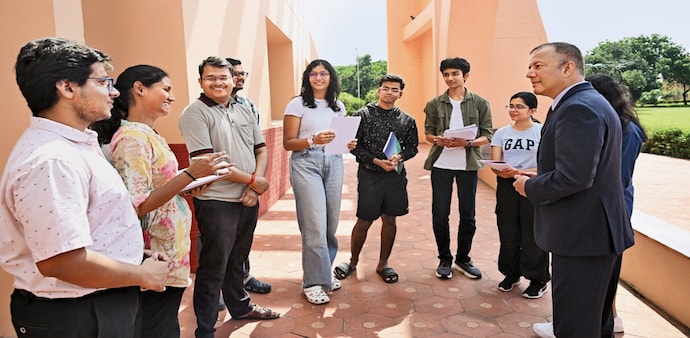
One example of this line of thinking is the Rural Engagement Programme. “Here, students engage with rural communities to understand development challenges, identify gaps in implementation of government schemes and develop practical recommendations,” he says.
The objective is to experience a sense of reality that cannot be understood through just classroom discussions. Equally, there is a focus on urban challenges, where both the faculty and students have worked with the government on issues such as traffic management and road safety. These areas are addressed through Anveshan (the institute’s centre of excellence for waste management) and Wash (water, sanitation and hygiene). Along with all this, environmental sustainability remains critical. IIM Indore wants to be a net-zero campus by 2035. It is because of this vision that IIM Indore has been ranked sixth in the BT-MDRA Best B-schools Survey 2026-27.
Advertisement
A thrust on the academic ecosystem is clear in the institute offering multiple courses—starting from undergraduate and postgraduate programmes all the way to executive MBA and doctoral research. “This enables us to bring together students at different stages of their careers to create a rich environment for the exchange of ideas and perspectives,” says Rai.
Future-ready approach
For any B-school, disrupting the present to get ready for a sturdy future is not an option but something that is mandatory. It’s not just about technology but the pace of change that we are in the midst of.
“AI, data, climate change, geopolitical shifts, and changing consumer behaviour are disrupting business models. A management institution that takes years to respond to these changes risks preparing students for a world that no longer exists,” says Rai.
To that extent, adaptability is key and IIM Indore, he says, has strengthened the connection between the classroom, industry, research and society.
The priority for Rai is to convert institutional strength into enduring global influence.
In the future, the institute will spend time on deepening research, making international engagement a part of the institution’s DNA, and getting better at technology in an AI-enabled world. Today, the building blocks appear to be in place. “The next few years are critical because we are moving from building an excellent institution to building an institution of consequence,” sums up Rai.
Advertisement
@krishnagopalan
Each B-School has a unique positioning. IIM Indore seeks to combine global excellence in management education with a deep commitment to nation building and solving India’s most complex problems. This, says the institute’s Director, Himanshu Rai, is done by bringing together rigorous academic programmes, impactful research, and industry and government partnerships. “It ensures knowledge created within the institution translates into leadership and impact beyond it,” says Rai.
Advertisement
In India, an MBA is viewed as a route to get the best on-campus job. In the process, that becomes an important parameter (certainly not the only one) to determine the ranking of an institute.
“A world-class B-school cannot be defined solely by its ranking. Rather, it is defined by the quality of knowledge it creates, the leaders it develops, the organisations it influences and the problems it helps solve,” he explains. To Rai, that is the IIM Indore to be built.
Doing the small things well
The role of management education has evolved, and in the modern era, must continue to do so. According to Rai, IIM Indore has identified four interconnected “wicked problems” that demand sustained, collaborative action. That encompasses income disparity, urban infrastructure, rural challenges, and environmental sustainability. “These cannot be solved through a single discipline, organisation or intervention. It requires management thinking to come together with technology, public policy, behavioural science, entrepreneurship, and community participation,” says Rai.
Advertisement
One example of this line of thinking is the Rural Engagement Programme. “Here, students engage with rural communities to understand development challenges, identify gaps in implementation of government schemes and develop practical recommendations,” he says.
The objective is to experience a sense of reality that cannot be understood through just classroom discussions. Equally, there is a focus on urban challenges, where both the faculty and students have worked with the government on issues such as traffic management and road safety. These areas are addressed through Anveshan (the institute’s centre of excellence for waste management) and Wash (water, sanitation and hygiene). Along with all this, environmental sustainability remains critical. IIM Indore wants to be a net-zero campus by 2035. It is because of this vision that IIM Indore has been ranked sixth in the BT-MDRA Best B-schools Survey 2026-27.
Advertisement
A thrust on the academic ecosystem is clear in the institute offering multiple courses—starting from undergraduate and postgraduate programmes all the way to executive MBA and doctoral research. “This enables us to bring together students at different stages of their careers to create a rich environment for the exchange of ideas and perspectives,” says Rai.
Future-ready approach
For any B-school, disrupting the present to get ready for a sturdy future is not an option but something that is mandatory. It’s not just about technology but the pace of change that we are in the midst of.
“AI, data, climate change, geopolitical shifts, and changing consumer behaviour are disrupting business models. A management institution that takes years to respond to these changes risks preparing students for a world that no longer exists,” says Rai.
To that extent, adaptability is key and IIM Indore, he says, has strengthened the connection between the classroom, industry, research and society.
The priority for Rai is to convert institutional strength into enduring global influence.
In the future, the institute will spend time on deepening research, making international engagement a part of the institution’s DNA, and getting better at technology in an AI-enabled world. Today, the building blocks appear to be in place. “The next few years are critical because we are moving from building an excellent institution to building an institution of consequence,” sums up Rai.
Advertisement
@krishnagopalan
Read more!