
How investors achieve long-term wealth amidst falling valuations
The Nifty's steep correction has shaken investors, but falling valuations and resilient economic growth are prompting fund managers to see opportunity amid the turmoil.
Shailendra Bhatnagar
- Oct 23, 2026,
- Updated Oct 23, 2026 8:05 PM IST
Abhishek Saraswat has been a regular investor in Indian equity funds for the past five years. An engineer by qualification, the Noida-based 33-year-old works with a global tech multinational corporation and has deployed about 15% of his income in monthly systematic investment plans (SIPs) in several equity schemes. “The first two years were super good,” Saraswat says. “But the last 24 months have been painful—no returns.”
Hey!
Already a subscriber? Sign In
THIS IS A PREMIUM STORY FROM BUSINESS TODAY.
Subscribe to Business Today Digital and continue enjoying India's premier business offering uninterrupted.
only FOR
₹999 / Year
Unlimited Digital Access + Ad Lite Experience
Cancel Anytime
-
 Unlimited access to Business Today website
- Exclusive insights on Corporate India's working, every quarter
- Access to our special editions, features, and priceless archives
- Get front-seat access to events such as BT Best Banks, Best CEOs and Mindrush
Abhishek Saraswat has been a regular investor in Indian equity funds for the past five years. An engineer by qualification, the Noida-based 33-year-old works with a global tech multinational corporation and has deployed about 15% of his income in monthly systematic investment plans (SIPs) in several equity schemes. “The first two years were super good,” Saraswat says. “But the last 24 months have been painful—no returns.”
Advertisement
Saraswat’s sentiment echoes that of thousands of retail investors who have been left on the fence as Indian equities took a deep dive after years of strong gains. Posts on social media, conversations in dealing rooms, drawing rooms and boardrooms, around coffee machines in offices and on the street, continue to focus on a bloodbath that shows no signs of letting up.
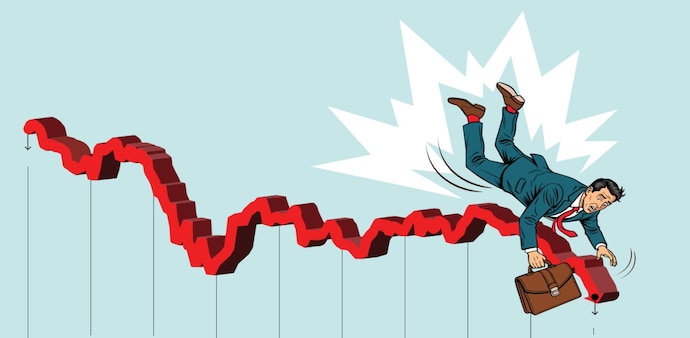
Steadily going downhill, with only a few spurts of growth, the Nifty 50 has fallen for eight consecutive weeks—its longest losing streak in the past two decades—as sustained selling by foreign investors, rocketing US bond yields, rising interest rates and surging crude oil prices have overshadowed an economy galloping at 7.8% and made Dalal Street one of the worst-performing major markets globally (see charts).
Advertisement
Compared to its previous peak of 26,277 in September 2024, the Nifty 50 has fallen about 15% to date, is down about 20% in dollar terms so far this year, and is now threatening to test two-year lows.
For investors like Saraswat, the question is obvious: Is this the time to stay away from equities— or the time to buy? Market veterans argue it is the latter.
“I believe we are somewhere in the endgame here,” Dinshaw Irani, CEO of Helios Capital, told Business Today. “I think it is time when one should be braver to start averaging as such, and that’s what maximizes the returns every time. So, I love it.”
That may sound counterintuitive when the headlines are dominated by a falling market, an expanding conflict in the Middle East, and a currency that has been hit hard —the rupee is down 6.6% this year and is the second-worst performing Asian unit so far in 2026 (see charts).
Advertisement
But for long-term investors, the sell-off has done something that the relentless rally of the past few years did not: it has brought valuations back towards more reasonable levels.
The Nifty is now trading at around 17-18 times one-year forward earnings, compared with 23-24 times in 2024. Consequently, several blue-chip stocks, including HDFC Bank and Tata Consultancy Services, have been de-rated and are trading substantially below their 10-year median valuation multiples on price-to-earnings and price-to-book ratios.
To be sure, the risks of the market falling further are very real, but the low valuations are prompting fund managers to say this is precisely why investors need to distinguish between what is happening to the market and what is happening to the Indian economy.
“The Nifty is not India,” says Ashish Chaturmota, Managing Director for the PMS business at JM Financial. “The market is now segmented into two halves: large caps were overvalued and showed just 6-8% earnings growth. Therefore, they got sold. On the other hand, small-caps and mid-caps had lots of strong themes running, plus sustainable earnings growth in excess of 20%.”
Advertisement
While large caps have been battered, small- and mid-cap indices rallied 25-30% between April and September, helped by strong earnings growth during the first quarter, expanding margins and relatively low equity floats. Fund managers rode that rally, even as foreign investors focused their selling on large caps.
According to Irani, who runs top-performing mid-cap and small-cap equity funds, those standing on the sidelines are missing the broader picture. He says Dalal Street’s fall is mainly because of two factors—rising oil prices and surging US bond yields—on which investors, corporates and the government have little or no control.
“These are imported problems. Focus instead on GDP expansion and strong credit growth,” he says. “This is a stock picker’s market, and there are plenty of good stories.”
The problem is that investors have been conditioned by a very different market. For two years, many have continued investing through SIPs even as returns have increasingly lagged fixed deposits.
At the same time, Dalal Street has seen an explosion of primary-market fundraising over the past two years —`2,09,344 crore in FY25 (highest in three decades) and `2,04,713 in FY26, according to data from Prime Database. In the current fiscal, `1,49,572 crore has been raised till September 30, including the bumper listing of the National Stock Exchange, with issue size of `22,568.9 crore (see charts).
Advertisement
Retail investors, attracted by spectacular listing gains in several of these IPOs, have increasingly diverted money from existing equity holdings to participate in new issues.
The IPO rush has also allowed private-equity funds, promoters and pre-IPO investors to monetise holdings at valuations that would have been difficult to achieve in the secondary market.
The local bottling unit of Coca-Cola is the latest example, preparing to raise about $1 billion through a sale of shares by existing investors as bankers tap into strong demand for quality companies.
The result is a market where the headline Nifty number masks a much more complicated picture.
Foreign investors have pulled out about `4 lakh crore so far this year, with selling concentrated in large caps, as money moved towards the AI-led technology trade in markets such as South Korea, Taiwan and Japan, where major indices surged.
In this tumultuous backdrop, both Irani and Chaturmota believe the India story remains relevant and that investors need to ride the correction out.
Advertisement
Their message is not to buy everything simply because prices have fallen. The message is that a judicious mix of small-cap and mid-cap funds with a sprinkling of gold and corporate bonds in the overall mutual fund basket will help investors achieve long-term wealth creation goals.
@shail_bhatnagar
Read more!