
Manufacturing companies are seeking better-skilled workers. But low wages remain a problem
Manufacturing companies are seeking better-skilled workers. But low wages remain a problem
As high-tech manufacturing comes of age in India, companies are seeking better-skilled workers. But low wages and poor working conditions are making workers look elsewhere. Can this gulf be bridged?
Surabhi
- Aug 27, 2026,
- Updated Aug 27, 2026 5:42 PM IST
Over the years, the Indian manufacturing landscape has been undergoing a gradual shift. With the likes of Apple and Samsung setting up shop, companies are increasingly considering the country as an option for their global value chains and building factories.
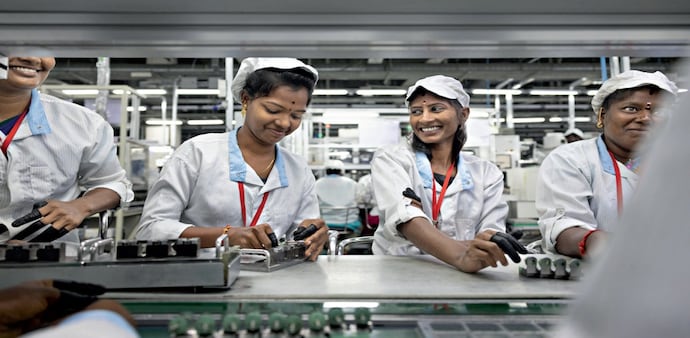
Equally important is that the manufacturing sector has started employing more workers out of India’s 616-million strong labour force, with women becoming the face of the new industrial worker. In fact, data from the Periodic Labour Force Report, 2025, revealed that the share of manufacturing in employment has increased to 12.1% in 2025 from 11.6% in 2024.
Advertisement
The State of Working India 2026 report by the Azim Premji University also revealed that young women in the age group of 20-29 are increasingly employed in manufacturing, primarily in textile and apparel. IT, motor vehicle manufacturing and business support are some of the other industries that have seen the largest increase in employment of young graduate women.
But an important question remains to be asked: Is this enough? Jobs are few and far between, and well-paying formal jobs with social security remain on the lower side. PLFS data reveals the labour force participation rate stood at 59.3% in 2025. With over eight million new entrants into the country’s labour force every year, job creation has been lagging.
Advertisement
What’s more, in the age of digitisation and AI, India’s manufacturing is facing what seems to be a chicken-and-egg problem, with a disconnect between requirements of companies and aspirations of shop-floor workers. People are needed to fill a slew of newer manufacturing roles like robotics welding operators, CNC operators, and automation technicians in highly automated factories. The sentiment is echoed by Siemens India CEO, Sunil Mathur, who recently told media that AI will reshape manufacturing jobs rather than eliminate them, with workers needing to continuously upskill as factories become increasingly automated.
Companies, looking for better skilled workers, often lament the skills of even graduate employees. They are being forced to retrain and re-skill workers to meet demands of new-age technologies. Earlier this year, Apple launched the Apple Education Hub in collaboration with the Manipal Academy of Higher Education in Bengaluru as part of its efforts to expand skill-building and training programmes for people across its supply chain in India.
Advertisement
A report by the Indian Staffing Federation pegs the total workforce in the country’s manufacturing sector at about 37.2 million. Manmeet Singh, President, Indian Staffing Federation (ISF), says nearly 80% of employers across industries struggle to find skilled workers. “This isn’t just an automation story—it’s also geographic and demographic. Much of our manufacturing base sits in Western and Southern India, while the talent pool is concentrated in the North and East. Employers need to invest in bridging that gap,” he says.
Only 5-10% factories in sectors like automobiles, pharma, and FMCG packaging are fully automated; the remaining are semi-automated or manual. Singh says high-automation companies (those using robotics) are facing the most talent shortage, and reskilling is catching up only slowly. In semiconductors, for instance, talent is often brought in from overseas alongside the machinery; these experts train the trainers locally. “We see a similar pattern of intensive on-the-job training in automotive engine plants and electronics manufacturing, where skill and digitisation demands are high,” he says.
While successive governments have made efforts on skilling, not enough has been achieved. The PLFS 2025 data revealed that 58.9% workers between 15-59 years did not receive any vocational or technical training. The India Skills Report 2024 highlighted that the overall young employability has improved to 51.25% over the previous year.
Advertisement
Singh says just as boardrooms plan succession at the leadership level, companies need succession planning on the shop floor—building their own supply chain of talent.
Meanwhile, even when workers receive formal skill education, the quality is not ideal. This is reflected in the State of Working India 2026 report, which found that the number of Industrial Training Institutes (ITIs) have increased by nearly 300%, led largely by private ITIs. “But this expansion has been accompanied by a decline in institutional quality, particularly among private providers,” it said.
Various government initiatives have had very limited success. The PM Internship Scheme that aims to improve employability of youth by providing on-ground experience at top India Inc firms has made little headway. It has received poor response from applicants, leading the government to expand the eligibility criteria in the third pilot round. Of the 368,000 internship opportunities posted in the three pilot rounds since the launch of the scheme in October 2024, only half the number of offer letters—186,000—were given, and an even fewer internships were taken up.
The Employment-Linked Incentives under the PM Viksit Bharat Rozgar Yojana has led to some formal employment. According to data with the ministry of labour and employment, incentives worth Rs 744.7 crore have been disbursed to 1.3 million first-time employees, and another Rs 2,068.84 crore has been disbursed to 83,535 beneficiary establishments.
Advertisement
On the other side of the spectrum, shop floor workers often call out long working hours, poor working conditions, and low wages as disincentives. The recent unrest in industrial belts in parts of the country is a case in point. Average wages in India are around Rs 15,000 per month for factory workers, compared to about Rs 50,000 per month, if not more, in China.
Experts agree these are challenges that need to be addressed, but underline that the priority is to first make manufacturing more competitive and attractive, which will then create more jobs for workers. The contractual nature of these jobs also acts as a disincentive to better skilling.
Amit Basole, Professor of Economics at Azim Premji University, says the supply of skilled workers to companies needs to increase and at the same time, we need better paying jobs to make manufacturing jobs more aspirational.
“There are two key aspects that need to be addressed. We need to create a policy climate where manufacturing is more competitive and people want to set up factories in the country, which will help provide jobs. Once the compliance burden reduces and there is more productivity and efficiency, companies will have the room to perhaps give better wages,” he says.
Advertisement
The government also needs to nudge companies to ensure they pay at least minimum wages, because in a country with surplus labour force like India, it is easy to get low-paid workers, says Basole.
New floor wages are expected to be set soon under the recently implemented Labour Codes that officials say will address this issue.
Going ahead, there needs be a balance between the requirements of industry and aspirations of workers to make ‘Make in India’ not only viable but also attractive and sustainable.
@surabhi_prasad
Over the years, the Indian manufacturing landscape has been undergoing a gradual shift. With the likes of Apple and Samsung setting up shop, companies are increasingly considering the country as an option for their global value chains and building factories.
Equally important is that the manufacturing sector has started employing more workers out of India’s 616-million strong labour force, with women becoming the face of the new industrial worker. In fact, data from the Periodic Labour Force Report, 2025, revealed that the share of manufacturing in employment has increased to 12.1% in 2025 from 11.6% in 2024.
Advertisement
The State of Working India 2026 report by the Azim Premji University also revealed that young women in the age group of 20-29 are increasingly employed in manufacturing, primarily in textile and apparel. IT, motor vehicle manufacturing and business support are some of the other industries that have seen the largest increase in employment of young graduate women.
But an important question remains to be asked: Is this enough? Jobs are few and far between, and well-paying formal jobs with social security remain on the lower side. PLFS data reveals the labour force participation rate stood at 59.3% in 2025. With over eight million new entrants into the country’s labour force every year, job creation has been lagging.
Advertisement
What’s more, in the age of digitisation and AI, India’s manufacturing is facing what seems to be a chicken-and-egg problem, with a disconnect between requirements of companies and aspirations of shop-floor workers. People are needed to fill a slew of newer manufacturing roles like robotics welding operators, CNC operators, and automation technicians in highly automated factories. The sentiment is echoed by Siemens India CEO, Sunil Mathur, who recently told media that AI will reshape manufacturing jobs rather than eliminate them, with workers needing to continuously upskill as factories become increasingly automated.
Companies, looking for better skilled workers, often lament the skills of even graduate employees. They are being forced to retrain and re-skill workers to meet demands of new-age technologies. Earlier this year, Apple launched the Apple Education Hub in collaboration with the Manipal Academy of Higher Education in Bengaluru as part of its efforts to expand skill-building and training programmes for people across its supply chain in India.
Advertisement
A report by the Indian Staffing Federation pegs the total workforce in the country’s manufacturing sector at about 37.2 million. Manmeet Singh, President, Indian Staffing Federation (ISF), says nearly 80% of employers across industries struggle to find skilled workers. “This isn’t just an automation story—it’s also geographic and demographic. Much of our manufacturing base sits in Western and Southern India, while the talent pool is concentrated in the North and East. Employers need to invest in bridging that gap,” he says.
Only 5-10% factories in sectors like automobiles, pharma, and FMCG packaging are fully automated; the remaining are semi-automated or manual. Singh says high-automation companies (those using robotics) are facing the most talent shortage, and reskilling is catching up only slowly. In semiconductors, for instance, talent is often brought in from overseas alongside the machinery; these experts train the trainers locally. “We see a similar pattern of intensive on-the-job training in automotive engine plants and electronics manufacturing, where skill and digitisation demands are high,” he says.
While successive governments have made efforts on skilling, not enough has been achieved. The PLFS 2025 data revealed that 58.9% workers between 15-59 years did not receive any vocational or technical training. The India Skills Report 2024 highlighted that the overall young employability has improved to 51.25% over the previous year.
Advertisement
Singh says just as boardrooms plan succession at the leadership level, companies need succession planning on the shop floor—building their own supply chain of talent.
Meanwhile, even when workers receive formal skill education, the quality is not ideal. This is reflected in the State of Working India 2026 report, which found that the number of Industrial Training Institutes (ITIs) have increased by nearly 300%, led largely by private ITIs. “But this expansion has been accompanied by a decline in institutional quality, particularly among private providers,” it said.
Various government initiatives have had very limited success. The PM Internship Scheme that aims to improve employability of youth by providing on-ground experience at top India Inc firms has made little headway. It has received poor response from applicants, leading the government to expand the eligibility criteria in the third pilot round. Of the 368,000 internship opportunities posted in the three pilot rounds since the launch of the scheme in October 2024, only half the number of offer letters—186,000—were given, and an even fewer internships were taken up.
The Employment-Linked Incentives under the PM Viksit Bharat Rozgar Yojana has led to some formal employment. According to data with the ministry of labour and employment, incentives worth Rs 744.7 crore have been disbursed to 1.3 million first-time employees, and another Rs 2,068.84 crore has been disbursed to 83,535 beneficiary establishments.
Advertisement
On the other side of the spectrum, shop floor workers often call out long working hours, poor working conditions, and low wages as disincentives. The recent unrest in industrial belts in parts of the country is a case in point. Average wages in India are around Rs 15,000 per month for factory workers, compared to about Rs 50,000 per month, if not more, in China.
Experts agree these are challenges that need to be addressed, but underline that the priority is to first make manufacturing more competitive and attractive, which will then create more jobs for workers. The contractual nature of these jobs also acts as a disincentive to better skilling.
Amit Basole, Professor of Economics at Azim Premji University, says the supply of skilled workers to companies needs to increase and at the same time, we need better paying jobs to make manufacturing jobs more aspirational.
“There are two key aspects that need to be addressed. We need to create a policy climate where manufacturing is more competitive and people want to set up factories in the country, which will help provide jobs. Once the compliance burden reduces and there is more productivity and efficiency, companies will have the room to perhaps give better wages,” he says.
Advertisement
The government also needs to nudge companies to ensure they pay at least minimum wages, because in a country with surplus labour force like India, it is easy to get low-paid workers, says Basole.
New floor wages are expected to be set soon under the recently implemented Labour Codes that officials say will address this issue.
Going ahead, there needs be a balance between the requirements of industry and aspirations of workers to make ‘Make in India’ not only viable but also attractive and sustainable.
@surabhi_prasad
Read more!