
Public health: The rising cost of falling ill
The Centre and states have slightly increased spending on health. But funds remain inadequate and inefficient usage a concern. As the country begins to age faster, is there a scope to correct this?
Surabhi
- Aug 18, 2026,
- Updated Aug 18, 2026 6:44 PM IST
The healthcare story of India is changing. More Indians today are covered by health insurance than ever before, and government hospitals are playing a bigger role in delivering affordable care. Yet, the cost of falling ill continues to climb.
The Survey on Household Social Consumption: Health, carried out by the National Sample Survey between January and December 2025, found that the landscape has significantly shifted since the previous survey in 2017-18, with more government initiatives to improve healthcare and coverage of health insurance. However, out-of-pocket expenditure, too, has risen substantially.
Advertisement
There was a substantial improvement in health insurance coverage across India between the two surveys—by 2025, 47% of rural and 44% of urban Indians, respectively, had health insurance compared to a mere 14% in rural and 19% in urban, respectively, in 2017–18. Still, the average medical expenditure per hospitalisation rose from Rs 20,135 in 2017-18 to Rs 37,858 in 2025.
The results are not surprising given the strides in healthcare by both private players, non-government agencies and government initiatives. Schemes such as Pulse Polio, steps for reproductive, maternal and child health, sale of generic medicines at affordable prices through Jan Aushadhi stores, the Ayushman Bharat scheme, and now the focus on Ayushman Bharat Digital Mission to support integrated digital health infrastructure have improved health outcomes of 1.48 billion Indians.
Advertisement
Importantly, spending on health by both the Centre and states has increased over the years to about 1.8% of the GDP by FY26. This is evident in lower mortality rates and higher life expectancy rates.
Government health expenditure has increased from 28.6% of the total health expenditure in 2013-14 to 43.7% in 2022-23, while per-capita government spending has nearly tripled over the same period.
-Bhanu Prakash Kalmath S. J.,Partner and Healthcare Industry Leader, Grant Thornton Bharat
Bhanu Prakash Kalmath S. J., Partner and Healthcare Industry Leader, Grant Thornton Bharat, says government health expenditure has increased from 28.6% of the total health expenditure in 2013-14 to 43.7% in 2022-23, while per-capita government spending has nearly tripled over the same period. “There has also been greater emphasis on primary care, financial protection, preventive health, early diagnosis, digital health infrastructure, and measures for social well-being,” he says.
Advertisement
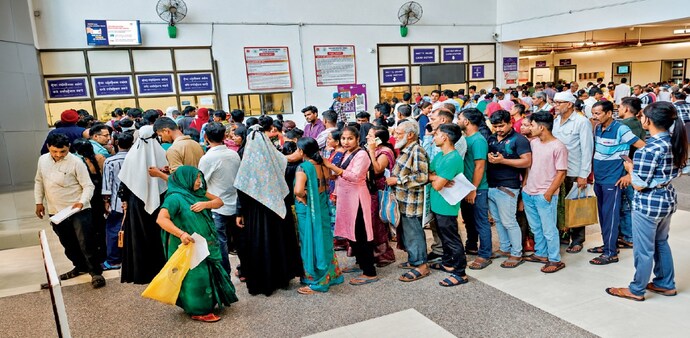
But beyond this, there continues to be a dichotomy between the on-ground experience of patients and the intent of government schemes. India’s public healthcare is plagued by insufficient infrastructure. Experts highlight the need for even higher spending, noting that it remains below target.
Kalmath says given India’s large population and evolving healthcare needs, there is an opportunity to further increase healthcare expenditure to the National Health Policy target of 2.5% of GDP.
Sunil Sinha, Professor of Economics at Chandigarh-based Institute of Development and Communication, says as per the National Health Policy 2017, states are expected to spend 8% of their budget on health as it is a state subject. “But hardly any state is doing so,” he says. CAG’s recent Publication on State Finances 2024-25 reveals that the share of expenditure on health and family welfare by states was just Rs 3.02 lakh crore, or 5.91% of their total expenditure of Rs 51.2 lakh crore in FY25.
The National Health Accounts data for 2021-22 shows the erstwhile Jammu and Kashmir spent the highest on health—3% of its GSDP, while a developed state like Kerala was at 1.7% and Tamil Nadu at 1.3%, says Sinha. “There is no correlation between the overall economic performance of a state and its health spending. The government opened the health sector to private participation during liberalisation. But it has led to an increase in out-of-pocket expenditure,” he says, adding that this will continue to until the government improves public health expenditure and infrastructure.
Advertisement
The NSS survey estimated that the average out-of-pocket medical expenditure per hospitalisation case (excluding childbirth) was Rs 34,064 in 2025. However, as per the National Health Accounts (NHA) estimates, the out-of-pocket expenditure as percentage of Total Health Expenditure declined to 39.4% in 2021-22 from 62.6% in 2014-15.
For millions of families in India, a severe illness can push them into poverty. While access to health insurance has increased, the coverage is often not sufficient and does not pay for outpatient departments and several medical tests.
Experts say governments typically compress expenditure in case of a revenue shortfall and find it easier to cut allocation for social sector schemes and capital expenditure. Health allocation tends to bear a major brunt.
Many people argue for increasing public spending but hitting 2.5% or 3% would not fix things...The real question for Indian health policy isn’t how to increase spending but how to increase effectiveness by improving accountability of current expenditure.
-Rahul Ahluwalia,Founder and Director at Foundation for Economic Development
Rahul Ahluwalia, Founder and Director at Foundation for Economic Development, highlights another challenge—underutilisation of funds. India spends about 1.9% of GDP on health through government channels, and along with private spending, the total comes to roughly 3.8% of GDP. “Many people argue for increasing public spending but hitting 2.5% or 3% would not fix things,” he says.
Advertisement
This is because government spending in India is very inefficient. “The real question for Indian health policy isn’t how to increase spending but how to increase effectiveness by improving accountability of current expenditure,” he says.
An analysis by PRS Legislative Research of the Demand for Grants for health and family welfare for FY27 points out that schemes like the National Health Mission, PM-ABHIM, NHM (for primary health infrastructure), and PMSSY (setting up new AIIMS) saw under-utilisation of funds in FY26.
Experts believe that apart from higher and better allocation of funds, we need more targeted initiatives and, more importantly, strengthen healthcare closer to where people live.
Kalmath of Grant Thornton Bharat says there is a need for investment in primary care, health and wellness centres, frontline health workers, diagnostics and essential medicines. “This is consistent with current spending patterns, with around 51% of government health expenditure directed towards primary care,” he says, adding that technology is also increasingly being used as an enabler of access and service delivery. Telemedicine, digital health records, and platforms such as the Ayushman Bharat Digital Mission can bridge the gaps in healthcare delivery.
Another important consideration is the role of states, which account for nearly two-thirds of government health expenditure and remain the primary drivers of healthcare delivery, he says.
Advertisement
With India’s population seen to age over the coming decades and the elderly population seen to double to over 300 million by 2050, public healthcare initiatives would also have to deal with this demographic shift.
But the question remains. Can India not just become richer but also healthier before it turns older? That hope remains.
@surabhi_prasad
The healthcare story of India is changing. More Indians today are covered by health insurance than ever before, and government hospitals are playing a bigger role in delivering affordable care. Yet, the cost of falling ill continues to climb.
The Survey on Household Social Consumption: Health, carried out by the National Sample Survey between January and December 2025, found that the landscape has significantly shifted since the previous survey in 2017-18, with more government initiatives to improve healthcare and coverage of health insurance. However, out-of-pocket expenditure, too, has risen substantially.
Advertisement
There was a substantial improvement in health insurance coverage across India between the two surveys—by 2025, 47% of rural and 44% of urban Indians, respectively, had health insurance compared to a mere 14% in rural and 19% in urban, respectively, in 2017–18. Still, the average medical expenditure per hospitalisation rose from Rs 20,135 in 2017-18 to Rs 37,858 in 2025.
The results are not surprising given the strides in healthcare by both private players, non-government agencies and government initiatives. Schemes such as Pulse Polio, steps for reproductive, maternal and child health, sale of generic medicines at affordable prices through Jan Aushadhi stores, the Ayushman Bharat scheme, and now the focus on Ayushman Bharat Digital Mission to support integrated digital health infrastructure have improved health outcomes of 1.48 billion Indians.
Advertisement
Importantly, spending on health by both the Centre and states has increased over the years to about 1.8% of the GDP by FY26. This is evident in lower mortality rates and higher life expectancy rates.
Government health expenditure has increased from 28.6% of the total health expenditure in 2013-14 to 43.7% in 2022-23, while per-capita government spending has nearly tripled over the same period.
-Bhanu Prakash Kalmath S. J.,Partner and Healthcare Industry Leader, Grant Thornton Bharat
Bhanu Prakash Kalmath S. J., Partner and Healthcare Industry Leader, Grant Thornton Bharat, says government health expenditure has increased from 28.6% of the total health expenditure in 2013-14 to 43.7% in 2022-23, while per-capita government spending has nearly tripled over the same period. “There has also been greater emphasis on primary care, financial protection, preventive health, early diagnosis, digital health infrastructure, and measures for social well-being,” he says.
Advertisement
But beyond this, there continues to be a dichotomy between the on-ground experience of patients and the intent of government schemes. India’s public healthcare is plagued by insufficient infrastructure. Experts highlight the need for even higher spending, noting that it remains below target.
Kalmath says given India’s large population and evolving healthcare needs, there is an opportunity to further increase healthcare expenditure to the National Health Policy target of 2.5% of GDP.
Sunil Sinha, Professor of Economics at Chandigarh-based Institute of Development and Communication, says as per the National Health Policy 2017, states are expected to spend 8% of their budget on health as it is a state subject. “But hardly any state is doing so,” he says. CAG’s recent Publication on State Finances 2024-25 reveals that the share of expenditure on health and family welfare by states was just Rs 3.02 lakh crore, or 5.91% of their total expenditure of Rs 51.2 lakh crore in FY25.
The National Health Accounts data for 2021-22 shows the erstwhile Jammu and Kashmir spent the highest on health—3% of its GSDP, while a developed state like Kerala was at 1.7% and Tamil Nadu at 1.3%, says Sinha. “There is no correlation between the overall economic performance of a state and its health spending. The government opened the health sector to private participation during liberalisation. But it has led to an increase in out-of-pocket expenditure,” he says, adding that this will continue to until the government improves public health expenditure and infrastructure.
Advertisement
The NSS survey estimated that the average out-of-pocket medical expenditure per hospitalisation case (excluding childbirth) was Rs 34,064 in 2025. However, as per the National Health Accounts (NHA) estimates, the out-of-pocket expenditure as percentage of Total Health Expenditure declined to 39.4% in 2021-22 from 62.6% in 2014-15.
For millions of families in India, a severe illness can push them into poverty. While access to health insurance has increased, the coverage is often not sufficient and does not pay for outpatient departments and several medical tests.
Experts say governments typically compress expenditure in case of a revenue shortfall and find it easier to cut allocation for social sector schemes and capital expenditure. Health allocation tends to bear a major brunt.
Many people argue for increasing public spending but hitting 2.5% or 3% would not fix things...The real question for Indian health policy isn’t how to increase spending but how to increase effectiveness by improving accountability of current expenditure.
-Rahul Ahluwalia,Founder and Director at Foundation for Economic Development
Rahul Ahluwalia, Founder and Director at Foundation for Economic Development, highlights another challenge—underutilisation of funds. India spends about 1.9% of GDP on health through government channels, and along with private spending, the total comes to roughly 3.8% of GDP. “Many people argue for increasing public spending but hitting 2.5% or 3% would not fix things,” he says.
Advertisement
This is because government spending in India is very inefficient. “The real question for Indian health policy isn’t how to increase spending but how to increase effectiveness by improving accountability of current expenditure,” he says.
An analysis by PRS Legislative Research of the Demand for Grants for health and family welfare for FY27 points out that schemes like the National Health Mission, PM-ABHIM, NHM (for primary health infrastructure), and PMSSY (setting up new AIIMS) saw under-utilisation of funds in FY26.
Experts believe that apart from higher and better allocation of funds, we need more targeted initiatives and, more importantly, strengthen healthcare closer to where people live.
Kalmath of Grant Thornton Bharat says there is a need for investment in primary care, health and wellness centres, frontline health workers, diagnostics and essential medicines. “This is consistent with current spending patterns, with around 51% of government health expenditure directed towards primary care,” he says, adding that technology is also increasingly being used as an enabler of access and service delivery. Telemedicine, digital health records, and platforms such as the Ayushman Bharat Digital Mission can bridge the gaps in healthcare delivery.
Another important consideration is the role of states, which account for nearly two-thirds of government health expenditure and remain the primary drivers of healthcare delivery, he says.
Advertisement
With India’s population seen to age over the coming decades and the elderly population seen to double to over 300 million by 2050, public healthcare initiatives would also have to deal with this demographic shift.
But the question remains. Can India not just become richer but also healthier before it turns older? That hope remains.
@surabhi_prasad
Read more!