
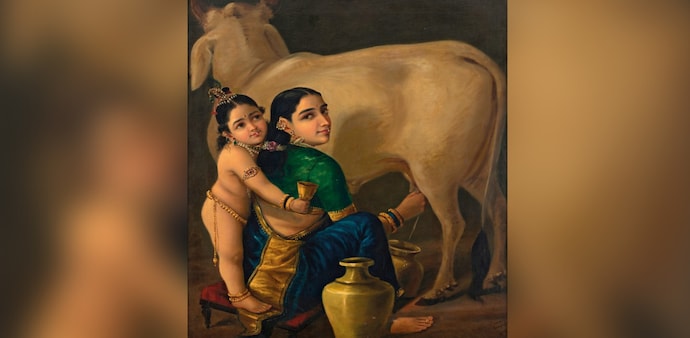
Raja Ravi Varma's ₹167-crore painting puts India's art market in the spotlight
Raja Ravi Varma's ₹167-crore painting puts India's art market in the spotlight
Record-breaking auctions are fuelling a surge in demand for Indian art, but sustaining the momentum will depend on a growing collector base, stronger cultural institutions, and wider public access.
Sakshi Batra
- Nov 22, 2026,
- Updated Nov 22, 2026 4:43 PM IST
About $18 million. That’s Rs. 167.2 crore. You might think this is the price of a sprawling mansion or a luxury penthouse. Think again. This is the highest value for a Raja Ravi Varma painting—Yashoda and Krishna—a tender, timeless portrayal of a mother and child. When the painting went under the hammer in April 2026, it did more than set an auction record. It put a spotlight on India’s growing appetite for art, where cultural icons are commanding extraordinary prices and a new generation of collectors is changing the rules of the market.
Advertisement
Indian art is being recognised not merely as an object of aesthetic appreciation, but as a repository of cultural legacy, personal identity, and long-term value. The country’s secondary art market reported a decade-high turnover of Rs. 2,543 crore in 2025, more than tripling from Rs. 792 crore in 2015, on the back of collector participation, higher prices, and rising interest from high-net-worth domestic collectors, according to 360 ONE’s The Collector’s Guide 2026.
It is certainly promising to see Indian artists achieving record breaking prices, as it reflects growing interest and confidence in the market
-KIRAN NADAR,CHAIRPERSON, KIRAN NADAR MUSEUM OF ART
Artery India, an art market intelligence firm that tracks secondary-market auctions, puts the 2025–26 turnover above Rs. 2,660 crore, more than double the number four years ago. “I project a sustained annual growth of 20–25%, which would take the market to Rs. 7,500–8,000 crore by 2030,” says founder Arvind Vijay Mohan.
Advertisement
For Minal Vazirani, the co-founder of auction house Saffronart, Raja Ravi Varma’s Yashoda and Krishna, which broke the world record for the highest value painting by a South Asian artist, was a significant moment for the Indian art landscape. “It demonstrated the importance collectors place on works that combine exceptional artistic quality, historical significance and cultural resonance, and reflects a growing confidence in the Indian art market.”
Mumbai-based Saffronart has recorded strong sales across its 2026 auctions. Its Spring sales generated Rs. 301 crore compared to Rs. 245 crore in 2025, followed by Rs. 108 crore from the Summer Online Auction and Rs. 250 crore from September Autumn Auctions. It recorded Rs. 355.77 crore from the 25th Anniversary Evening Sale, and Rs. 162.14 crore from the Winter Auctions.
Advertisement
The Indian art market has entered what looks like its most consequential decade yet amid a global art market that returned to growth in 2025 after three consecutive years of contraction. It continues to be supported by established collectors, but a younger generation of entrepreneurs, professionals, and high-net-worth individuals is expanding its reach. This new cohort is geographically diverse, digitally comfortable and exposed to international trends. Some are building on family collections; others are entering the market independently.
The Ravi Varma painting was bought by billionaire Cyrus Poonawalla, the founder of one of the world’s largest vaccine manufacturers, the Serum Institute in Pune.
Before Ravi Varma, there was M. F. Husain’s Gram Yatra, which was sold at a whopping Rs. 118 crore in 2025. Amrita Sher-Gil’s The Storyteller, which held the world record for the highest-value work in 2023, was valued at Rs. 61.8 crore.
I would like to see India move from participation to leadership. We have done a great deal to preserve and share our heritage. Now we must play a much more active role in shaping global cultural conversations”
--SUNIL KANT MUNJAL,FOUNDER-PATRON, SERENDIPITY ARTS FOUNDATION
If the numbers by the greats are staggering, the artists awaiting wider recognition are not far behind. Aparna Batra, Chief Business Officer, AstaGuru Auction House, says the demand is expanding beyond the Progressive Artists’ Group to artists such as J. Swaminathan, Manjit Bawa, Bhupen Khakhar, and B. Prabha.
Advertisement
“At our Manifest auction, S.H. Raza’s La Provence Noire fetched Rs. 48.7 crore, becoming his second most expensive work. Among female artists, B. Prabha has seen strong demand. Her signature-style work fetched Rs. 2.19 crore in June, setting an auction record for the artist. An early Sakti Burman painting, estimated at Rs. 25–35 lakh, sold for Rs. 3.2 crore, while a Shyamal Dutta Ray-work fetched Rs. 1.04 crore against an estimate of Rs. 8–12 lakh, setting a world auction record for the artist,” says Batra.
A clear evidence of improving valuations is the strength of bidding across price segments. Collectors are increasingly rewarding rarity, quality, and artistic significance across a wider range of artists.
Auction data for 2025 suggests that demand extends beyond the most expensive artworks. The Rs. 1-10 lakh segment recorded 1,699 lots sold, while there were buyers for 1,287 lots in the Rs. 10 lakh– Rs. 1 crore category, per data from 360 ONE’s The Collector’s Guide 2026.
Challenges remain
Record prices alone cannot build a lasting market. That requires sustained patronage, institutions that nurture talent, and wider public access. As India’s collector base expands, a parallel question is gaining importance: who will support artists and cultural institutions beyond the auction room?
Advertisement
For Kiran Nadar, Chairperson of the Kiran Nadar Museum of Art (KNMA), the answer lies in building cultural infrastructure that can serve generations.
“While market cycles are natural, it is important to look beyond the numbers and focus on building a sustainable ecosystem where artists are supported over the long term and collectors are engaging with the work for its artistic and cultural significance, not just its investment potential,” she says.
Nadar’s journey as an art collector began in the late 1980s when she started acquiring works for her home. That passion has evolved into a significant collection of over 17,000 pieces.
She is preparing now for the next chapter of KNMA, with plans for a sprawling, over one-million-square-foot museum (touted to be the largest museum in South Asia) and cultural centre near Delhi’s International Airport, expected to open in the next 2-3 years. The project marks a major step in her effort to make art more accessible to the public.
“I think we are at a very exciting point in India, with more private and public institutions coming together, a growing gallery ecosystem, and an increasing number of biennales and art fairs,” adds Nadar.
Advertisement
Industrialist Sunil Kant Munjal, Founder-Patron of Serendipity Arts, echoes this view. “Historically, art has never survived without patronage. That role has evolved from royalty and religious institutions to governments and, increasingly, private individuals and organisations. In India, the private sector has a much larger role to play than it currently does,” says Munjal.
Over the past decade, Serendipity Arts has worked to bring artists and audiences closer. Its tenth edition in 2025 featured 280 projects, brought together more than 2,200 artists across over 22 venues, and drew more than two million visitors.
But widening access, Munjal believes, requires investment that goes beyond festivals. Art, he says, should be part of everyday life.
India has one of the richest cultural heritages in the world, yet access to this heritage and contemporary art remains limited. India has extraordinary artists and practitioners, but talent needs an ecosystem to nurture the culture.
The attempt to bridge this gap is through THE BRIJ—a large-scale arts and cultural centre being developed by the Serendipity Arts Foundation in the National Capital Region.
The initiative aims to create a broader support system for artists and cultural practitioners, while helping build a creative economy that generates not just cultural value but also opportunities for entrepreneurship, employment, and innovation.
For Munjal, the measure of a successful society goes beyond economic growth. It also lies in how well it nurtures imagination, sensibility, and the ability to engage with different ideas.
The true measure of India’s art boom, therefore, will not be how much its masterpieces sell for, but in the legacy it leaves behind.
@sakshibatra18
Read more!