
Virtuous Circle: A Question of Scale
Bigger factories are more productive, competitive, and export-ready; but India's manufacturing plants remain smaller than global peers.
- Aug 27, 2026,
- Updated Aug 27, 2026 1:03 PM IST
For decades, and even today, the government has pushed initiatives to get small enterprises to export more. But outside of a set of niche sectors, the bulk of industrial exports comes from larger firms.
This makes sense. Large firms have massive economies of scale, and are able to cut costs to a much greater degree, making them much more competitive in the global market. A major part of the reason for China’s success in global exports is just the sheer scale of its major manufacturing plants. A paper for the Madras Institute for Development Studies by Abhishek Anand, Arvind Subramanian, and Naveen Thomas Average Wage Per Worker in 2024 found that the average size for export units in India is substantially larger than for non-exporting units. And, here is the key—plants which employ fewer workers (and thus are lower scale) are less productive than those with more workers.
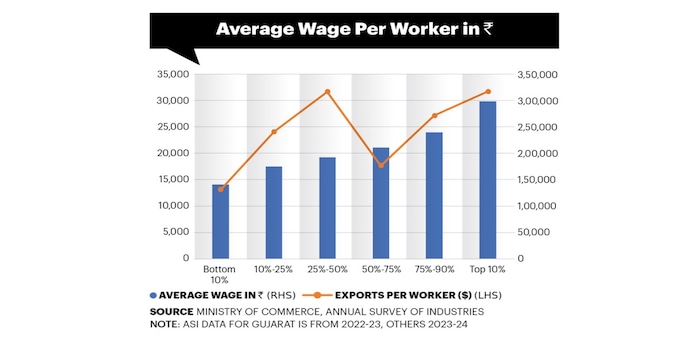
As the chart shows, its also a virtuous circle. It uses data from the three states (Gujarat, Maharashtra, and Tamil Nadu) for which we have district level data on wages and workers from the Annual Survey of Industries (ASI). The districts were split according to the average wage of industrial workers in the district, with the top 10% of districts having the highest average wage. It’s no surprise that these districts also have the highest exports per worker. Not shown here is the fact that the districts with higher wages also have higher concentrations of BSE 1000 manufacturing company plants. The top set of districts (i.e. with highest average wage per worker) have 36 plants on average per district—the lowest ranked set of districts have only three. The average number of workers per factory are higher as well—98 per factory (according to ASI data) for the top 10% of districts versus just 55 per factory in the bottom segment.
Thus, it’s a virtuous circle—higher plant sizes, higher productivity per worker, higher competitiveness in the global market, with such firms being able to pay their workers more (than average).
Worryingly, the paper quoted above found that: “India’s large plants have not grown and may in fact have shrunk…” In the context of the textile industry, it found that the scale of plants is on average smaller than their counterparts in Bangladesh.
It is important to note that the standard explanation for this: i.e. restrictive labour laws which apply disproportionately to larger firms and are seen to act as a disincentive to growth, don’t really hold here, since the plants in question are already much larger than the threshold level at which labour laws kick in. As the authors point out, there are a set of relatively newer plants in states like Karnataka and Tamil Nadu which have well over 10,000 workers in some sectors.
For decades, and even today, the government has pushed initiatives to get small enterprises to export more. But outside of a set of niche sectors, the bulk of industrial exports comes from larger firms.
This makes sense. Large firms have massive economies of scale, and are able to cut costs to a much greater degree, making them much more competitive in the global market. A major part of the reason for China’s success in global exports is just the sheer scale of its major manufacturing plants. A paper for the Madras Institute for Development Studies by Abhishek Anand, Arvind Subramanian, and Naveen Thomas Average Wage Per Worker in 2024 found that the average size for export units in India is substantially larger than for non-exporting units. And, here is the key—plants which employ fewer workers (and thus are lower scale) are less productive than those with more workers.
As the chart shows, its also a virtuous circle. It uses data from the three states (Gujarat, Maharashtra, and Tamil Nadu) for which we have district level data on wages and workers from the Annual Survey of Industries (ASI). The districts were split according to the average wage of industrial workers in the district, with the top 10% of districts having the highest average wage. It’s no surprise that these districts also have the highest exports per worker. Not shown here is the fact that the districts with higher wages also have higher concentrations of BSE 1000 manufacturing company plants. The top set of districts (i.e. with highest average wage per worker) have 36 plants on average per district—the lowest ranked set of districts have only three. The average number of workers per factory are higher as well—98 per factory (according to ASI data) for the top 10% of districts versus just 55 per factory in the bottom segment.
Thus, it’s a virtuous circle—higher plant sizes, higher productivity per worker, higher competitiveness in the global market, with such firms being able to pay their workers more (than average).
Worryingly, the paper quoted above found that: “India’s large plants have not grown and may in fact have shrunk…” In the context of the textile industry, it found that the scale of plants is on average smaller than their counterparts in Bangladesh.
It is important to note that the standard explanation for this: i.e. restrictive labour laws which apply disproportionately to larger firms and are seen to act as a disincentive to growth, don’t really hold here, since the plants in question are already much larger than the threshold level at which labour laws kick in. As the authors point out, there are a set of relatively newer plants in states like Karnataka and Tamil Nadu which have well over 10,000 workers in some sectors.