
Where heritage, craftsmanship and rarity come together
A celebration of the extraordinary, where heritage meets craftsmanship and rarity defines luxury.
Bandeep Singh
- Nov 18, 2026,
- Updated Nov 18, 2026 4:33 PM IST
Living, Breathing Lustre
At its pinnacle, luxury is not something that can be created on demand. It belongs to the realm of the irreplaceable. To this rarefied world belong Basra pearls—treasures of nature whose legendary beauty can no longer be summoned from the sea.
Born in the warm, shallow waters of the Persian Gulf, these luminous jewels once graced the necks of maharanis, the turbans of emperors, and the treasure chests of great dynasties. Unlike cultured pearls, each was conceived entirely by nature, through years of silent alchemy within a living oyster. Today, exceptional Basra pearls, particularly those assembled into harmonious strands, are among the most coveted treasures for collectors.
Advertisement
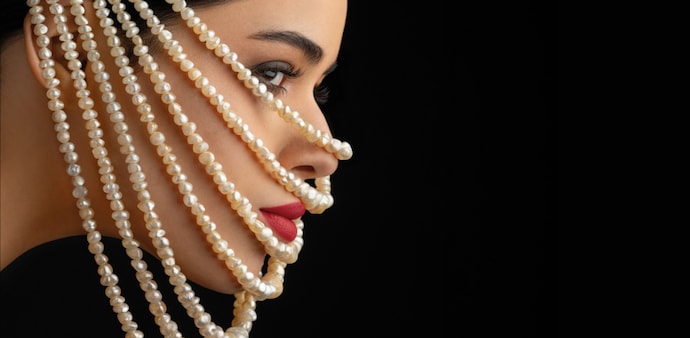
This rarity is exquisitely embodied by the Nayab-e-Khas, a magnificent seven-strand Basra pearl necklace by Hyderabad-based jewellery house Kishandas & Co. Its extraordinary 680 pearls were sourced and collected for 18 years before being assembled into a symphony of graded symmetry, coaxed from nature’s exquisite irregularities. Each pearl possesses the individuality of a fingerprint, its unrepeatable contours becoming the signature of its authenticity.
Inspired by the opulent layered necklaces of Indian royalty, this price-on-request masterpiece radiates an extraordinary warmth, its translucent lustre seeming to emanate from within. It is a distinct unreplicable glow that promises its fortunate possessor, the aura of a connoisseur.
A Platter of Taste
Advertisement
A thali has always been more than a plate. It is a small, round country, and everything a food culture loves is arranged along its rim. The Chhint Thali, an exquisite collaboration between interior designer Shalini Misra and British decorative arts house de Gournay, celebrates this culinary tradition, elevating the quintessential Indian dining ritual into an expression of cultivated elegance.
Drawing on the exuberant florals of Indian chintz and the jewelled intricacy of Mughal zardozi, the hand-painted porcelain ensemble is a masterclass in decorative refinement. Delicate botanical sprays, elaborate floral borders and shimmering gold latticework unfold across luminous porcelain, each painstakingly rendered by artisans in Jingdezhen, China’s historic porcelain capital.
There is also a sophisticated cultural dialogue at play. Indian chintz, once the obsession of European aristocracy, finds new expression through a British luxury house, translated into Chinese porcelain and returned to the Indian table as an offering of beauty.
Advertisement
Priced at at $1,926 (Rs. 1,83,000), each platter paired with a set of four bowls comes with promise to bring exquisite taste to the guests at the table, much before the meal is served.
Tasting Time
In the rarefied world of collectible whiskies, age is a measure of prestige. In India, it is a triumph over nature. Amrut Expedition, the country’s oldest single malt at 15 years, is a testament to its maker’s mastery over wood, climate and time.
The genius lies in its casking. India’s tropical climate extracts a punishing price: annual evaporation losses, poetically called the angel’s share, approaching 10% against Scotland’s 2%. Fifteen years of maturation is therefore an audacious undertaking.
Amrut’s masterstroke was its passage through two distinct woods. Eight years in a European sherry cask bestowed richness and opulence; seven more in an American ex-bourbon cask refined its complexity. The resulting 62.8% ABV expression unfolds in sumptuous layers of sherried truffle, chocolate, vanilla, dried fruits and bitter cocoa.
Advertisement
Its diamond-cut, gold-engraved bottle rests within an exquisite handcrafted wood, metal and leather case, perfected over six months and five prototypes. Individual numbering, authentication credentials, a silver peg measure and crystal stopper complete its splendour.
With just 75 bottles worldwide, priced above $12,500 (Rs. 11 lakh), Expedition commands the reverence once reserved for exalted Scottish malts. Celebrating Amrut’s 75-year legacy, it is less a whisky release than an acquisition of history.
Woven Geography
What if a saree could become a map of India, its fabric tracing the contours of a landscape and its craftsmanship traversing the country. The Jamban Saree by Delhi-based Studio Medium is an exquisite expression of this imagination, where geography becomes poetry in silk.
Conceived by NID-trained designer duo Dhruv Satija and Riddhi Jain, Jamban brings together two venerable textile traditions: Bengal’s intricate Jamdani weaving and Kutch’s exquisite Bandhani tie-dye. Its name, like its creation, is a marriage of the two.
But this is no conventional fusion of crafts. The designers envisioned a seamless textile, liberated from the traditional demarcations of border and pallu. First woven in Bengal, shimmering zari threads meander across the silk in leher, or wave-like Jamdani patterns. The saree then journeys westward to Kutch, where master artisans painstakingly introduce Bandhani resist-dyeing along the woven contours. The resulting asymmetric patterns evoke an aerial landscape of undulating rivers, mosaic fields and shifting terrain.
Advertisement
Each saree demands three to four months of meticulous craftsmanship, involving ten artisans across two distant regions. Priced at Rs. 75,000, its luxury lies not merely in rarity but in the extraordinary dialogue between inherited skill and contemporary imagination.Exhibited as textile art at the National Museum in 2024, The Jamban Saree transcends fashion. It is a landscape to be worn, and a geography of craftsmanship to be cherished.
Rare Melody
Even the faintest pluck of a sitar string can summon the soul of India. But to give this ancient classical instrument its voice demands more than craftsmanship. It requires an inheritance of musical intuition, passed through generations, where material knowledge of wood steel wires and an understanding of sound vibrations converge in a perfect harmony .
For 120 years, the Rikhi Ram family has perfected this alchemy, crafting instruments for legends from Pandit Ravi Shankar and Ustad Vilayat Khan to the Beatles.
Its crowning masterpiece is the Ravi Shankar Model, a professional-grade Burmese teak sitar, handcrafted by the Ajay Rikhi Ram to the legendary maestro’s exacting musical specifications.
Advertisement
Seven years of seasoning prepare the wood for its destiny. Specially cultivated tumba gourds are selected for resonance, while silver-and-tin-coated steel strings lend the instrument its distinctive warmth and brilliance. Every joint is engineered for enduring tonal stability; every surface polished rich, bearing intricate floral and geometric inlay.
Yet its ultimate luxury is its individuality – its distinctive sound. Each sitar possesses what Sitar Maestro Pt Shubhenra Rao calls “ a deep resonance that vibrates within your soul”.
With barely seven or eight instruments crafted annually, a waiting period of three to five months and prices ranging from Rs 2.75 lakh to Rs. 7.5 lakh, this is no ordinary musical instrument. It is where sound becomes luminous.
A Seven-Year Longing
Deep in the Western Ghats, the Karvi flower (Strobilanthes callosa) performs one of nature’s most extraordinary rituals. For seven long years, the plant gathers its strength before erupting into a spectacular profusion of violet-blue blossoms, carpeting the hillsides in a fleeting floral extravagance. It is during this brief flowering that bees harvest the nectar for one of India’s most elusive honeys.
The result is liquid poetry. Rich, deep gold-green amber and seductively aromatic, Priced between Rs. 3,500 and Rs. 5,000 a kg, Karvi honey possesses a complex flavour that transcends ordinary sweetness. Its floral delicacy unfolds into earthy, herbaceous undertones, with a lingering, gently wild finish that speaks unmistakably of its forest origins. Each spoonful carries the untamed character of the landscape from which it comes.
Its rarity is its greatest extravagance. With flowering occurring only once in seven years, authentic Karvi blossom honey is a seasonal treasure, its availability dictated not by commerce but by the rhythms of nature.
In a world where luxury is increasingly manufactured, Karvi honey offers something far more precious: the exquisite privilege of tasting time itself.
Read more!