
Bull run or bumps ahead? Two experts weigh in
Stock market veterans Raamdeo Agrawal and Shankar Sharma offer sharply contrasting views on equity valuations, risks, and opportunities ahead.
- Nov 25, 2026,
- Updated Nov 25, 2026 11:52 AM IST
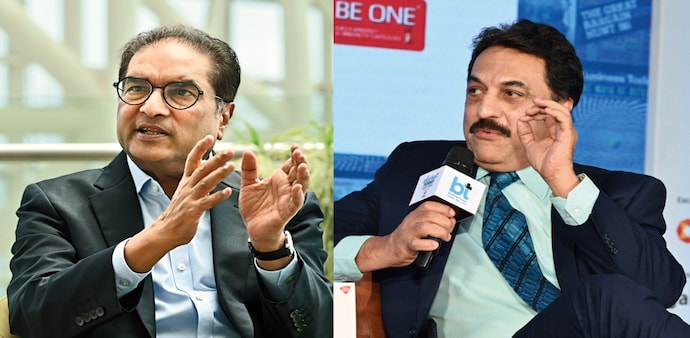
The markets may be showing signs of recovery, but are the worst days really behind us? Ask two seasoned market veterans, and you get two very different answers. Raamdeo Agrawal, Chairman and Co-founder of Motilal Oswal Financial Services, believes the correction has made Indian equities attractive, with the potential for handsome returns over the next few years. Shankar Sharma, Founder of GQuant and First Global, is less convinced. He sees more bumps ahead and believes investors should be wary of calling the start of a new bull market.
Their differences go beyond the near-term market outlook. From the return of foreign investors and debate over long-term capital gains tax to prospects for small caps and possibility of an AI bubble, the two offer contrasting perspectives on what lies ahead for investors. They also differ on where the next big wealth-creation opportunities could emerge.
In two separate interviews, Agrawal and Sharma share their reading of a market at a crossroads, what could drive its next move, and where they believe investors should be looking. Edited excerpts:
Q: On whether the worst is behind the markets.
Agrawal: We are scraping the bottom, both in geopolitics and the market in India. I don ’t think it can go worse, but it could take more time to get out of the woods. The downside is limited. If the earnings momentum continues, 40-50% (Nifty) returns are likely over the next two-three years. Can it go 5-7% lower? That is quite possible. So, I would say the downside-to-upside ratio is looking favourable for investors. If somebody says that there’s no risk from any level, that will be foolhardy, but the risk is much lower than the potential return.
Things are falling in place. One of the things that was completely out of our hands was the artificial intelligence (AI) trade. Everybody is saying that at some point of time, oil (prices) will come down, because there is enough oil and oil consumption is actually stagnating or going down.
I do not see any force going against India particularly, but the global environment is still challenging. The rupee is under pressure. We have $200-250 billion of short positions in the futures market. I think the rupee is still a thing to watch. As the rupee becomes stronger and more stable, I think the confidence of foreign investors will return, and earnings are.
Already in place.
Sharma: It is still early days to call the bottom of the market or anything of that sort. Also, remember that it has been two-and-a-half years of the downturn. It is not unheard of that the market rises by 2.5% or 3% during downturns. It should have risen earlier. It is rising now because of the Jio listing, Reliance results, and the slight fall in oil prices. I do not think we should call this the beginning of a new bull market. I think there are still plenty of speed bumps ahead. For example, the latest goods and services tax (GST) numbers looked strong. But if you dissect it, most of the growth has come from import GST because of high imports. Domestic GST has grown 6% year-to-date. The GST numbers do not, at the headline level, capture the reality of the underlying. I still believe that the markets will grind towards a period of tepid returns, barring these intermittent rallies that we will keep seeing for the next couple of years.
Q: On rationalising long-term capital gains tax (LTCG) for foreign investors.
Agrawal: It is a positive news. It has been a demand that capital gains tax should be rationalised for foreign investors. If it can be removed in competition with other countries, it is the right thing to do, in the sense that you are competing with Indonesia, Singapore, Korea, Taiwan, China, and they do not have the concept of capital gains tax. But we have to see the overall proposal, because this is from the Securities and Exchange Board of India (SEBI). The notification has to come from the finance ministry. It is moving in the right direction.
Sharma: It does not work. It would have worked if the government said we made a mistake, we have heard you, and please wait for sometime and we will give you a positive surprise. What has happened is that the government is now aware that LTCG is a problem, and they should work on reducing the pain. Now, whatever happens, will happen in the budget. What should happen is that while LTCG may be applied to earlier investments that are sold, it should not be applicable for new investments. If you reduce LTCG on earlier investments, there will be a stampede to get out.
Q: On foreign investors’ mood for India.
Agrawal: I would think so (foreign investors’ mood for India being the worst in the recent past). There is data quoted, where DII (domestic institutional investors) inflow is Rs. 8 lakh crore and FII (foreign institutional investors) outflow is Rs. 5 lakh crore. Now, which comes first? If you talk about an Rs. 8 lakh-crore inflow, who is going to fill that demand? There are only three segments of the market: DIIs and retail investors, FIIs, and promoters. Basically, this Rs. 8 lakh-crore demand is being met partly by FIIs and partly by promoters. This is the way the market is moving. Say next year, if by chance there is a Rs. 10 lakh-crore demand by retail, there is some 15-20% growth. Even if there is no growth, another Rs. 8 lakh crore comes in next year. From where will the demand be met? This has to be met either by promoters, new issuances, or FIIs by net selling. But the stock market, per se, is not so impacted by who is buying, who is selling. The levels of the market are decided by earnings and maybe interest rate to some extent. At current levels of the market with 18-19 PE (price-to-earnings) multiple, historically, it is the lowest multiple we have ever seen. And in contrast, the backdrop is that we have one of the fastest-growing earning cycles. I would think that we have a corrected market in terms of valuation, and we have a very promising earning cycle.
Sharma: Look, for FIIs, India is an additional factor, not the only factor. The real point is that all our companies —even large companies—are domestic players. They do not export, do not have offices outside India, do not have global brands. Our companies depend so much on the domestic market that the view is that the saturation at top income levels has already happened in 15-25 cities. The costs are higher to bring in incremental consumers because they have to be converted. Therefore, there is pressure on growth, pressure on margins, and it is the same for banks, for Asian Paints, for HUL. The question is, if you take a scenario where India has really good tech companies showing great growth, their stocks going up, and the market grows like 40% in Sensex and Nifty, would FIIs not come? Just because you have LTCG here? The answer is: they will come. But because of the lacuna in returns, they have lost interest in India, not just because of LTCG. If you see, the companies that have done well are the ones that are focused on exports, that have technology, that have some edge, rather than just making the same old steel, automobiles, paints and consumer goods.
Q: On whether small caps will continue to outperform.
Agrawal: If large caps have the lowest PE multiple, they will recover. If small caps have the lowest multiple, they will recover. For the first time, we are seeing that very large companies are available at a 13-15 PE multiple, which reminds me of pre-2004-05. At that time, we used to talk about 12, 13, 14 multiple. Right now, it is all about 30, 40, 80, 100, or infinite PE multiple situation. So, here you have a terrific franchise and well-corrected large caps. And I would think that large cap has a better chance in comparison with mid and small. Stock-wise, they will also do very well, but because they are starting at higher multiples, I think the recovery could be slower.
Sharma: Small caps themselves do not know when they will outperform or underperform. There used to be a great spinner in the Indian cricket team, Bhagwat Chandrashekhar. Batsmen would fail to read him. When asked, he said when I myself don’t know what delivery I will bowl, how will the batsman read me? Our small caps are similar. It is very difficult to form a view on them. I take a view of four to eight months. My view in March was really good. Right now, the view is a bit tepid because the stocks that did well, did much better than expected. Many stocks doubled or tripled in six months. Expecting them to double or triple next year too, I do not think that will happen. That is why I have started taking money out rather than putting it back in the market. This is my tactical strategy.
Q: On bubble formation in the AI trade.
Agrawal: AI is going to stay—it is like the internet, electricity, and telecom. AI is now a fundamental part of our lives. The question is at what pace the world wants to build its AI capabilities. The world was thinking of spending perhaps $8-10 trillion without revenue or profits, with annual spending scheduled to be about $2 trillion. And that is where I think the trouble started. All the suppliers involved in the AI build-up— chips, data centres, cables—were on fire. If you look at US earnings, S&P 500 earnings are expected to grow by about 27-30% this quarter. In that kind of environment, you do not expect money to flow from the US to other emerging markets. But now, data centre stocks have gone underwater. Their debentures and stocks are trading below par, and funding the AI boom is becoming challenging. I do not know what the second- and third-order effects of these funding challenges will be. The AI boom will continue, albeit in a slightly milder form—it is not going to collapse. As long as AI remains, there will be capital investment and earnings from building it. So, there will be a correction.
Sharma: Look, in the past two to four days, there have been quite a few cuts. As I said, I am a hare, not a bear, nor a bull. Right now, I am checking numbers to see whether this is a reversal or a typical correction. Because, Such corrections have happened before as well. It is not like there have not been 2-8% falls in NASDAQ. Since 2022, when ChatGPT was released, there have been many falls. We have to judge
Whether this is the final point or whether it will become a renewal again. So far, my view on this isn’t clear, to be honest.
@sakshibatra18 @shail_bhatnagar