
Garware Technical Fibres: CEO sees positive Q2 outlook; value-added products in focus
Garware Technical Fibres CEO Shujaul Rehman sees a positive Q2 outlook, while highlighting aquaculture, geosynthetics and value-added products as key growth drivers.
- Aug 10, 2026,
- Updated Aug 10, 2026 3:42 PM IST
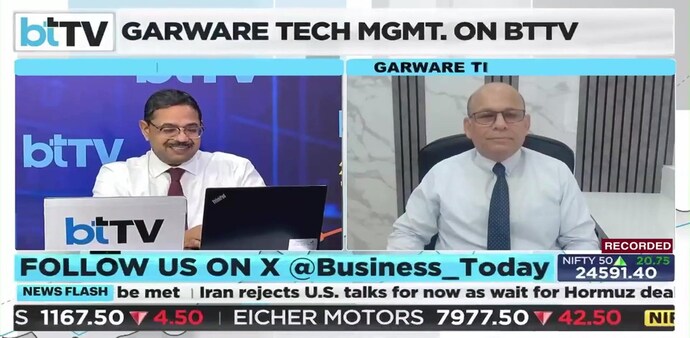
Garware Technical Fibres expects the positive momentum seen across its key businesses to continue into the second quarter, supported by healthy demand across aquaculture, geosynthetics and domestic industrial segments, CEO Shujaul Rehman said in a recent interaction.
Rehman said the company's first-quarter performance reflected its focus on innovation and developing solutions to address customer requirements. While the company does not provide quarterly guidance, he said the outlook for the second quarter remains positive.
“Q1 results are a testimony of the effort that we put in in the area of innovation and trying to understand and solve customers' problems,” Rehman said.
Raw material volatility remains key concern Rehman said raw material price volatility remains one of the key challenges for the company, particularly amid the ongoing West Asia crisis. Container availability and shipment delays are also creating logistical challenges.
However, he said the company's value-added business model helps mitigate the impact of higher raw material costs. In aquaculture, raw materials account for around 30 per cent of the overall cost structure, allowing the company to largely pass on cost increases to customers.
There can be a short-term lag in passing on higher costs because of existing orders, but the impact is not expected to be significant over the long term, Rehman said. The company was able to maintain margins at historical levels in the first quarter despite raw material inflation.
The domestic business, which operates through dealers and distributors, can see temporary inventory-related pressure when raw material prices move sharply, as channel partners tend to defer purchases until price movements stabilise.
Focus on value-added products Garware Technical Fibres currently derives around 80 per cent of its business from value-added products, while the remaining 20 per cent is still commodity-oriented, particularly ropes used in areas such as transmission, shipping, oil and gas and towing.
Rehman said the company aims to gradually upgrade this commodity portfolio into higher-value products, which could support margin expansion over the medium to long term.
Innovation remains central to the company's strategy, with around 28-29 patents already approved and more than 100 patents filed. The company is also conducting trials with customers to develop products aimed at solving specific operational challenges.
Aquaculture, geosynthetics drive growth Aquaculture, which contributes nearly 35 per cent of the company's business, remains a key growth and margin driver. Norway is its largest aquaculture market, while Chile has also performed well, supported by a strong market position. Other markets, including Northern Europe and Canada, are also witnessing healthy demand.
The company's geosynthetics business, which uses polymer-based products in construction and infrastructure, has grown at around 40 per cent CAGR over the past three years. Rehman attributed the growth to increasing government investment and infrastructure development in India.
The domestic industrial business, spanning construction, safety and fishing, has also improved significantly after facing challenges two to three years ago.
Capacity utilisation remains high The company's manufacturing capacities are modular, with utilisation currently at around 80-85 per cent. Garware typically invests around Rs 50-70 crore annually in capital expenditure, with the spending funded internally.
Rehman said capacity additions are made incrementally depending on constraints in individual manufacturing processes, with a typical lead time of around three to four months.
Looking ahead, the company's broader objective remains focused on innovation, customer value creation and improving profitability. Rehman said Garware's long-term planning is aimed at doubling profits every five years.
Garware Technical Fibres expects the positive momentum seen across its key businesses to continue into the second quarter, supported by healthy demand across aquaculture, geosynthetics and domestic industrial segments, CEO Shujaul Rehman said in a recent interaction.
Rehman said the company's first-quarter performance reflected its focus on innovation and developing solutions to address customer requirements. While the company does not provide quarterly guidance, he said the outlook for the second quarter remains positive.
“Q1 results are a testimony of the effort that we put in in the area of innovation and trying to understand and solve customers' problems,” Rehman said.
Raw material volatility remains key concern Rehman said raw material price volatility remains one of the key challenges for the company, particularly amid the ongoing West Asia crisis. Container availability and shipment delays are also creating logistical challenges.
However, he said the company's value-added business model helps mitigate the impact of higher raw material costs. In aquaculture, raw materials account for around 30 per cent of the overall cost structure, allowing the company to largely pass on cost increases to customers.
There can be a short-term lag in passing on higher costs because of existing orders, but the impact is not expected to be significant over the long term, Rehman said. The company was able to maintain margins at historical levels in the first quarter despite raw material inflation.
The domestic business, which operates through dealers and distributors, can see temporary inventory-related pressure when raw material prices move sharply, as channel partners tend to defer purchases until price movements stabilise.
Focus on value-added products Garware Technical Fibres currently derives around 80 per cent of its business from value-added products, while the remaining 20 per cent is still commodity-oriented, particularly ropes used in areas such as transmission, shipping, oil and gas and towing.
Rehman said the company aims to gradually upgrade this commodity portfolio into higher-value products, which could support margin expansion over the medium to long term.
Innovation remains central to the company's strategy, with around 28-29 patents already approved and more than 100 patents filed. The company is also conducting trials with customers to develop products aimed at solving specific operational challenges.
Aquaculture, geosynthetics drive growth Aquaculture, which contributes nearly 35 per cent of the company's business, remains a key growth and margin driver. Norway is its largest aquaculture market, while Chile has also performed well, supported by a strong market position. Other markets, including Northern Europe and Canada, are also witnessing healthy demand.
The company's geosynthetics business, which uses polymer-based products in construction and infrastructure, has grown at around 40 per cent CAGR over the past three years. Rehman attributed the growth to increasing government investment and infrastructure development in India.
The domestic industrial business, spanning construction, safety and fishing, has also improved significantly after facing challenges two to three years ago.
Capacity utilisation remains high The company's manufacturing capacities are modular, with utilisation currently at around 80-85 per cent. Garware typically invests around Rs 50-70 crore annually in capital expenditure, with the spending funded internally.
Rehman said capacity additions are made incrementally depending on constraints in individual manufacturing processes, with a typical lead time of around three to four months.
Looking ahead, the company's broader objective remains focused on innovation, customer value creation and improving profitability. Rehman said Garware's long-term planning is aimed at doubling profits every five years.