
Hindustan Zinc, IIT Madras unveil zinc-air battery-powered three-wheeler
For Hindustan Zinc, the initiative is part of its broader HZL 2.0 growth and diversification strategy, which focuses on exploring emerging applications of zinc and expanding its presence in value-added product segments.
- Nov 26, 2026,
- Updated Nov 26, 2026 4:48 PM IST
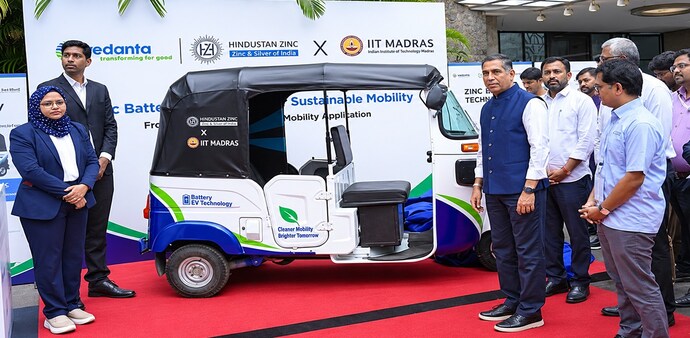
Hindustan Zinc Ltd has collaborated with the Indian Institute of Technology Madras (IIT Madras) to advance zinc-air battery technology for next-generation electric mobility, unveiling an electric three-wheeler prototype equipped with a 1 kWh zinc-air battery.
The prototype, unveiled at the recently held IIT Madras Energy Summit 2026, uses the zinc-air battery as a range extender. It features a dual-battery configuration in which the existing lithium-ion battery supports acceleration and peak power requirements, while the zinc-air battery provides a steady supply of energy during operation. The zinc-air battery contributes nearly 10% of the vehicle's total energy requirements.
Hindustan Zinc stock closed at Rs 527.50, up 1.42% or Rs 7.40 in the current session against the previous close of Rs 520.10. It opened at Rs 528 and touched a high of Rs 538 and a low of Rs 525.05 during the session.
The collaboration between Hindustan Zinc and IIT Madras began in 2024 and has now progressed from laboratory-scale research to a vehicle-level demonstration. The development highlights the potential of zinc-based batteries to complement existing energy storage systems and diversify battery technologies used in electric mobility.
Zinc-air batteries generate electricity using zinc and oxygen from the surrounding air. According to the company, the technology uses a non-flammable, water-based electrolyte and an abundant, recyclable metal, offering potential advantages in safety, affordability and environmental sustainability. Hindustan Zinc said India's zinc resources could also support the development of indigenous energy storage solutions.
Amarendu Prakash, CEO and Whole-time Director of Hindustan Zinc, said the collaboration with IIT Madras reflected the company's commitment to translating scientific research into practical applications, creating new demand avenues for zinc and strengthening its role in the global clean energy transition.
For Hindustan Zinc, the initiative is part of its broader HZL 2.0 growth and diversification strategy, which focuses on exploring emerging applications of zinc and expanding its presence in value-added product segments.