
How Narayana Murthy's era, Vishal Sikka's stint and Salil Parekh's tenure differed; big task awaits next Infosys CEO
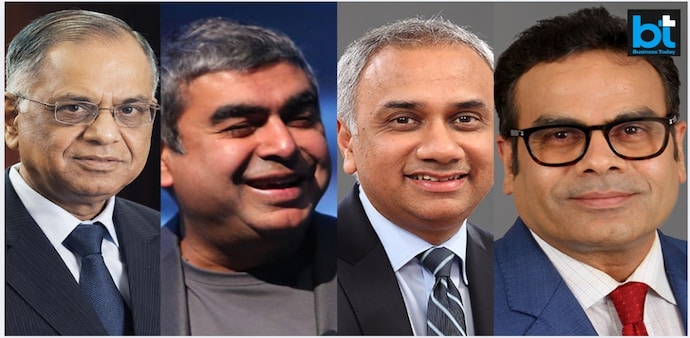
How Narayana Murthy's era, Vishal Sikka's stint and Salil Parekh's tenure differed; big task awaits next Infosys CEO
Murthy's was a period when the industry size was small and IT exports were at $6-8 billion and, on a low base, the industry was growing at 50-60 per cent annually
Amit Mudgill
- Jul 27, 2026,
- Updated Jul 28, 2026 11:26 AM IST
With artificial intelligence (AI) witnessing enterprise-scale adoption, Infosys CEO-designate Ashiss Kumar Dash has a key task ahead when he takes over the top post on April 1, 2027: scaling up the Bengaluru-based company's AI business, which currently contributes 8.2 per cent of revenue, while protecting margins. Frontier AI models have advanced faster than expected in software-related tasks, fuelling Street concerns over GenAI-led pricing deflation for the Indian IT services industry.
Advertisement
Dash has big shoes to fill.
Among all Infosys CEOs, N R Narayana Murthy (NRN) led Infosys' golden era. Ajay Garg, Director & CEO at SMC Global Securities said Murthy's biggest achievement was building an institution that could grow beyond its founders. At a time when India's IT industry was still evolving, he made Infosys synonymous with ethics, transparency and strong corporate governance.
"That reputation helped Infosys earn the trust of global clients and investors. More importantly, he built a leadership culture that has endured through multiple CEO transitions. That's perhaps his greatest legacy," Garg said.
Business cycles
During Murthy's tenure, the IT major recorded a 28.6 per cent compounded quarterly revenue growth, expanded operating margin by 50 basis points and delivered a staggering 36,381 per cent gain in its share price post listing in June 1993.
Advertisement
His successors recorded a slower growth as the industry matured: Nandan Nilekani (March 2002-June 2007) at 9.1 per cent, S Gopalakrishnan (June 2007-August 2011) at 4.2 per cent, S D Shibulal (August 2011-August 2014) at 2.6 per cent, Vishal Sikka (August 2014-August 2017) at 1.8 per cent, and Salil Parekh (January 2018-present) also at 1.8 per cent, Mint reported.
Garg of SMC Global Securities said every Infosys CEO has led the company through a different business cycle.
He said Nandan Nilekani played a key role in scaling the company globally. Kris Gopalakrishnan and S.D. Shibulal steered Infosys through the slowdown that followed the global financial crisis.
Vishal Sikka, he said, pushed the company towards automation, artificial intelligence and innovation-led transformation, but his tenure was also marked by governance-related differences. Salil Parekh restored stability, strengthened client confidence and expanded Infosys' cloud and digital capabilities, Garg said.
Advertisement
"The challenge ahead is different. Ashiss Kumar Dash will be judged on how effectively Infosys translates its AI investments into stronger client outcomes, sustainable growth and healthy margins," Garg said.
Three structural changes
Murthy's was a period when the industry size was small and IT exports were at $6-8 billion and, on a low base, the industry was growing at 50-60 per cent annually, said Chokkalingam G, Founder, at Equinomics Research.
"He was there at the right time. Of course, NRN had unquestionable talent - not everybody could build an Infosys. But one has to accept, structural changes were taking place in the industry to his advantage," Chokkalingam told Business Today.
Chokkalingam said Infosys under NRN gained from his leadership, hard work and changes that were waiting to happen, and they did. The analyst said in the last 26 years, the industry base has grown quite a bit. "You can grow at 50 per cent in a $10 billion industry, but, at $200 billion, a 10-15 per cent growth looks solid," Chokkalingam said.
Advertisement
Another structural change that happened in the past 26-odd years is that the rupee depreciation has over a period stopped aiding margins of IT firms, including Infosys. "Buyers of Indian IT services have become smarter, so they bargain," Chokkalingam said.
The third big change that has come to the industry in the past three decades is the emerge of AI. The IT industry was growing a 6 per cent a few years ago. Now it may grow at 0-3 per cent, the analyst said.
Each past Infosys CEO had different skillset, different ask and their tenure also differed, said Sameer Pardikar - Lead Research Analyst for IT at Elara Securities. "Salil will complete nine years- that is a long time. Vishal Sikka, on the other hand, had just three years as CEO," he noted.
There were rumours that Infosys planned an investment in OpenAI under Sikka, who led the IT giant from August 2014 to August 2017. But there was reportedly no consensus at the board. Speaking at India Today AI Summit 2026, Sikka earlier this year said "no regrets", adding that "“what happened, happened and couldn’t have happened any other way.”
Infosys post 2002
Murthy, popularly known as NRN, stepped down as CEO and Managing Director of Infosys in March 2002. Since then, the company's annual revenue has grown 68.61 times, from Rs 2,603.59 crore in FY02 to Rs 1,78,650 crore in FY26. During the same period, profit after tax (PAT) increased 36.47 times to Rs 29,474 crore from Rs 807.96 crore 24 years ago, data compiled from corporate database AceEquity suggests.
Advertisement
Operating margin, however, declined to 20.3 per cent in FY26 from 32.76 per cent in FY02, although it briefly remained above 30 per cent in FY09 and FY10, according to Bloomberg data compiled by Business Today.
Infosys now elevating an internal leader reflects the board's belief that the AI transition is fundamentally an execution challenge rather than a strategic reset, said Kunal Bajaj, Research Analyst at Choice Institutional Equities.
"AI is undoubtedly reshaping delivery models, pricing dynamics and productivity, but client trust, execution discipline and organisational stability remain the key differentiators," Bajaj told Business Today.
He said an internal leader with 31 years at Infosys brings deep institutional knowledge and established client relationships, allowing the company to accelerate AI adoption while minimising execution risk. The message is clear—the Board is prioritising continuity and disciplined AI monetisation over disruptive leadership change, he said.
Dash's predecessor and current MD & CEO Salil Parekh expanded Infosys' annual large-deal total contract value (TCV) to $14 billion in FY26 from $3.1 billion in FY18. During the same period, the company's revenue more than doubled to $20.2 billion from $9.5 billion. However, Ebit margin declined to 21 per cent in FY26 from 24.3 per cent in FY24 due to accelerated investments. Parekh assumed the top role in January 2018.
Advertisement
"His strategy navigated the transition to the digital era and laid the foundation for a differentiated AI strategy. Three strategic pillars define Parekh's legacy — digital transition, large-deal engine and AI foundation," Systematix said in a note.
Dash's career, meanwhile, has spanned the full breadth of Infosys' operating model, covering delivery, account management, delivery centre leadership, sales and business segment leadership.
"The board has chosen continuity over disruption — an insider with deep operating experience, technical fluency and cultural credibility. The transition is well structured with an extended mentoring period," Systematix said.
JM Financial said Dash's focus would remain on economically attractive deals, margins and his technical understanding of AI.
Disclaimer: Business Today provides stock market news for informational purposes only and should not be construed as investment advice. Readers are encouraged to consult with a qualified financial advisor before making any investment decisions.
With artificial intelligence (AI) witnessing enterprise-scale adoption, Infosys CEO-designate Ashiss Kumar Dash has a key task ahead when he takes over the top post on April 1, 2027: scaling up the Bengaluru-based company's AI business, which currently contributes 8.2 per cent of revenue, while protecting margins. Frontier AI models have advanced faster than expected in software-related tasks, fuelling Street concerns over GenAI-led pricing deflation for the Indian IT services industry.
Advertisement
Dash has big shoes to fill.
Among all Infosys CEOs, N R Narayana Murthy (NRN) led Infosys' golden era. Ajay Garg, Director & CEO at SMC Global Securities said Murthy's biggest achievement was building an institution that could grow beyond its founders. At a time when India's IT industry was still evolving, he made Infosys synonymous with ethics, transparency and strong corporate governance.
"That reputation helped Infosys earn the trust of global clients and investors. More importantly, he built a leadership culture that has endured through multiple CEO transitions. That's perhaps his greatest legacy," Garg said.
Business cycles
During Murthy's tenure, the IT major recorded a 28.6 per cent compounded quarterly revenue growth, expanded operating margin by 50 basis points and delivered a staggering 36,381 per cent gain in its share price post listing in June 1993.
Advertisement
His successors recorded a slower growth as the industry matured: Nandan Nilekani (March 2002-June 2007) at 9.1 per cent, S Gopalakrishnan (June 2007-August 2011) at 4.2 per cent, S D Shibulal (August 2011-August 2014) at 2.6 per cent, Vishal Sikka (August 2014-August 2017) at 1.8 per cent, and Salil Parekh (January 2018-present) also at 1.8 per cent, Mint reported.
Garg of SMC Global Securities said every Infosys CEO has led the company through a different business cycle.
He said Nandan Nilekani played a key role in scaling the company globally. Kris Gopalakrishnan and S.D. Shibulal steered Infosys through the slowdown that followed the global financial crisis.
Vishal Sikka, he said, pushed the company towards automation, artificial intelligence and innovation-led transformation, but his tenure was also marked by governance-related differences. Salil Parekh restored stability, strengthened client confidence and expanded Infosys' cloud and digital capabilities, Garg said.
Advertisement
"The challenge ahead is different. Ashiss Kumar Dash will be judged on how effectively Infosys translates its AI investments into stronger client outcomes, sustainable growth and healthy margins," Garg said.
Three structural changes
Murthy's was a period when the industry size was small and IT exports were at $6-8 billion and, on a low base, the industry was growing at 50-60 per cent annually, said Chokkalingam G, Founder, at Equinomics Research.
"He was there at the right time. Of course, NRN had unquestionable talent - not everybody could build an Infosys. But one has to accept, structural changes were taking place in the industry to his advantage," Chokkalingam told Business Today.
Chokkalingam said Infosys under NRN gained from his leadership, hard work and changes that were waiting to happen, and they did. The analyst said in the last 26 years, the industry base has grown quite a bit. "You can grow at 50 per cent in a $10 billion industry, but, at $200 billion, a 10-15 per cent growth looks solid," Chokkalingam said.
Advertisement
Another structural change that happened in the past 26-odd years is that the rupee depreciation has over a period stopped aiding margins of IT firms, including Infosys. "Buyers of Indian IT services have become smarter, so they bargain," Chokkalingam said.
The third big change that has come to the industry in the past three decades is the emerge of AI. The IT industry was growing a 6 per cent a few years ago. Now it may grow at 0-3 per cent, the analyst said.
Each past Infosys CEO had different skillset, different ask and their tenure also differed, said Sameer Pardikar - Lead Research Analyst for IT at Elara Securities. "Salil will complete nine years- that is a long time. Vishal Sikka, on the other hand, had just three years as CEO," he noted.
There were rumours that Infosys planned an investment in OpenAI under Sikka, who led the IT giant from August 2014 to August 2017. But there was reportedly no consensus at the board. Speaking at India Today AI Summit 2026, Sikka earlier this year said "no regrets", adding that "“what happened, happened and couldn’t have happened any other way.”
Infosys post 2002
Murthy, popularly known as NRN, stepped down as CEO and Managing Director of Infosys in March 2002. Since then, the company's annual revenue has grown 68.61 times, from Rs 2,603.59 crore in FY02 to Rs 1,78,650 crore in FY26. During the same period, profit after tax (PAT) increased 36.47 times to Rs 29,474 crore from Rs 807.96 crore 24 years ago, data compiled from corporate database AceEquity suggests.
Advertisement
Operating margin, however, declined to 20.3 per cent in FY26 from 32.76 per cent in FY02, although it briefly remained above 30 per cent in FY09 and FY10, according to Bloomberg data compiled by Business Today.
Infosys now elevating an internal leader reflects the board's belief that the AI transition is fundamentally an execution challenge rather than a strategic reset, said Kunal Bajaj, Research Analyst at Choice Institutional Equities.
"AI is undoubtedly reshaping delivery models, pricing dynamics and productivity, but client trust, execution discipline and organisational stability remain the key differentiators," Bajaj told Business Today.
He said an internal leader with 31 years at Infosys brings deep institutional knowledge and established client relationships, allowing the company to accelerate AI adoption while minimising execution risk. The message is clear—the Board is prioritising continuity and disciplined AI monetisation over disruptive leadership change, he said.
Dash's predecessor and current MD & CEO Salil Parekh expanded Infosys' annual large-deal total contract value (TCV) to $14 billion in FY26 from $3.1 billion in FY18. During the same period, the company's revenue more than doubled to $20.2 billion from $9.5 billion. However, Ebit margin declined to 21 per cent in FY26 from 24.3 per cent in FY24 due to accelerated investments. Parekh assumed the top role in January 2018.
Advertisement
"His strategy navigated the transition to the digital era and laid the foundation for a differentiated AI strategy. Three strategic pillars define Parekh's legacy — digital transition, large-deal engine and AI foundation," Systematix said in a note.
Dash's career, meanwhile, has spanned the full breadth of Infosys' operating model, covering delivery, account management, delivery centre leadership, sales and business segment leadership.
"The board has chosen continuity over disruption — an insider with deep operating experience, technical fluency and cultural credibility. The transition is well structured with an extended mentoring period," Systematix said.
JM Financial said Dash's focus would remain on economically attractive deals, margins and his technical understanding of AI.
Disclaimer: Business Today provides stock market news for informational purposes only and should not be construed as investment advice. Readers are encouraged to consult with a qualified financial advisor before making any investment decisions.
Read more!