
Indian market outlook: ‘Pessimism is excessive’; Maneesh Dangi turns neutral, sees better 6-12 months
Mosaic Asset Manager's Maneesh Dangi has shifted from bearish to neutral on Indian equities, saying investor pessimism is excessive and markets could perform better over the next 6-12 months.
- Aug 31, 2026,
- Updated Aug 31, 2026 3:56 PM IST
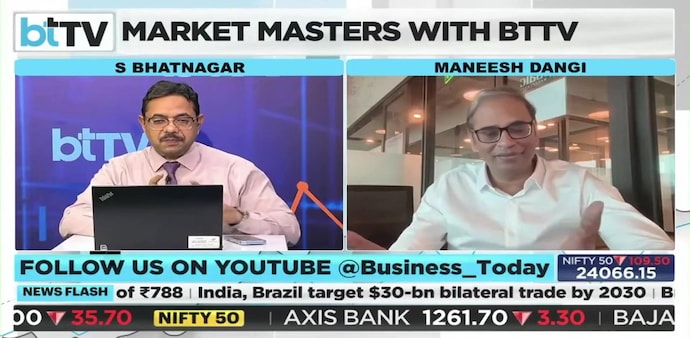
Indian equities could perform relatively better over the next six to 12 months as investor pessimism around the market appears excessive, according to Maneesh Dangi, founder and chief executive officer of Mosaic Asset Management. Dangi, who had stayed cautious on Indian equities for much of the past two-and-a-half years, said his view has now shifted to neutral rather than bullish.
In an interaction with Business Today TV, Dangi said the mood around Indian markets was weaker than warranted, even though he was not making an outright bullish call. “Right now, I’m not bullish. It’s just that relative to what is the general mood in Bombay right now, I think the mood is too pessimistic and we deserve a better outlook on India,” he said.
Dangi said Indian equities could do better over the next six to 12 months than they did in the previous 12 to 18 months. He pointed to improving domestic capital expenditure, relatively resilient economic fundamentals and easing headwinds from the Middle East as factors that could support the market. “The quarter has been decent. There’s a decent CapEx growth. Much of the headwind with respect to the Middle East actually is beginning to fade,” he said. Even so, he said the change in his stance should be seen mainly as a move from bearishness to neutrality.
He also argued that India’s balance sheet is much stronger than it was in the past, which has helped the economy absorb recent shocks better than markets had expected. Dangi cited the recent oil crisis and earlier concerns over a sharp economic slowdown as examples where India showed more resilience than anticipated. He said markets had also expected significant rate hikes along with FCNR-related measures, but those expectations did not materialise. “India, relative to any time in the past, actually has weathered the storm better,” he said.
At the same time, Dangi said India’s relative position against other major economies has weakened. In his view, the biggest disadvantage for India is that it is not among the economies benefiting directly from the global artificial intelligence investment cycle. He said the AI-driven technology shift is likely to reshape businesses across sectors, including banking and wealth management, but India is not currently at the frontier of that change.
“India is not winning. US is winning. China is winning,” Dangi said, adding that Japan, South Korea and Taiwan are also benefiting from the AI-led investment cycle. As a result, while India’s domestic macroeconomic position remains relatively strong, its standing versus the rest of the world has deteriorated over the past 18 months, he said.
Dangi, however, said there could be an opportunity in India’s capital expenditure cycle. He noted that Indian equity strategists have spoken for years about a CapEx revival, but actual investment on the ground often did not match those expectations. That, he said, could now begin to change. “I am actually hopeful that India CapEx will pick up in a meaningful fashion,” he said.
He expects the large investment wave in the US around AI, data centres and technology infrastructure to eventually spill over to India. According to Dangi, the first phase is likely to stay concentrated in the US because of its deep capital markets, large technology ecosystem and access to financing, but India could benefit later through a trickle-down effect. From an asset-allocation perspective, he said he remains positive on the US, which he sees as staying on the winning side for some time. He added that even Japan and South Korea, despite their exposure to the AI ecosystem, have faced pressure relative to the US, particularly through currency movements.
For Indian investors, Dangi’s outlook suggests a more balanced picture: domestic fundamentals and the possibility of a stronger CapEx cycle could support equities, even as India continues to trail global AI leaders. Overall, his view marks a shift from the bearish position he held in recent years to a more neutral stance, with scope for Indian markets to perform relatively better over the next six to 12 months.
Indian equities could perform relatively better over the next six to 12 months as investor pessimism around the market appears excessive, according to Maneesh Dangi, founder and chief executive officer of Mosaic Asset Management. Dangi, who had stayed cautious on Indian equities for much of the past two-and-a-half years, said his view has now shifted to neutral rather than bullish.
In an interaction with Business Today TV, Dangi said the mood around Indian markets was weaker than warranted, even though he was not making an outright bullish call. “Right now, I’m not bullish. It’s just that relative to what is the general mood in Bombay right now, I think the mood is too pessimistic and we deserve a better outlook on India,” he said.
Dangi said Indian equities could do better over the next six to 12 months than they did in the previous 12 to 18 months. He pointed to improving domestic capital expenditure, relatively resilient economic fundamentals and easing headwinds from the Middle East as factors that could support the market. “The quarter has been decent. There’s a decent CapEx growth. Much of the headwind with respect to the Middle East actually is beginning to fade,” he said. Even so, he said the change in his stance should be seen mainly as a move from bearishness to neutrality.
He also argued that India’s balance sheet is much stronger than it was in the past, which has helped the economy absorb recent shocks better than markets had expected. Dangi cited the recent oil crisis and earlier concerns over a sharp economic slowdown as examples where India showed more resilience than anticipated. He said markets had also expected significant rate hikes along with FCNR-related measures, but those expectations did not materialise. “India, relative to any time in the past, actually has weathered the storm better,” he said.
At the same time, Dangi said India’s relative position against other major economies has weakened. In his view, the biggest disadvantage for India is that it is not among the economies benefiting directly from the global artificial intelligence investment cycle. He said the AI-driven technology shift is likely to reshape businesses across sectors, including banking and wealth management, but India is not currently at the frontier of that change.
“India is not winning. US is winning. China is winning,” Dangi said, adding that Japan, South Korea and Taiwan are also benefiting from the AI-led investment cycle. As a result, while India’s domestic macroeconomic position remains relatively strong, its standing versus the rest of the world has deteriorated over the past 18 months, he said.
Dangi, however, said there could be an opportunity in India’s capital expenditure cycle. He noted that Indian equity strategists have spoken for years about a CapEx revival, but actual investment on the ground often did not match those expectations. That, he said, could now begin to change. “I am actually hopeful that India CapEx will pick up in a meaningful fashion,” he said.
He expects the large investment wave in the US around AI, data centres and technology infrastructure to eventually spill over to India. According to Dangi, the first phase is likely to stay concentrated in the US because of its deep capital markets, large technology ecosystem and access to financing, but India could benefit later through a trickle-down effect. From an asset-allocation perspective, he said he remains positive on the US, which he sees as staying on the winning side for some time. He added that even Japan and South Korea, despite their exposure to the AI ecosystem, have faced pressure relative to the US, particularly through currency movements.
For Indian investors, Dangi’s outlook suggests a more balanced picture: domestic fundamentals and the possibility of a stronger CapEx cycle could support equities, even as India continues to trail global AI leaders. Overall, his view marks a shift from the bearish position he held in recent years to a more neutral stance, with scope for Indian markets to perform relatively better over the next six to 12 months.