
IT stocks set for worst performance in 18 years; brokerages and analysts share outlook
IT stocks set for worst performance in 18 years; brokerages and analysts share outlook
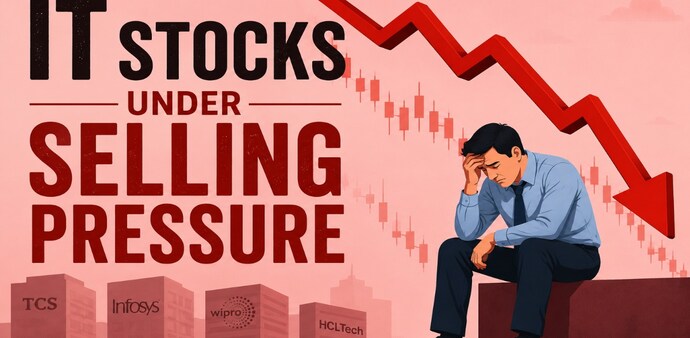
IT stocks: Shares of IT sector leaders such as TCS, Infosys and Tech Mahindra are trading near their 52 week lows.
Aseem Thapliyal
- Jul 1, 2026,
- Updated Jul 1, 2026 1:49 PM IST
IT stocks crash: IT shares are set for their worst performance in 18 years as investors grapple with a major correction this year. The Nifty IT index-with 10 big IT sector stocks-is down 31% in the first six months of 2026. The index saw its last major correction 18 years ago when it crashed 54.56% in 2008 during the global financial crisis triggered by the collapse of Lehman Brothers.
Advertisement
Since then, the index has witnessed three notable corrections. The index fell 12.58% in 2025, 26% in 2022 and 18% in 2011.
The IT sector is the worst performing in the Indian stock market this year.
Shares of IT sector leaders such as TCS, Infosys and Tech Mahindra are trading near their 52 week lows. While shares of TCS and Infosys fell to their 52-week lows of Rs 2037.50 and Rs 1006 on June 30, 2026, Tech Mahindra shares touched their yearly low of Rs 1304.25 on March 9, 2026.
Another IT major Wipro's stock slipped to its 52-week low of Rs 169.40 in the current session. Other IT stocks such as Persistent Systems, Tata Elxsi, and Zensar Technologies are also trading near their 52 week lows reached in the previous session.
Advertisement
IT crash triggers, outlook
The correction in the IT stocks comes on fears of AI-led disruption, US-Iran war and global IT firm Accenture's weak guidance. These factors have cast a concerns over the upcoming Q1 earnings and outlook of the IT sector.
Ankur Punj, MD & Business Head at Equirus Wealth said, "The market is effectively pricing in slower revenue growth, lower pricing power, uncertainty around AI’s impact on staffing and weaker margins over the next 12–24 months. Rather than fearing a collapse in earnings, investors are assigning lower valuation multiples to the sector. Outlook Management commentary is likely to remain cautious. Deal wins may improve, but conversion into revenue could stay slow. Earnings downgrades remains a risk."
Advertisement
Indian IT stocks have remained under pressure in 2026 as investors assess the combined impact of rapid advances in generative artificial intelligence (AI) and weakening technology spending by global enterprises. The growing belief that AI could fundamentally reshape the traditional IT services business model has weighed heavily on sector valuations, leading to a broad-based correction in IT stocks.
Brokerages have also turned increasingly cautious on the industry's medium- to long-term growth prospects. According to Kotak Institutional Equities, AI is expected to open up new business opportunities, including legacy application modernization, enterprise AI implementation and digital transformation projects. However, these emerging revenue streams may not be sufficient to compensate for the slowdown in traditional application development, maintenance and outsourcing services that have historically driven growth for IT companies.
The cautious sentiment has been reinforced by recent commentary from industry leaders. Both Infosys and Accenture have issued subdued revenue guidance and reported weaker large-deal wins, highlighting a softer demand environment as clients remain selective with technology spending amid macroeconomic uncertainty.
Nishchal Jain, Quant Researcher, Share.Market by PhonePe said, "The sell-off reflects growing investor caution toward the sector as market participants reassess near-term growth visibility for Indian IT services companies in a challenging global demand environment.
Advertisement
The current de-rating appears to be a valuation adjustment for a sector where near-term growth expectations had run ahead of immediate demand realities. In the short term, traders may remain cautious until there is clearer evidence of demand recovery, deal conversion and stabilisation in sector leadership stocks. For long-term investors, however, the correction may create selective opportunities in large-cap IT companies with strong balance sheets, diversified client bases, robust execution capabilities and the ability to transition toward AI-first service models."
Brokerage JPMorgan in a report said India's information technology sector could remain trapped in a prolonged period of sluggish growth as artificial intelligence-driven disruption and geopolitical uncertainty continue to dampen enterprise technology spending.
The brokerage said the industry is navigating one of its most challenging demand environments in years, with structural changes driven by AI coinciding with a weak global business cycle. As companies reassess their technology budgets, JPMorgan believes a meaningful recovery in IT services growth is unlikely in the near term.
According to the report, the sector has delivered only 2-3% revenue growth over the past three years, and the impact of AI-led productivity improvements is still in its early stages. Since the industry is only in the second year of what JPMorgan describes as "AI deflation," the brokerage expects growth headwinds to persist over the next two years.
Disclaimer: Business Today provides stock market news for informational purposes only and should not be construed as investment advice. Readers are encouraged to consult with a qualified financial advisor before making any investment decisions.
IT stocks crash: IT shares are set for their worst performance in 18 years as investors grapple with a major correction this year. The Nifty IT index-with 10 big IT sector stocks-is down 31% in the first six months of 2026. The index saw its last major correction 18 years ago when it crashed 54.56% in 2008 during the global financial crisis triggered by the collapse of Lehman Brothers.
Advertisement
Since then, the index has witnessed three notable corrections. The index fell 12.58% in 2025, 26% in 2022 and 18% in 2011.
The IT sector is the worst performing in the Indian stock market this year.
Shares of IT sector leaders such as TCS, Infosys and Tech Mahindra are trading near their 52 week lows. While shares of TCS and Infosys fell to their 52-week lows of Rs 2037.50 and Rs 1006 on June 30, 2026, Tech Mahindra shares touched their yearly low of Rs 1304.25 on March 9, 2026.
Another IT major Wipro's stock slipped to its 52-week low of Rs 169.40 in the current session. Other IT stocks such as Persistent Systems, Tata Elxsi, and Zensar Technologies are also trading near their 52 week lows reached in the previous session.
Advertisement
IT crash triggers, outlook
The correction in the IT stocks comes on fears of AI-led disruption, US-Iran war and global IT firm Accenture's weak guidance. These factors have cast a concerns over the upcoming Q1 earnings and outlook of the IT sector.
Ankur Punj, MD & Business Head at Equirus Wealth said, "The market is effectively pricing in slower revenue growth, lower pricing power, uncertainty around AI’s impact on staffing and weaker margins over the next 12–24 months. Rather than fearing a collapse in earnings, investors are assigning lower valuation multiples to the sector. Outlook Management commentary is likely to remain cautious. Deal wins may improve, but conversion into revenue could stay slow. Earnings downgrades remains a risk."
Advertisement
Indian IT stocks have remained under pressure in 2026 as investors assess the combined impact of rapid advances in generative artificial intelligence (AI) and weakening technology spending by global enterprises. The growing belief that AI could fundamentally reshape the traditional IT services business model has weighed heavily on sector valuations, leading to a broad-based correction in IT stocks.
Brokerages have also turned increasingly cautious on the industry's medium- to long-term growth prospects. According to Kotak Institutional Equities, AI is expected to open up new business opportunities, including legacy application modernization, enterprise AI implementation and digital transformation projects. However, these emerging revenue streams may not be sufficient to compensate for the slowdown in traditional application development, maintenance and outsourcing services that have historically driven growth for IT companies.
The cautious sentiment has been reinforced by recent commentary from industry leaders. Both Infosys and Accenture have issued subdued revenue guidance and reported weaker large-deal wins, highlighting a softer demand environment as clients remain selective with technology spending amid macroeconomic uncertainty.
Nishchal Jain, Quant Researcher, Share.Market by PhonePe said, "The sell-off reflects growing investor caution toward the sector as market participants reassess near-term growth visibility for Indian IT services companies in a challenging global demand environment.
Advertisement
The current de-rating appears to be a valuation adjustment for a sector where near-term growth expectations had run ahead of immediate demand realities. In the short term, traders may remain cautious until there is clearer evidence of demand recovery, deal conversion and stabilisation in sector leadership stocks. For long-term investors, however, the correction may create selective opportunities in large-cap IT companies with strong balance sheets, diversified client bases, robust execution capabilities and the ability to transition toward AI-first service models."
Brokerage JPMorgan in a report said India's information technology sector could remain trapped in a prolonged period of sluggish growth as artificial intelligence-driven disruption and geopolitical uncertainty continue to dampen enterprise technology spending.
The brokerage said the industry is navigating one of its most challenging demand environments in years, with structural changes driven by AI coinciding with a weak global business cycle. As companies reassess their technology budgets, JPMorgan believes a meaningful recovery in IT services growth is unlikely in the near term.
According to the report, the sector has delivered only 2-3% revenue growth over the past three years, and the impact of AI-led productivity improvements is still in its early stages. Since the industry is only in the second year of what JPMorgan describes as "AI deflation," the brokerage expects growth headwinds to persist over the next two years.
Disclaimer: Business Today provides stock market news for informational purposes only and should not be construed as investment advice. Readers are encouraged to consult with a qualified financial advisor before making any investment decisions.
Read more!