
Kospi plunges 8%, trading halted: Why South Korean market is seeing extreme volatility
Stock market: Kospi has witnessed sharp swings in recent sessions as concerns mounted over leveraged funds linked to blue-chip stocks, introduced last month, which are believed to have amplified market volatility.
- Jun 26, 2026,
- Updated Jun 26, 2026 11:11 AM IST
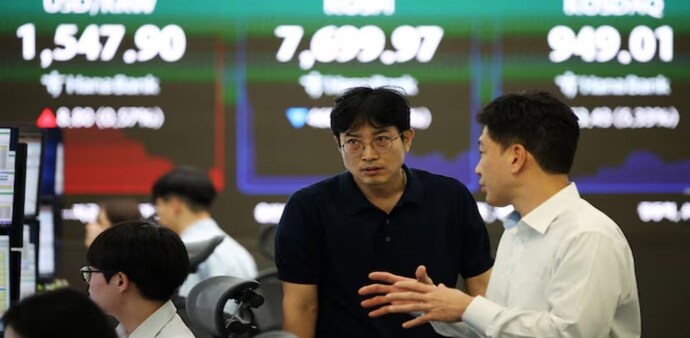
The South Korean equity benchmark Kospi saw a 20-minute trading halt on Friday after plunging 8 per cent intraday, rattling investors. The index remained under pressure after trading resumed and was quoted at 8,265.31, down 645 points, or 7.45 per cent, at 11 am IST. This was the second session of trading halt this week, the first on Tuesday.
Kospi has witnessed sharp swings in recent sessions as concerns mounted over leveraged funds linked to blue-chip stocks, introduced last month, which are believed to have amplified market volatility.
Nenad Dinic, Equity Strategy Research at Julius Baer said the recent volatility is amplified by the rapid growth of leveraged retail instruments that have altered South Korea’s volatility profile in 2026.
"Daily price moves exceeding ±5 per cent in the MSCI Korea Index have occurred on 20 per cent of all trading days this year (23 of 115 sessions), versus just 0.8 per cent in 2025 (2 of 242 sessions). As a result, we believe the large pullback is primarily driven by retail investors using high leverage and forced liquidations on ETFs, rather than a fundamental deterioration in the AI hardware demand cycle," he said earlier on Wednesday.
Siddharth Vora, Fund Manager & Head of Asset Management at PL Capital said the Korean market was highly concentrated. The top five stocks accounted for nearly 70 per cent of the Korean index and about 60 per cent of Taiwan’s market, with Samsung and SK Hynix contributing roughly 45 per cent in Korea.
"This concentration has amplified returns, but it also increases sensitivity to any moderation in AI capex, memory pricing or earnings expectations," Vora said.
He noted that valuations and price momentum also indicate that expectations are elevated, and so the volatility.
"South Korea is trading around 5.9 standard deviations above its five-year average P/E and nearly 50 per cent above its 200-day moving average, while Taiwan is around 2.9 standard deviations above its historical valuation and over 35% above its 200-day average. These are genuine growth markets, but the margin for disappointment has narrowed materially," Vora said.
The South Korean equity benchmark Kospi saw a 20-minute trading halt on Friday after plunging 8 per cent intraday, rattling investors. The index remained under pressure after trading resumed and was quoted at 8,265.31, down 645 points, or 7.45 per cent, at 11 am IST. This was the second session of trading halt this week, the first on Tuesday.
Kospi has witnessed sharp swings in recent sessions as concerns mounted over leveraged funds linked to blue-chip stocks, introduced last month, which are believed to have amplified market volatility.
Nenad Dinic, Equity Strategy Research at Julius Baer said the recent volatility is amplified by the rapid growth of leveraged retail instruments that have altered South Korea’s volatility profile in 2026.
"Daily price moves exceeding ±5 per cent in the MSCI Korea Index have occurred on 20 per cent of all trading days this year (23 of 115 sessions), versus just 0.8 per cent in 2025 (2 of 242 sessions). As a result, we believe the large pullback is primarily driven by retail investors using high leverage and forced liquidations on ETFs, rather than a fundamental deterioration in the AI hardware demand cycle," he said earlier on Wednesday.
Siddharth Vora, Fund Manager & Head of Asset Management at PL Capital said the Korean market was highly concentrated. The top five stocks accounted for nearly 70 per cent of the Korean index and about 60 per cent of Taiwan’s market, with Samsung and SK Hynix contributing roughly 45 per cent in Korea.
"This concentration has amplified returns, but it also increases sensitivity to any moderation in AI capex, memory pricing or earnings expectations," Vora said.
He noted that valuations and price momentum also indicate that expectations are elevated, and so the volatility.
"South Korea is trading around 5.9 standard deviations above its five-year average P/E and nearly 50 per cent above its 200-day moving average, while Taiwan is around 2.9 standard deviations above its historical valuation and over 35% above its 200-day average. These are genuine growth markets, but the margin for disappointment has narrowed materially," Vora said.