
Nvidia, the chipmaking giant's China concerns: What did short seller Culper Research flag in its May report?
Culper Research had disclosed its short position in Nvidia in a report dated May 13, exactly six months ago. Since then, the global chipmaker giant's stock has declined 26.41%, or $59.64.
- Nov 13, 2026,
- Updated Nov 13, 2026 12:25 PM IST
In mid-May, a little-known short seller named after George Washington's Revolutionary War-era spy network raised concerns about Nvidia Corp's exposure to China. The market largely shrugged off the warning then regarding .
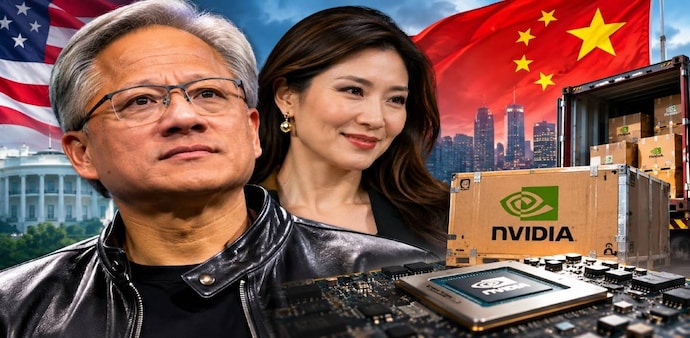
Six months later, Culper Research founder Christian Lamarco is drawing renewed attention to the 40-page report he published on the semiconductor giant. The report, which cited investigations by Bloomberg and The New York Times alongside Culper's own research, raised questions about the relationship between Nvidia's then-CEO Jensen Huang and Alice Huang, an executive at Megaspeed International. It described the alleged extramarital relationship as "uncomfortably close" and referred to Alice Huang as a suspected Chinese spy. The espionage allegation, however, remains unverified.
Huang stepped down on Thursday amid the controversy surrounding the alleged relationship and espionage claims. Nvidia Chief Financial Officer (CFO) Colette Kress has been appointed interim CEO. "The Board is initiating a search for a permanent Chief Executive Officer and will consider internal and external candidates," the company said in a statement.
Culper Research had disclosed its short position in Nvidia in a report dated May 13, exactly six months ago. Since then, the global chipmaker giant's stock has declined 26.41%, or $59.64.
Here's a closer look at the key findings and allegations in Culper Research's report:
-- "Nvidia claims that its business in China went to 'zero' after April 2025 US trade restrictions. We believe that in reality, over 20% of Nvidia's FY 2026 compute revenues remained driven by China – supported both by illegal GPU diversion and Southeast Asian intermediaries.
-- Nvidia has repeatedly vouched for Megaspeed – its single largest Southeast Asian chip buyer currently under investigation by both US Commerce and Singapore authorities – as 'wholly owned and operated by a company based and headquartered outside China, with no China shareholders.' Nvidia has also claimed that it has 'repeatedly tested and sampled data centers around the world and found no diversion.' Documents we uncovered, however, suggest that Megaspeed has been secretly financed by Alibaba via a series of apparent shell companies. Tellingly, Nvidia's lawyered phrasing – that Megaspeed holds no Chinese equity – doesn't seem to preclude Chinese financing. (For the unversed, Alibaba is a Chinese multinational technology and e-commerce conglomerate.)
-- Megaspeed's financial statements reveal that from year-end 2023 to year-end 2024, its balance sheet exploded from just $33 million to $3.0 billion in total liabilities and equity, driven almost entirely by $2.9 billion in 'refundable deposits received' from an un-named source. Megaspeed's financials also show $2.9 billion in 'amounts due from subsidiaries' – money that it forwarded onto its operating subsidiaries such as Malaysia-based Speedmatrix.
-- Malaysian filings reveal that in June 2024 – two months prior to commencing operations – Speedmatrix filed a charge in which it pledged its entire business as collateral to Apex Enterprise Solutions (Singapore). Singapore filings disclose that Apex's corporate parent is Alibaba, and its sole purpose is stated as 'providing procurement activities.' As of March 31, 2025 (latest available), Apex reported over $4.1 billion in prepayments against $4.2 billion in loans payable to Alibaba.
-- Trade records reveal that from December 2024 through January 2026, Speedmatrix imported $4.6 billion in product, of which $4.0 billion originated from Aivres Systems Inc, an Nvidia Elite OEM compute partner that assembles high-end Nvidia-equipped servers.
-- Aivres Systems was formerly known as Inspur Systems Inc., but rebranded after its parent, China-based Inspur Group, was placed on the US entity list. Today, Aivres remains one-third owned by the Chinese state – just under 50% restriction thresholds. Aivres has also supplied servers via Indosat to Shanghai's INF Tech, whose founder is a former Alibaba VP. In March 2026, the WSJ reported that Aivres would supply $2.5 billion in Blackwell chips to a Malaysian operator who would lease the servers to ByteDance. Taken together, it seems to us that Aivres' business remains, in effect, a China-dedicated supply channel.
-- Just last month, Bain's Bridge Data Centres (BDC) reportedly dropped Megaspeed as a tenant. BDC declined to cite why. One source we spoke with, however, suggested that BDC found that Megaspeed had been caught using the data center as 'a place for Megaspeed to install their dummy servers' and 'divert the hardware.'
-- Jensen Huang has not only vouched for Megaspeed, but seems to have quite literally walked alongside Megaspeed at every step, while maintaining an uncomfortably close relationship with Megaspeed's Alice Huang, a Chinese national. He was first spotted partying with Alice Huang in June 2024 – the same month the Apex/Alibaba pledge was filed. He then dined with Alice Huang in Taiwan in May 2025 – just weeks after the news of US trade restrictions. Finally, per one current Megaspeed employee, Jensen visits Megaspeed-linked data centers 'every few months' and 'every single time' he visits, he is accompanied by representatives from Alibaba. The Megaspeed employee characterized their relationship with Jensen as 'very close', corroborating another former Nvidia employee's suggestion to us that many Nvidia employees wondered if there was a special relationship.
-- In March 2026, the DoJ (US Department of Justice) indicted three individuals tied to Supermicro Computer (SMCI), including cofounder Wally Liaw, for allegedly smuggling $2.5 billion of Nvidia-powered servers into China via a Southeast Asian pass-through entity identified only as 'Company-1.' Days ago, Bloomberg reported that 'Company-1' is OBON Corp. (OBON i.e., One Belt One Network), a conclusion we agree with. We think there's far more to the story.
-- However, we believe OBON is affiliated with Megaspeed, and that, in the words of one former high-level Nvidia employee we spoke with, 'Megaspeed is just the tip of the iceberg.' The March 2026 indictment alleged $2.5 billion in smuggling via a single corridor (Supermicro to OBON) – our research suggests this corridor is just one of many in what is a complex and far-flung operation involving multiple additional Nvidia OEMs, partners, and intermediaries.
-- In October 2025, Nvidia partner YTL AI Cloud opened a $4.3 billion data center in Johor, Malaysia, housing Blackwell-equipped servers. A current Megaspeed employee told us that Megaspeed is "one of the most important customers" for YTL, but that the parties conceal the relationship, saying, 'Megaspeed is able to get the supply of the GPUs and supply to the Chinese companies. They don't want the media attention so that it doesn't disrupt their business plans in the data centers.'
-- Nvidia Elite OEM partner Giga Computing has exported over $500 million in H200 and Blackwellequipped servers to Speedmatrix and to Novagate Cloud Bhd. Sdn. (Novagate). Novagate appears to be another Megaspeed offshoot – its website is nearly identical to Megaspeed's website, and one of its directors shares an address with Megaspeed’s corporate headquarters. Novagate's Malaysian subsidiary was incorporated on April 11, 2025 – two days after trade restrictions were announced.
-- Numerous experts told us that Nvidia has long possessed the means to detect diversion, including pre-sale signposts and standard KYC checks – e.g., recently-incorporated customers suddenly placing large orders and sales without warranties – as well as post-sale technical indicators – e.g., server IP data, mismatched server latency times, and servers 'going dark' without explanation.
-- Analysts treat China as potential upside. We believe it's the exact opposite. Nvidia's China business – which the Company told investors went to zero a year ago – is now actually going to zero as Beijing's late 2025 and early 2026 policies have, for example, blocked Nvidia imports in favor of its own domestic alternatives. Beijing's stance appears hardline. Our review of trade records suggests substantial declines in CY Q1 2026 shipments, while mainland operators tell us that there are now 'very few orders' in China, presenting 'a huge blow to Nvidia financially.' Nvidia now faces a massive air gap in this year's estimates."
It is important to note that Business Today has not independently verified the allegations made in Culper Research's report.