
Sensex, Nifty extend losing streak to 4th day as Brent crude nears $100; more downside ahead?
Among the biggest contributors to the Sensex's decline were Reliance Industries Ltd (RIL), HDFC Bank Ltd, Bharti Airtel Ltd, Bajaj Finance Ltd, ICICI Bank Ltd, State Bank of India (SBI), Axis Bank Ltd, Adani Ports and Special Economic Zone Ltd, Larsen & Toubro Ltd (L&T) and InterGlobe Aviation Ltd, the parent of IndiGo.
- Jul 23, 2026,
- Updated Jul 23, 2026 5:52 PM IST
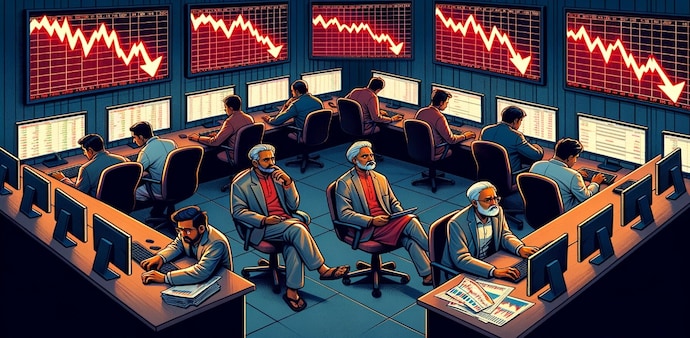
Indian equity benchmarks extended their fall for the fourth consecutive session on Thursday as rising geopolitical tensions and surging crude oil prices weighed on investor sentiment. The 30-share BSE Sensex pack declined 363.66 points or 0.47 per cent to settle at 76,391.39, while the broader NSE Nifty50 index fell 126.65 points or 0.53 per cent to close at 23,869.60.
Among the biggest contributors to the Sensex's decline were Reliance Industries Ltd (RIL), HDFC Bank Ltd, Bharti Airtel Ltd, Bajaj Finance Ltd, ICICI Bank Ltd, State Bank of India (SBI), Axis Bank Ltd, Adani Ports and Special Economic Zone Ltd, Larsen & Toubro Ltd (L&T) and InterGlobe Aviation Ltd, the parent of IndiGo.
Sectoral participation remained largely negative, with realty, energy and banking emerging as the biggest drags. However, buying in select auto and IT heavyweights helped limit the overall losses to some extent.
The broader market continued to underperform the benchmark indices, with both Nifty Smallcap100 and Nifty Midcap100 declining around 1 per cent each, reflecting sustained risk aversion beyond frontline stocks.
Ajit Mishra, SVP (Research) at Religare Broking, said investor sentiment remained subdued as Brent crude prices continued to climb following fresh attacks on oil tankers in the Red Sea, raising concerns over supply disruptions.
"Persistent geopolitical tensions in the Middle East, disappointing quarterly earnings from select large-cap companies, and continued weakness in the rupee further weighed on market sentiment, keeping participants on the sidelines," Mishra said.
Vinod Nair, Head of Research at Geojit Investments, noted that markets were increasingly concerned as crude oil prices approached the $100-a-barrel mark.
"With crude oil prices approaching the $100/bbl amid concerns over further disruptions to global energy supplies, investor sentiment remained subdued as markets reassessed inflation risks and corporate margins," Nair said.
He added that elevated energy prices have strengthened expectations of a higher-for-longer global interest rate environment, reducing risk appetite for emerging markets.
Meanwhile, Brent crude futures were last seen trading more than 5 per cent higher at around $99 per barrel.
Nifty outlook
From a technical perspective, Osho Krishan, Chief Manager – Technical & Derivative Research at Angel One, said the 23,800-23,780 zone would be the immediate support for Nifty50.
"A decisive breach below this range could accelerate selling pressure and trigger fresh short positions, dragging the index towards the 23,650-23,600 range in the intermediate term," he stated.
On the upside, Krishan expects the 24,000-24,100 range to act as a strong resistance.
"Unless the index reclaims this hurdle with strong conviction and sustained buying momentum, the near-term bias is expected to remain fragile," he added.
Indian equity benchmarks extended their fall for the fourth consecutive session on Thursday as rising geopolitical tensions and surging crude oil prices weighed on investor sentiment. The 30-share BSE Sensex pack declined 363.66 points or 0.47 per cent to settle at 76,391.39, while the broader NSE Nifty50 index fell 126.65 points or 0.53 per cent to close at 23,869.60.
Among the biggest contributors to the Sensex's decline were Reliance Industries Ltd (RIL), HDFC Bank Ltd, Bharti Airtel Ltd, Bajaj Finance Ltd, ICICI Bank Ltd, State Bank of India (SBI), Axis Bank Ltd, Adani Ports and Special Economic Zone Ltd, Larsen & Toubro Ltd (L&T) and InterGlobe Aviation Ltd, the parent of IndiGo.
Sectoral participation remained largely negative, with realty, energy and banking emerging as the biggest drags. However, buying in select auto and IT heavyweights helped limit the overall losses to some extent.
The broader market continued to underperform the benchmark indices, with both Nifty Smallcap100 and Nifty Midcap100 declining around 1 per cent each, reflecting sustained risk aversion beyond frontline stocks.
Ajit Mishra, SVP (Research) at Religare Broking, said investor sentiment remained subdued as Brent crude prices continued to climb following fresh attacks on oil tankers in the Red Sea, raising concerns over supply disruptions.
"Persistent geopolitical tensions in the Middle East, disappointing quarterly earnings from select large-cap companies, and continued weakness in the rupee further weighed on market sentiment, keeping participants on the sidelines," Mishra said.
Vinod Nair, Head of Research at Geojit Investments, noted that markets were increasingly concerned as crude oil prices approached the $100-a-barrel mark.
"With crude oil prices approaching the $100/bbl amid concerns over further disruptions to global energy supplies, investor sentiment remained subdued as markets reassessed inflation risks and corporate margins," Nair said.
He added that elevated energy prices have strengthened expectations of a higher-for-longer global interest rate environment, reducing risk appetite for emerging markets.
Meanwhile, Brent crude futures were last seen trading more than 5 per cent higher at around $99 per barrel.
Nifty outlook
From a technical perspective, Osho Krishan, Chief Manager – Technical & Derivative Research at Angel One, said the 23,800-23,780 zone would be the immediate support for Nifty50.
"A decisive breach below this range could accelerate selling pressure and trigger fresh short positions, dragging the index towards the 23,650-23,600 range in the intermediate term," he stated.
On the upside, Krishan expects the 24,000-24,100 range to act as a strong resistance.
"Unless the index reclaims this hurdle with strong conviction and sustained buying momentum, the near-term bias is expected to remain fragile," he added.