
SpaceX weight in Nasdaq 100 to jump to 2.82% following quarterly index rebalance: Report
The recalibration helps narrow a glaring disconnect on Wall Street: despite commanding a market capitalisation exceeding $2 trillion as the seventh-largest constituent in the Nasdaq 100, SpaceX’s initial weighting failed to rank among the benchmark’s top 20 holdings.
- Sep 20, 2026,
- Updated Sep 20, 2026 12:44 PM IST
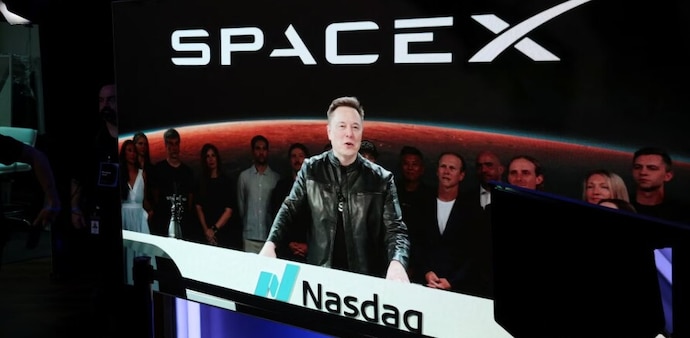
When the Nasdaq 100 Index executes its quarterly rebalance on Monday, SpaceX will see its allocation more than double, taking up 2.82% of the benchmark after previously holding a 1.28% footprint, Bloomberg reported, citing data from the index provider.
The adjustment, calculated using Friday's closing prices, confirms a provisional weighting that brings the space and satellite giant’s benchmark footprint closer to its overall market valuation.
SpaceX made its public debut in July, but post-listing share lockups initially constrained its free-float availability. That dynamic capped its influence on the gauge, even after Nasdaq modified its rules to grant newly listed mega-cap companies faster entry without meeting standard 10% free-float thresholds.
The recalibration helps narrow a glaring disconnect on Wall Street: despite commanding a market capitalisation exceeding $2 trillion as the seventh-largest constituent in the Nasdaq 100, SpaceX’s initial weighting failed to rank among the benchmark’s top 20 holdings.
With post-IPO lockups expiring and more shares becoming freely tradable, passive investment funds and exchange-traded funds tracking the index — such as the $482 billion Invesco QQQ Trust — will be required to adjust their holdings to maintain tracking accuracy.
Analysts estimate the weight increase could spark anywhere between $15.5 billion and $22 billion in passive buying across Nasdaq 100-linked products globally.
SpaceX launches & Future roadmap
SpaceX maintains an aggressive launch cadence while advancing toward ambitious exploration goals centered around its next-generation Starship vehicle and NASA’s Artemis lunar program.
Key scheduled launches
- Starship Integrated Flight Tests: Flight 14 is scheduled for late September from Pad 2 at Starbase, Texas. Key objectives focus on testing upper-stage heat shield resilience, Raptor engine reignition in space, and precise booster catches using the launch tower's "Mechazilla" arms. Subsequent tests will focus on in-space propellant transfer demonstrations in Low Earth Orbit (LEO).
- Commercial Crew & Space Station Operations: The NASA Crew-13 mission is targeted for early October aboard a Falcon 9 and Crew Dragon to transport astronauts to the International Space Station (ISS). Autonomous Cargo Dragon resupply missions also continue regularly.
- Commercial, Science & National Security Payloads: Launches include USSF national security missions (USSF-385, USSF-259, USSF-153) for high-orbit defense satellite placement, the Falcon Heavy launch of NASA's Nancy Grace Roman Space Telescope to study dark energy and exoplanets, and commercial payloads like O3b mPOWER high-throughput communications satellites.
- Starlink Mega-Constellation Deployment: Falcon 9 rockets continue deploying next-generation Direct-to-Cell and v2 mini Starlink satellites every few days from launch sites in Florida (SLC-40/LC-39A) and California (SLC-4E).
Future roadmap & Strategic objectives
- 2027: Starship HLS Uncrewed Lunar Demo: An uncrewed test flight demonstrating the Starship Human Landing System (HLS) docking and lunar surface landing under NASA's Artemis program.
- 2028: Artemis III Crewed Lunar Landing: Delivering NASA astronauts from the Orion spacecraft down to the lunar surface near the Moon's South Pole.
- 2028+: Initial Cargo Missions to Mars: Uncrewed Starship missions targeted toward Mars to validate entry, descent, and landing (EDL) systems while establishing groundwork for local propellant production.
- Long-Term: Starlink V3 & Point-to-Point Travel: Leveraging Starship's payload capacity to launch massive V3 Starlink satellites, along with evaluating sub-orbital point-to-point human travel on Earth.
When the Nasdaq 100 Index executes its quarterly rebalance on Monday, SpaceX will see its allocation more than double, taking up 2.82% of the benchmark after previously holding a 1.28% footprint, Bloomberg reported, citing data from the index provider.
The adjustment, calculated using Friday's closing prices, confirms a provisional weighting that brings the space and satellite giant’s benchmark footprint closer to its overall market valuation.
SpaceX made its public debut in July, but post-listing share lockups initially constrained its free-float availability. That dynamic capped its influence on the gauge, even after Nasdaq modified its rules to grant newly listed mega-cap companies faster entry without meeting standard 10% free-float thresholds.
The recalibration helps narrow a glaring disconnect on Wall Street: despite commanding a market capitalisation exceeding $2 trillion as the seventh-largest constituent in the Nasdaq 100, SpaceX’s initial weighting failed to rank among the benchmark’s top 20 holdings.
With post-IPO lockups expiring and more shares becoming freely tradable, passive investment funds and exchange-traded funds tracking the index — such as the $482 billion Invesco QQQ Trust — will be required to adjust their holdings to maintain tracking accuracy.
Analysts estimate the weight increase could spark anywhere between $15.5 billion and $22 billion in passive buying across Nasdaq 100-linked products globally.
SpaceX launches & Future roadmap
SpaceX maintains an aggressive launch cadence while advancing toward ambitious exploration goals centered around its next-generation Starship vehicle and NASA’s Artemis lunar program.
Key scheduled launches
- Starship Integrated Flight Tests: Flight 14 is scheduled for late September from Pad 2 at Starbase, Texas. Key objectives focus on testing upper-stage heat shield resilience, Raptor engine reignition in space, and precise booster catches using the launch tower's "Mechazilla" arms. Subsequent tests will focus on in-space propellant transfer demonstrations in Low Earth Orbit (LEO).
- Commercial Crew & Space Station Operations: The NASA Crew-13 mission is targeted for early October aboard a Falcon 9 and Crew Dragon to transport astronauts to the International Space Station (ISS). Autonomous Cargo Dragon resupply missions also continue regularly.
- Commercial, Science & National Security Payloads: Launches include USSF national security missions (USSF-385, USSF-259, USSF-153) for high-orbit defense satellite placement, the Falcon Heavy launch of NASA's Nancy Grace Roman Space Telescope to study dark energy and exoplanets, and commercial payloads like O3b mPOWER high-throughput communications satellites.
- Starlink Mega-Constellation Deployment: Falcon 9 rockets continue deploying next-generation Direct-to-Cell and v2 mini Starlink satellites every few days from launch sites in Florida (SLC-40/LC-39A) and California (SLC-4E).
Future roadmap & Strategic objectives
- 2027: Starship HLS Uncrewed Lunar Demo: An uncrewed test flight demonstrating the Starship Human Landing System (HLS) docking and lunar surface landing under NASA's Artemis program.
- 2028: Artemis III Crewed Lunar Landing: Delivering NASA astronauts from the Orion spacecraft down to the lunar surface near the Moon's South Pole.
- 2028+: Initial Cargo Missions to Mars: Uncrewed Starship missions targeted toward Mars to validate entry, descent, and landing (EDL) systems while establishing groundwork for local propellant production.
- Long-Term: Starlink V3 & Point-to-Point Travel: Leveraging Starship's payload capacity to launch massive V3 Starlink satellites, along with evaluating sub-orbital point-to-point human travel on Earth.