
Inflation may stay at 5.5–6% for three quarters: What does it mean for debt mutual fund investors?
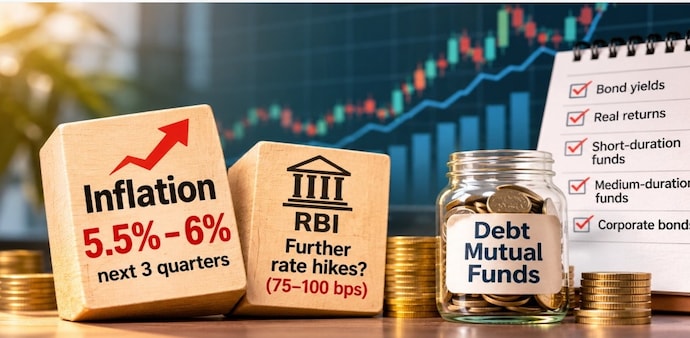
Inflation is expected to remain at 5.5–6% over the next three quarters, with bond markets pricing in additional RBI rate hikes of 75–100 basis points. Mirae Asset Mutual Fund recommends staggered investments in corporate bonds and aligning debt fund allocations with investment horizons to navigate interest rate uncertainty.
- Nov 27, 2026,
- Updated Nov 27, 2026 7:10 AM IST
Persistent inflation, geopolitical uncertainty and expectations of further monetary tightening could influence debt mutual fund returns over the coming months. However, with bond markets already factoring in several adverse developments, elevated yields could offer selective investment opportunities for fixed-income investors.
According to Basant Bafna, Head of Fixed Income, Mirae Asset Mutual Fund, inflation is expected to remain between 5.5% and 6% over the next three quarters, close to the upper end of the Reserve Bank of India's (RBI) tolerance band.
Have bond markets already priced in inflation risks?
Despite some moderation in international crude oil prices, bond yields remain elevated, reflecting uncertainty surrounding geopolitical developments and future monetary policy actions.
“Yields in the Short and Medium Duration segments are forward looking in nature and are currently pricing in most of the negative events. Even as crude has fallen post-mid-terms to USD 90-95 per barrel, yields are still - 30-35 bps higher vis-à-vis yields in end-August 2026 when crude was at similar levels as markets continue to await clarity in relation to resolution on the geopolitical front,” Bafna said.
Markets factoring in further rate hikes
Higher interest rates generally put downward pressure on existing bond prices, while persistent inflation can erode investors' inflation-adjusted returns. However, much will depend on whether actual monetary policy decisions differ from market expectations.
“While the Money Market curve remains backward-looking and reacts to policy actions based on actual events, the Corporate Bond Curve is forward-looking and reacts based on anticipated policy actions. Hence, forward-looking inflation holds greater importance than near-term prints when considering short- and medium-duration funds. Inflation for the next 3 quarters is expected to remain in the upper end of RBI's tolerance band (5.50-6.00%) and hence the OIS curve is still factoring in an additional 75-100 bps hike between now and February. Yields are expected to move based on actual policy actions vs expectations, which would in turn drive debt fund returns,” Bafna said.
Short-duration versus medium-duration funds
Investors should align their debt fund allocations with their financial goals and investment horizon.
“While undertaking investment allocations, investors should duly consider their investment horizon vis-a-vis the duration of the underlying schemes being considered. Ideally, investors with an investment horizon of 1-2 years should consider Short Duration Categories whereas investors with an investment horizon of 3+ years should consider Medium Duration funds,” Bafna said.
Are corporate bond funds becoming attractive?
Bafna recommends staggered investments to capitalise on elevated corporate bond spreads.
“Yes, as corporate bond spreads are significantly higher vis-à-vis historical averages, in our view, as most of the negatives are already priced in, we would recommend investors build exposures in a calibrated manner, in stages over the next two to three months, adding on yield spikes around data and policy events. While prolonged geopolitical escalations resulting in a prolonged spike in crude, higher global yields and a deeper El Nino impact on food prices, any of which could extend the cycle, remain key risks to the outlook, fundamental as well as technical factors remain supportive.”