
India’s e-visa portal tests travellers before their journey has even begun
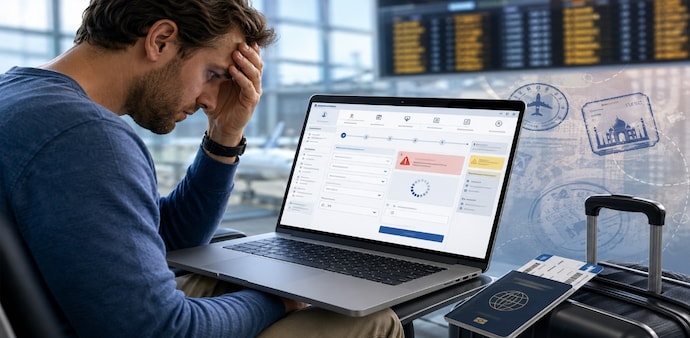
International travellers face difficulty finding the correct application page, understanding which form applies to them, uploading documents and tracking the status of their applications
- Jun 29, 2026,
- Updated Jun 29, 2026 2:55 PM IST
For one woman travelling from the United States to meet her fiancé’s family in India, the journey ended before she could reach her destination.
According to this social media account, she completed the required e-arrival or pre-arrival application before leaving the US. But the expected update did not arrive while she was in transit. She remained stranded in Dubai for about a week before eventually returning to the United States.
The account reflects a wider frustration among travellers trying to navigate India’s online visa and arrival systems. Applicants have complained about confusing pages, unclear instructions, slow responses and websites that are difficult to use on mobile devices.
More than a dated interface
The complaints are not limited to how the portal looks. Users face difficulty finding the correct application page, understanding which form applies to them, uploading documents and tracking the status of their applications.
The experience can become especially stressful when travel dates are approaching and there is no clear update.
The Economist recently highlighted similar concerns about indianvisaonline.gov.in, describing a process better suited to a laptop than a mobile phone. It pointed to dated design elements and a user journey that can make even a basic application difficult to complete.
“We need to build tourist-friendly UI,” one X user wrote, arguing that India should be drawing many times its current number of visitors given its tourism potential.
Frustration turns into sarcasm
Some users have responded with sarcasm. One joked that the website had been deliberately slowed to ensure that only “serious visitors” made it through. Another compared navigating the portal with the patience required to travel on India’s roads and trains.
Behind the jokes is a more serious concern: India wants to attract significantly more international tourists, but the visa portal is often the first interaction a prospective visitor has with the country.
Paper processes moved online
The visa portal is part of a wider challenge facing government websites in India. Many public services have moved online, including railway bookings, tax filings, voter registration and education-related applications.
The scale of this digitisation has made services more accessible, but the quality of the user experience varies considerably.
One explanation is that several services were initially digitised by transferring existing paper-based procedures onto a website rather than redesigning the entire process around the user. Forms, approvals and departmental requirements remained largely unchanged even when they were moved online.
User experience, or UX, became part of the official guidelines for Indian government websites only in 2023, according to The Economist.
Multiple departments, one crowded portal
The National Informatics Centre, the government’s main technology provider, develops and manages a large number of public-sector websites.
These projects often involve multiple ministries and departments, each with its own information, compliance and security requirements. The result can be a portal filled with necessary details but lacking a simple route for the applicant.
A visitor’s first experience of India
The challenge is to apply those lessons to routine public-facing services.
For international travellers, a visa portal is not merely another government website. It is often their first practical experience of India. A clear application process, a mobile-friendly interface and timely status updates can influence how easily they plan their visit, and whether they complete the journey at all.
For one woman travelling from the United States to meet her fiancé’s family in India, the journey ended before she could reach her destination.
According to this social media account, she completed the required e-arrival or pre-arrival application before leaving the US. But the expected update did not arrive while she was in transit. She remained stranded in Dubai for about a week before eventually returning to the United States.
The account reflects a wider frustration among travellers trying to navigate India’s online visa and arrival systems. Applicants have complained about confusing pages, unclear instructions, slow responses and websites that are difficult to use on mobile devices.
More than a dated interface
The complaints are not limited to how the portal looks. Users face difficulty finding the correct application page, understanding which form applies to them, uploading documents and tracking the status of their applications.
The experience can become especially stressful when travel dates are approaching and there is no clear update.
The Economist recently highlighted similar concerns about indianvisaonline.gov.in, describing a process better suited to a laptop than a mobile phone. It pointed to dated design elements and a user journey that can make even a basic application difficult to complete.
“We need to build tourist-friendly UI,” one X user wrote, arguing that India should be drawing many times its current number of visitors given its tourism potential.
Frustration turns into sarcasm
Some users have responded with sarcasm. One joked that the website had been deliberately slowed to ensure that only “serious visitors” made it through. Another compared navigating the portal with the patience required to travel on India’s roads and trains.
Behind the jokes is a more serious concern: India wants to attract significantly more international tourists, but the visa portal is often the first interaction a prospective visitor has with the country.
Paper processes moved online
The visa portal is part of a wider challenge facing government websites in India. Many public services have moved online, including railway bookings, tax filings, voter registration and education-related applications.
The scale of this digitisation has made services more accessible, but the quality of the user experience varies considerably.
One explanation is that several services were initially digitised by transferring existing paper-based procedures onto a website rather than redesigning the entire process around the user. Forms, approvals and departmental requirements remained largely unchanged even when they were moved online.
User experience, or UX, became part of the official guidelines for Indian government websites only in 2023, according to The Economist.
Multiple departments, one crowded portal
The National Informatics Centre, the government’s main technology provider, develops and manages a large number of public-sector websites.
These projects often involve multiple ministries and departments, each with its own information, compliance and security requirements. The result can be a portal filled with necessary details but lacking a simple route for the applicant.
A visitor’s first experience of India
The challenge is to apply those lessons to routine public-facing services.
For international travellers, a visa portal is not merely another government website. It is often their first practical experience of India. A clear application process, a mobile-friendly interface and timely status updates can influence how easily they plan their visit, and whether they complete the journey at all.