
'Remove 18% GST on group health cover': Dr Devi Shetty's demand that could make insurance cheaper
The Centre last year exempted individual health policies from GST while retaining the levy on group and employer-sponsored health policies.
- Nov 26, 2026,
- Updated Nov 26, 2026 2:56 PM IST
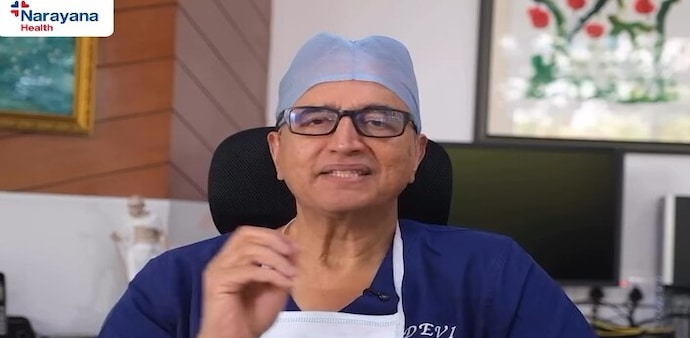
Narayana Health founder Dr Devi Shetty has called for the removal of the 18 per cent goods and services tax (GST) on group health insurance, saying the levy restricts access to medical cover for workers in the informal and gig economies.
He said India could make quality healthcare independent of a person’s wealth within the next five to seven years by lowering treatment costs, using hospital and diagnostic infrastructure more efficiently, expanding preventive screening and developing smaller hospitals for middle-class patients.
Why Shetty wants GST removed
Group insurance is particularly important for informal and gig workers, who may find it difficult to buy individual health cover, Shetty told The Economic Times. “They have to remove the 18% GST on group insurance,” he said.
He said the tax becomes significant when insurers offer policies with relatively low premiums of ₹5,000, ₹10,000 or ₹20,000. The tax is ultimately added to the premiums paid by subscribers.
Narayana Health is exploring ways to extend insurance to groups such as autorickshaw drivers. It is working with Namma Yatri on a pilot involving about 5,000 drivers.
The Centre last year exempted individual health policies from GST while retaining the levy on group and employer-sponsored health policies.
Lowering healthcare costs
Shetty said India could become the first country to demonstrate that the quality of healthcare received by a citizen need not depend on the wealth of the individual or family.
India has expanded medical education, while private investment has added hospital beds, particularly in large cities. However, patients’ ability to pay for treatment remains a major problem, he said.
Shetty said average occupancy at Indian corporate hospitals was 50-60 per cent despite demand for treatment. As hospitals are largely fixed-cost businesses, higher utilisation could spread costs across more patients and help reduce treatment prices.
Greater use of diagnostic equipment such as CT scanners could similarly reduce the cost per test and make preventive screening affordable for more people. Wider screening could also help detect cardiovascular disease and cancer earlier, reducing treatment costs and mortality.
Smaller hospitals for middle-class patients
Narayana Health plans to demonstrate its affordability model through smaller hospitals for middle-class patients earning ₹30,000 to ₹60,000 a month.
The healthcare provider wants to expand the model through hospitals with about 100-150 beds, while using its larger infrastructure and digital capabilities to centralise support functions.
GST Council proposal
The GST Council on Thursday recommended amending Section 17(5) of the Central Goods and Services Tax Act, 2017, to remove restrictions on input tax credit for health and life insurance, among other expenses. Legal changes will be required before eligible businesses can claim the credit.
Group health and life insurance premiums generally attract 18 per cent GST. Employers could not ordinarily claim credit for this tax unless an applicable exception allowed it, adding to the cost of providing employee insurance.
For example, a company paying an annual group health insurance premium of ₹10 lakh also pays ₹1.8 lakh in GST, taking its total bill to ₹11.8 lakh. If the entire GST amount becomes eligible for input tax credit and the company can use it, the effective cost could fall to ₹10 lakh.
What businesses could benefit?
The benefit will depend on a business’s eligibility and its ability to use the credit against its GST liability. It will not be an automatic cash refund.
The recommendation also does not require employers to pass the savings on to employees. Companies could use the savings to increase the sum insured, extend coverage to dependants, add benefits or improve access to preventive healthcare. They could also retain the money for operating expenses or expansion.
Smaller businesses could benefit from a lower effective cost as they often have to balance employee benefits against tight budgets and cash-flow requirements. However, the proposed change will take effect only after amendments to the CGST Act and rules are notified. Employers will also have to maintain proper tax invoices and meet the applicable input tax credit conditions.