
Plot or apartment near Mumbai? Five risks buyers must check before investing in Khopoli real estate
As major developers expand plotted housing projects in Khopoli near Mumbai, buyers are weighing the flexibility of owning land against the convenience of apartments. However, title disputes, regulatory approvals, hidden construction costs and resale risks could turn a promising investment into a costly mistake.
- Nov 11, 2026,
- Updated Nov 11, 2026 3:45 AM IST
Buying a residential plot near Mumbai may offer greater flexibility and long-term appreciation potential than an apartment, but it also comes with additional risks. As developers expand into Khopoli and the Panvel–Karjat corridor, investors must examine land ownership, legal approvals, infrastructure costs and resale prospects before committing their savings.
Plotted developments are gaining attention among second-home buyers and families seeking larger living spaces, customised homes and greener surroundings.
Khopoli, located along the Mumbai–Pune Expressway, is emerging as a destination for such investments, supported by improving connectivity and interest from organised developers.
Shapoorji Pallonji Real Estate has announced a 900-acre plotted township with estimated gross development value exceeding ₹6,000 crore. NeoLiv has acquired 76 acres for a proposed ₹800-crore mixed-use development comprising plots, villas and retail facilities.
However, buying land differs significantly from purchasing a ready-to-move-in apartment.
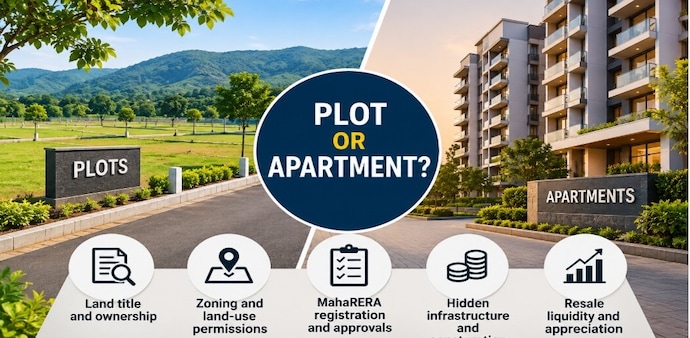
1. Land ownership and title disputes
Clear ownership is the first requirement when purchasing a plot.
Buyers should examine the chain of title, registered sale deeds, encumbrance records, mutation entries and Maharashtra's 7/12 land extracts, where applicable.
They must also check for outstanding loans, inheritance disputes, litigation or restrictions on transferring the property.
A developer's reputation does not replace independent legal due diligence.
2. Zoning and land-use permissions
Not every parcel of land can legally accommodate a residential home.
Investors should verify whether the plot falls within an approved residential zone and whether non-agricultural (NA) conversion or other land-use permissions are required.
Purchasing agricultural land without understanding applicable restrictions can create serious legal complications.
3. MahaRERA registration and development approvals
Buyers should check whether the plotted project requires registration under the Maharashtra Real Estate Regulatory Authority (MahaRERA).
For applicable projects, registration details, sanctioned layouts, development permissions and declared completion timelines should be verified on the regulator's website.
Importantly, MahaRERA registration does not guarantee investment returns or eliminate execution risks.
4. Hidden infrastructure and construction costs
An apartment generally comes with a defined built-up structure, whereas purchasing a plot may involve substantial additional expenditure.
Beyond the land price, buyers should budget for stamp duty, registration, construction, utility connections, compound walls, drainage, maintenance and applicable development charges.
In managed plotted communities, investors must verify which amenities are included and when they will become operational.
5. Resale liquidity and uncertain appreciation
Plots may take longer to sell than apartments, particularly in emerging locations with limited end-user demand.
Infrastructure announcements, including improved airport connectivity, can support sentiment but do not guarantee price appreciation.
Investors should assess actual transactions, nearby occupancy, employment opportunities and local infrastructure rather than relying solely on projected returns.
Plot versus apartment: What should buyers choose?
A plot may suit buyers seeking customisation and willing to manage construction and longer holding periods.
Apartments may offer easier occupancy, established amenities and potentially more predictable rental opportunities.
Ultimately, buyers should prioritise legal clarity, affordability, infrastructure readiness and liquidity over speculative appreciation.