
1,000 times faster than Hubble: Why NASA’s Roman telescope will map the dark universe
Roman is not designed simply to produce spectacular space images. Its primary mission is to survey enormous portions of the sky and investigate some of modern astronomy’s biggest unanswered questions.
- Aug 30, 2026,
- Updated Aug 30, 2026 8:30 PM IST
The search for the universe’s biggest secrets has entered a new phase. NASA’s Nancy Grace Roman Space Telescope blasted off on August 30, 2026, beginning a roughly three-month journey to a vantage point nearly one million miles from Earth.
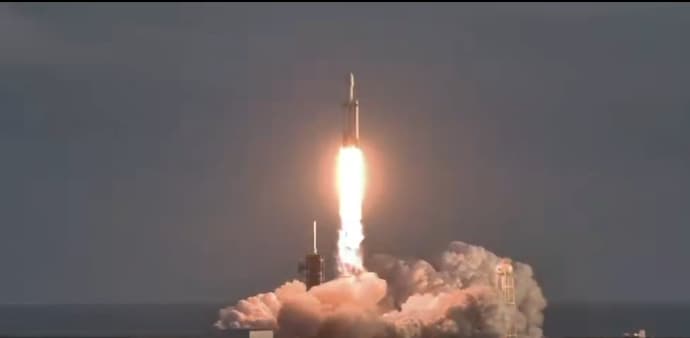
A SpaceX Falcon Heavy launched Roman at 7:26 a.m. EDT from Launch Complex 39A at NASA’s Kennedy Space Center in Florida. The observatory separated from the rocket about 31 minutes into the flight, while its solar panels were successfully deployed about 83 minutes after launch.
Roman is not designed simply to produce spectacular space images. Its primary mission is to survey enormous portions of the sky and investigate some of modern astronomy’s biggest unanswered questions.
Where is Roman going?
Roman is travelling toward the second Sun-Earth Lagrange point, or L2, about 930,000 miles (1.5 million km) from Earth.
This region, on the opposite side of Earth from the Sun, offers a relatively stable environment for an infrared telescope. Roman will operate in a halo orbit around L2, allowing it to maintain a favourable view of the cosmos while keeping sunlight and heat away from its sensitive instruments.
NASA expects the journey and initial commissioning phase to take about three months. The agency anticipates releasing Roman's first images in early 2027.
What makes Roman different?
Roman's greatest strength is not simply the size of its mirror. It is the amount of sky it can see at once.
The telescope has a 2.4-metre primary mirror, roughly the same diameter as Hubble's. But its Wide Field Instrument can capture an area of sky at least 100 times larger than Hubble's field of view, while maintaining comparable image sharpness and sensitivity.
That makes Roman less like a telescope that stares intensely at one cosmic target and more like a giant astronomical survey camera.
NASA estimates that Roman will be capable of surveying the universe roughly 1,000 times faster than Hubble. Its 300-megapixel infrared camera will collect enormous quantities of data, creating a detailed map of the cosmos over large areas.
The dark universe
One of Roman's central missions is to understand dark energy, the mysterious phenomenon believed to be responsible for the accelerating expansion of the universe.
Astronomers know that the universe is expanding, but the precise nature of dark energy remains unknown. Roman will examine how galaxies and cosmic structures have evolved over billions of years, helping scientists trace how the expansion of the universe changed over time.
It will also investigate dark matter, the invisible material whose gravitational influence helps shape galaxies and large-scale cosmic structures.
By mapping huge numbers of galaxies and measuring their distances and shapes, Roman could provide one of the most comprehensive pictures yet of how the visible universe is organised.
A massive hunt for exoplanets
Roman will also turn its attention toward the Milky Way. Using a technique called gravitational microlensing, astronomers will look for tiny changes in the brightness of stars when the gravity of a foreground object bends and magnifies light from a more distant star.
This method can reveal planets that are difficult to find using conventional techniques. NASA expects Roman's microlensing survey to discover more than 1,000 exoplanets, potentially expanding our knowledge of planetary systems across the Milky Way.
The telescope will therefore complement missions such as NASA's Kepler and TESS, which have focused heavily on finding planets that pass in front of their host stars.
Roman will also test technology for finding other Earths
Roman carries a second major instrument: the Coronagraph Instrument. A coronagraph blocks the overwhelming glare of a star, making it possible to detect much fainter objects orbiting nearby stars.
Roman's coronagraph is primarily a technology demonstration rather than the mission's main scientific instrument. It will test advanced methods for directly imaging and studying planets around other stars.
NASA sees this as an important stepping stone toward future observatories designed to directly image potentially Earth-like planets and examine their atmospheres for signs that could indicate habitability or life.
How Roman fits between Hubble & Webb
Roman does not replace either the Hubble Space Telescope or the James Webb Space Telescope. Instead, the three observatories have different strengths.
Hubble is renowned for high-resolution observations across visible, ultraviolet and some infrared wavelengths. Webb operates primarily in infrared and is exceptionally powerful for studying distant galaxies, stars, planetary systems and the early universe.
Where Webb can examine individual objects in extraordinary detail, Roman can survey huge areas of the sky quickly. NASA describes the telescope as a wide-eyed counterpart to Hubble: its images will cover vastly more sky in a single observation while retaining sharpness.
That combination could also allow astronomers to use Roman to identify interesting targets that Webb and other telescopes can subsequently study in greater detail.
NASA says the spacecraft will transmit about 1.4 terabytes of data every day, making it the highest data-rate NASA astrophysics mission so far. Artificial intelligence, machine learning and citizen scientists will help sift through the data and identify potentially important discoveries.
Who was Nancy Grace Roman?
The telescope is named after Nancy Grace Roman, NASA's first chief astronomer and one of the key figures in establishing the agency's space astronomy programme.
Roman played an important role in developing NASA's early astronomical missions and was instrumental in advancing the concept that eventually led to the Hubble Space Telescope.
The observatory bearing her name is therefore designed to continue that legacy — not by replacing Hubble, but by opening a much wider window on the universe. NASA expects the primary science mission to last five years, with enough capability for a potential additional five-year extended mission.
The search for the universe’s biggest secrets has entered a new phase. NASA’s Nancy Grace Roman Space Telescope blasted off on August 30, 2026, beginning a roughly three-month journey to a vantage point nearly one million miles from Earth.
A SpaceX Falcon Heavy launched Roman at 7:26 a.m. EDT from Launch Complex 39A at NASA’s Kennedy Space Center in Florida. The observatory separated from the rocket about 31 minutes into the flight, while its solar panels were successfully deployed about 83 minutes after launch.
Roman is not designed simply to produce spectacular space images. Its primary mission is to survey enormous portions of the sky and investigate some of modern astronomy’s biggest unanswered questions.
Where is Roman going?
Roman is travelling toward the second Sun-Earth Lagrange point, or L2, about 930,000 miles (1.5 million km) from Earth.
This region, on the opposite side of Earth from the Sun, offers a relatively stable environment for an infrared telescope. Roman will operate in a halo orbit around L2, allowing it to maintain a favourable view of the cosmos while keeping sunlight and heat away from its sensitive instruments.
NASA expects the journey and initial commissioning phase to take about three months. The agency anticipates releasing Roman's first images in early 2027.
What makes Roman different?
Roman's greatest strength is not simply the size of its mirror. It is the amount of sky it can see at once.
The telescope has a 2.4-metre primary mirror, roughly the same diameter as Hubble's. But its Wide Field Instrument can capture an area of sky at least 100 times larger than Hubble's field of view, while maintaining comparable image sharpness and sensitivity.
That makes Roman less like a telescope that stares intensely at one cosmic target and more like a giant astronomical survey camera.
NASA estimates that Roman will be capable of surveying the universe roughly 1,000 times faster than Hubble. Its 300-megapixel infrared camera will collect enormous quantities of data, creating a detailed map of the cosmos over large areas.
The dark universe
One of Roman's central missions is to understand dark energy, the mysterious phenomenon believed to be responsible for the accelerating expansion of the universe.
Astronomers know that the universe is expanding, but the precise nature of dark energy remains unknown. Roman will examine how galaxies and cosmic structures have evolved over billions of years, helping scientists trace how the expansion of the universe changed over time.
It will also investigate dark matter, the invisible material whose gravitational influence helps shape galaxies and large-scale cosmic structures.
By mapping huge numbers of galaxies and measuring their distances and shapes, Roman could provide one of the most comprehensive pictures yet of how the visible universe is organised.
A massive hunt for exoplanets
Roman will also turn its attention toward the Milky Way. Using a technique called gravitational microlensing, astronomers will look for tiny changes in the brightness of stars when the gravity of a foreground object bends and magnifies light from a more distant star.
This method can reveal planets that are difficult to find using conventional techniques. NASA expects Roman's microlensing survey to discover more than 1,000 exoplanets, potentially expanding our knowledge of planetary systems across the Milky Way.
The telescope will therefore complement missions such as NASA's Kepler and TESS, which have focused heavily on finding planets that pass in front of their host stars.
Roman will also test technology for finding other Earths
Roman carries a second major instrument: the Coronagraph Instrument. A coronagraph blocks the overwhelming glare of a star, making it possible to detect much fainter objects orbiting nearby stars.
Roman's coronagraph is primarily a technology demonstration rather than the mission's main scientific instrument. It will test advanced methods for directly imaging and studying planets around other stars.
NASA sees this as an important stepping stone toward future observatories designed to directly image potentially Earth-like planets and examine their atmospheres for signs that could indicate habitability or life.
How Roman fits between Hubble & Webb
Roman does not replace either the Hubble Space Telescope or the James Webb Space Telescope. Instead, the three observatories have different strengths.
Hubble is renowned for high-resolution observations across visible, ultraviolet and some infrared wavelengths. Webb operates primarily in infrared and is exceptionally powerful for studying distant galaxies, stars, planetary systems and the early universe.
Where Webb can examine individual objects in extraordinary detail, Roman can survey huge areas of the sky quickly. NASA describes the telescope as a wide-eyed counterpart to Hubble: its images will cover vastly more sky in a single observation while retaining sharpness.
That combination could also allow astronomers to use Roman to identify interesting targets that Webb and other telescopes can subsequently study in greater detail.
NASA says the spacecraft will transmit about 1.4 terabytes of data every day, making it the highest data-rate NASA astrophysics mission so far. Artificial intelligence, machine learning and citizen scientists will help sift through the data and identify potentially important discoveries.
Who was Nancy Grace Roman?
The telescope is named after Nancy Grace Roman, NASA's first chief astronomer and one of the key figures in establishing the agency's space astronomy programme.
Roman played an important role in developing NASA's early astronomical missions and was instrumental in advancing the concept that eventually led to the Hubble Space Telescope.
The observatory bearing her name is therefore designed to continue that legacy — not by replacing Hubble, but by opening a much wider window on the universe. NASA expects the primary science mission to last five years, with enough capability for a potential additional five-year extended mission.