
49 years out: How Voyager 1 survives deep space as it hits the one light-day mark
Launched on September 5, 1977, Voyager 1 originally had a primary mission profile limited to investigating Jupiter and Saturn. Its initial engineering design anticipated a functional lifespan of barely five years.
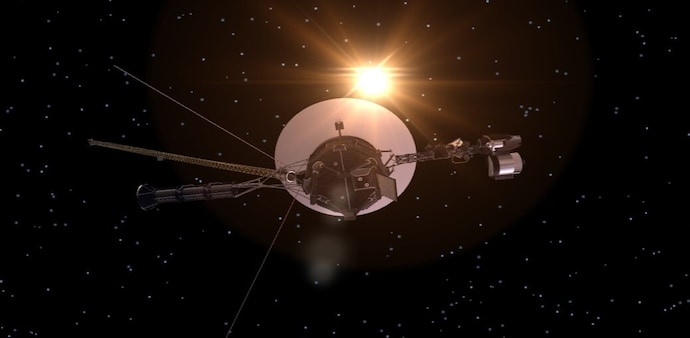
- Nov 5, 2026,
- Updated Nov 5, 2026 11:15 AM IST
Across the abyss of interstellar space, NASA’s Voyager 1 is hurtling toward a threshold once confined to science fiction. Nearly 49 years after launching from Cape Canaveral on a modest grand tour of the outer planets, the veteran spacecraft is on the cusp of a staggering milestone: traversing a distance of one light-day from Earth.
At 16.09 billion miles (25.9 billion km) away and racing outward at roughly 38,000 miles per hour, the probe's radio signals now take nearly 24 hours to complete a single one-way trip to NASA’s Deep Space Network dishes on Earth. It stands unmatched as the most distant human-made object in history, operating deep within the uncharted realm of interstellar space.
Legacy born of ingenuity
Launched on September 5, 1977, Voyager 1 originally had a primary mission profile limited to investigating Jupiter and Saturn. Its initial engineering design anticipated a functional lifespan of barely five years. Instead, it leveraged planetary gravitational assists to rewrite our solar system's textbook before marching out into the cosmic void.
In August 2012, Voyager 1 crossed the heliopause — the outer boundary of the Sun's magnetic bubble — becoming the first emissary of humankind to enter the interstellar medium.
Yet keeping the aging pioneer alive has increasingly become a masterclass in interplanetary engineering. Powered by decaying plutonium radioisotope thermoelectric generators (RTGs), the spacecraft loses roughly 4 watts of electrical power every year. To stave off total blackout, NASA’s Jet Propulsion Laboratory mission operators have systematically shut down non-essential systems, heaters, and secondary science instruments over the decades.
Surviving the twilight years
The mission’s longevity has continually faced existential threats. Engineers have successfully navigated through severe computer memory faults, clogged thruster fuel lines, and unexpected telemetry anomalies by writing ingenious remote patches across billions of miles of space. Most recently, flight controllers executed a strategic power-saving maneuver — affectionately dubbed the "Big Bang" — swapping high-consumption operations for alternative low-power configurations to preserve the craft's remaining core instruments, ensuring it can continue transmitting telemetry data through the late 2030s.
Today, operating on deeply reduced power with its remaining core systems — including its magnetometer and plasma wave subsystem — Voyager 1 samples the ambient density and magnetic architecture of deep space beyond our solar neighborhood.
Even when its generators eventually fade into silence, Voyager 1 will endure. Locked on a trajectory toward the constellation Ophiuchus, the spacecraft carries the Voyager Golden Record — a gold-plated copper phonograph disk packed with greetings in 55 languages, Earth's natural sounds, musical selections ranging from Bach to Chuck Berry, and encoded images portraying life and culture on Earth.