
66 billion trees: China's great green wall offers climate hope — but not a complete solution
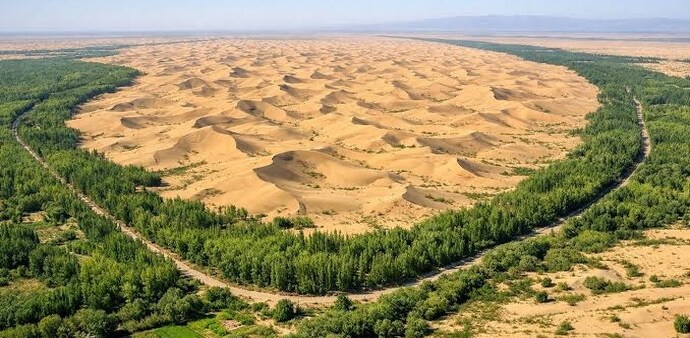
The project aims to reduce desertification, curb dust storms, restore degraded land and increase carbon absorption. China plans to continue expanding the forest belt with billions more trees over the coming decades.
- Jul 7, 2026,
- Updated Jul 7, 2026 7:30 AM IST
For nearly five decades, China has pursued one of the most ambitious environmental projects ever attempted — planting billions of trees across its arid north to halt advancing deserts. Today, that effort is delivering a remarkable result: the country's human-planted forests are growing significantly faster than its natural forests.
A new study has found that forests created under China's vast reforestation drive are expanding their leafy canopy around 66% faster than naturally occurring forests. While the finding underscores the potential of large-scale tree planting in fighting climate change, researchers caution that rapid growth does not automatically translate into long-term ecological success.
Forest built by human hands
China launched the Three-North Shelterbelt Program, often called the Great Green Wall, in 1978 to combat the relentless expansion of the Gobi and Taklamakan deserts. Since then, roughly 66 billion trees have been planted, making it the world's largest afforestation initiative.
The project aims to reduce desertification, curb dust storms, restore degraded land and increase carbon absorption. China plans to continue expanding the forest belt with billions more trees over the coming decades.
Why are planted forests growing faster?
Researchers used satellite observations to compare planted forests with natural ones, focusing on the Leaf Area Index (LAI) — a measure of canopy density closely linked to photosynthesis and carbon uptake.
They discovered that planted forests increased their leaf area 66% faster than natural forests.
The primary reason is simple: most planted forests are relatively young. Young trees naturally grow faster than mature forests, producing denser canopies and absorbing carbon dioxide at a higher rate during their early decades.
However, age was not the only factor. Even after comparing forests of similar age and environmental conditions, planted forests still showed around 4.6% faster growth.
The human advantage
Scientists say active forest management also plays a major role. Many of China's plantations consist of fast-growing species such as poplar and eucalyptus, which are selected specifically for rapid biomass production. These forests are also managed through practices including vegetation clearing and, in some cases, fertilisation, reducing competition for water, sunlight and nutrients.
Combined with rising atmospheric carbon dioxide levels, these conditions allow planted forests to grow more aggressively than their natural counterparts.
Growth doesn't last forever
The researchers stress that the growth advantage has limits.
The study found that planted forests perform best when trees are roughly 30 to 40 years old. After that, their growth rate slows considerably.
Natural forests, by contrast, grow more gradually but continue accumulating biomass over much longer periods. This makes them more resilient ecosystems and often better suited for sustained carbon storage over decades or centuries.
In other words, planted forests can deliver a rapid climate benefit, but natural forests remain indispensable for long-term environmental stability.
Carbon storage is more complicated
Experts not involved in the study note that leaf area tells only part of the story. While denser canopies generally indicate higher photosynthesis, carbon is stored throughout a forest — in trunks, branches, roots and soils — not just in leaves.
Previous research has shown that natural forests can sometimes accumulate more above-ground carbon than plantations, particularly over longer timescales. Scientists therefore caution against using canopy growth alone as a measure of climate benefits.
Rethinking climate models
The findings also expose a limitation in many global climate models.
Researchers argue that many forecasting systems treat all forests similarly, without adequately accounting for differences in forest age, species composition or management practices. The new evidence suggests these factors can significantly influence how forests respond to rising carbon dioxide levels and climate change.
Improving these models could help governments design more effective reforestation strategies and better estimate future carbon sequestration.
More than just planting trees
The study reinforces an increasingly important lesson in climate science: planting trees is only the beginning.
The long-term success of reforestation depends on choosing suitable species, maintaining biodiversity, managing forests responsibly and allowing ecosystems to mature naturally.
China's Great Green Wall demonstrates that large-scale tree planting can rapidly transform landscapes and boost carbon uptake. But scientists say lasting climate resilience will require balancing fast-growing plantations with the protection and restoration of natural forests, whose ecological value extends far beyond their rate of growth.
For nearly five decades, China has pursued one of the most ambitious environmental projects ever attempted — planting billions of trees across its arid north to halt advancing deserts. Today, that effort is delivering a remarkable result: the country's human-planted forests are growing significantly faster than its natural forests.
A new study has found that forests created under China's vast reforestation drive are expanding their leafy canopy around 66% faster than naturally occurring forests. While the finding underscores the potential of large-scale tree planting in fighting climate change, researchers caution that rapid growth does not automatically translate into long-term ecological success.
Forest built by human hands
China launched the Three-North Shelterbelt Program, often called the Great Green Wall, in 1978 to combat the relentless expansion of the Gobi and Taklamakan deserts. Since then, roughly 66 billion trees have been planted, making it the world's largest afforestation initiative.
The project aims to reduce desertification, curb dust storms, restore degraded land and increase carbon absorption. China plans to continue expanding the forest belt with billions more trees over the coming decades.
Why are planted forests growing faster?
Researchers used satellite observations to compare planted forests with natural ones, focusing on the Leaf Area Index (LAI) — a measure of canopy density closely linked to photosynthesis and carbon uptake.
They discovered that planted forests increased their leaf area 66% faster than natural forests.
The primary reason is simple: most planted forests are relatively young. Young trees naturally grow faster than mature forests, producing denser canopies and absorbing carbon dioxide at a higher rate during their early decades.
However, age was not the only factor. Even after comparing forests of similar age and environmental conditions, planted forests still showed around 4.6% faster growth.
The human advantage
Scientists say active forest management also plays a major role. Many of China's plantations consist of fast-growing species such as poplar and eucalyptus, which are selected specifically for rapid biomass production. These forests are also managed through practices including vegetation clearing and, in some cases, fertilisation, reducing competition for water, sunlight and nutrients.
Combined with rising atmospheric carbon dioxide levels, these conditions allow planted forests to grow more aggressively than their natural counterparts.
Growth doesn't last forever
The researchers stress that the growth advantage has limits.
The study found that planted forests perform best when trees are roughly 30 to 40 years old. After that, their growth rate slows considerably.
Natural forests, by contrast, grow more gradually but continue accumulating biomass over much longer periods. This makes them more resilient ecosystems and often better suited for sustained carbon storage over decades or centuries.
In other words, planted forests can deliver a rapid climate benefit, but natural forests remain indispensable for long-term environmental stability.
Carbon storage is more complicated
Experts not involved in the study note that leaf area tells only part of the story. While denser canopies generally indicate higher photosynthesis, carbon is stored throughout a forest — in trunks, branches, roots and soils — not just in leaves.
Previous research has shown that natural forests can sometimes accumulate more above-ground carbon than plantations, particularly over longer timescales. Scientists therefore caution against using canopy growth alone as a measure of climate benefits.
Rethinking climate models
The findings also expose a limitation in many global climate models.
Researchers argue that many forecasting systems treat all forests similarly, without adequately accounting for differences in forest age, species composition or management practices. The new evidence suggests these factors can significantly influence how forests respond to rising carbon dioxide levels and climate change.
Improving these models could help governments design more effective reforestation strategies and better estimate future carbon sequestration.
More than just planting trees
The study reinforces an increasingly important lesson in climate science: planting trees is only the beginning.
The long-term success of reforestation depends on choosing suitable species, maintaining biodiversity, managing forests responsibly and allowing ecosystems to mature naturally.
China's Great Green Wall demonstrates that large-scale tree planting can rapidly transform landscapes and boost carbon uptake. But scientists say lasting climate resilience will require balancing fast-growing plantations with the protection and restoration of natural forests, whose ecological value extends far beyond their rate of growth.