
August 12 solar eclipse: Where the total solar eclipse will be visible & how to see in India
The total eclipse will be visible only within a relatively narrow corridor. Depending on the location, totality can last for up to about 2 minutes and 18 seconds.
- Aug 10, 2026,
- Updated Aug 10, 2026 2:22 PM IST
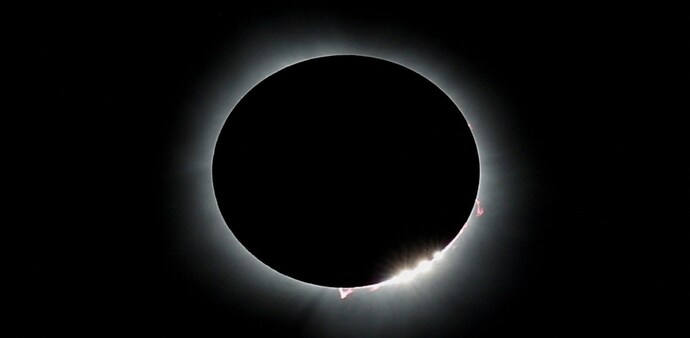
The Moon is set to turn day into night in parts of the Northern Hemisphere on August 12, 2026, when a rare total solar eclipse sweeps across the Arctic and parts of Europe. For viewers inside a narrow path, the Moon will completely cover the Sun, briefly revealing the Sun’s outer atmosphere, or corona.
But there is one important catch for Indian skywatchers: the August 12 total solar eclipse will not be visible from India. The eclipse occurs when it is nighttime across the country. India will therefore miss both the total and partial phases of the event.
Where will the August 12 eclipse be visible?
The eclipse's path of totality begins in the far northern regions of Russia before crossing the Arctic Ocean and Greenland. It then passes over western Iceland, including the Reykjavik region, before reaching northern Spain and parts of the Balearic Islands. A small part of Portugal also falls within the total-eclipse path. (NASA Science)
The total eclipse will be visible only within a relatively narrow corridor. Depending on the location, totality can last for up to about 2 minutes and 18 seconds. Iceland and northern Spain are among the most accessible destinations for observers hoping to experience the complete blackout.
Outside the path of totality, a much larger area will see a partial solar eclipse. This includes large parts of Europe as well as sections of Africa and North America, along with areas over the Atlantic, Arctic and Pacific oceans.
What about India?
For India, the answer is straightforward: the eclipse will not be visible from any part of the country.
According to the India Meteorological Department's eclipse information, the August 12 total solar eclipse is not visible in India. The event's timing means the Sun will be below the horizon for Indian observers.
In Indian Standard Time, the eclipse begins during the evening of August 12 and continues into the early hours of August 13. However, those timings do not mean the eclipse can be seen from India.
When will the eclipse happen?
Globally, the eclipse begins at around 15:35 UTC on August 12 and ends at about 19:59 UTC. The greatest eclipse occurs at approximately 17:47 UTC.
For Indian viewers, that corresponds roughly to 9:05 pm on August 12 to 1:29 am on August 13 IST. But because it is nighttime in India, there will be no visible solar eclipse from the country.
The exact timing of totality varies significantly by location. Someone in Iceland, for example, will experience totality at a different local time from an observer in northern Spain.
How can people watch it?
Those travelling to the path of totality should choose a location with a clear view of the sky and check local weather forecasts before the event.
For everyone outside the path — including viewers in India — the safest option is to watch an official livestream rather than attempting to look at the Sun.
NASA has announced live coverage of the August 12 eclipse, with views from multiple locations along the eclipse path as well as scientific observations from a high-altitude research aircraft.
A solar eclipse should never be viewed directly through ordinary sunglasses, cameras, binoculars or telescopes without appropriate solar filters.
During the partial phases, viewers must use certified solar-viewing glasses or an appropriate solar filter. During the brief period of totality, observers inside the path can look directly at the completely eclipsed Sun — but they must put the eye protection back on before the Sun begins reappearing.
The Moon is set to turn day into night in parts of the Northern Hemisphere on August 12, 2026, when a rare total solar eclipse sweeps across the Arctic and parts of Europe. For viewers inside a narrow path, the Moon will completely cover the Sun, briefly revealing the Sun’s outer atmosphere, or corona.
But there is one important catch for Indian skywatchers: the August 12 total solar eclipse will not be visible from India. The eclipse occurs when it is nighttime across the country. India will therefore miss both the total and partial phases of the event.
Where will the August 12 eclipse be visible?
The eclipse's path of totality begins in the far northern regions of Russia before crossing the Arctic Ocean and Greenland. It then passes over western Iceland, including the Reykjavik region, before reaching northern Spain and parts of the Balearic Islands. A small part of Portugal also falls within the total-eclipse path. (NASA Science)
The total eclipse will be visible only within a relatively narrow corridor. Depending on the location, totality can last for up to about 2 minutes and 18 seconds. Iceland and northern Spain are among the most accessible destinations for observers hoping to experience the complete blackout.
Outside the path of totality, a much larger area will see a partial solar eclipse. This includes large parts of Europe as well as sections of Africa and North America, along with areas over the Atlantic, Arctic and Pacific oceans.
What about India?
For India, the answer is straightforward: the eclipse will not be visible from any part of the country.
According to the India Meteorological Department's eclipse information, the August 12 total solar eclipse is not visible in India. The event's timing means the Sun will be below the horizon for Indian observers.
In Indian Standard Time, the eclipse begins during the evening of August 12 and continues into the early hours of August 13. However, those timings do not mean the eclipse can be seen from India.
When will the eclipse happen?
Globally, the eclipse begins at around 15:35 UTC on August 12 and ends at about 19:59 UTC. The greatest eclipse occurs at approximately 17:47 UTC.
For Indian viewers, that corresponds roughly to 9:05 pm on August 12 to 1:29 am on August 13 IST. But because it is nighttime in India, there will be no visible solar eclipse from the country.
The exact timing of totality varies significantly by location. Someone in Iceland, for example, will experience totality at a different local time from an observer in northern Spain.
How can people watch it?
Those travelling to the path of totality should choose a location with a clear view of the sky and check local weather forecasts before the event.
For everyone outside the path — including viewers in India — the safest option is to watch an official livestream rather than attempting to look at the Sun.
NASA has announced live coverage of the August 12 eclipse, with views from multiple locations along the eclipse path as well as scientific observations from a high-altitude research aircraft.
A solar eclipse should never be viewed directly through ordinary sunglasses, cameras, binoculars or telescopes without appropriate solar filters.
During the partial phases, viewers must use certified solar-viewing glasses or an appropriate solar filter. During the brief period of totality, observers inside the path can look directly at the completely eclipsed Sun — but they must put the eye protection back on before the Sun begins reappearing.