
Bypassing the chip ban: China clinches the global supercomputing crown without Nvidia tech
The milestone returns Beijing to the summit of public supercomputing metrics for the first time since 2017, altering the trajectory of the ongoing technological standoff between the two countries.
- Jun 25, 2026,
- Updated Jun 25, 2026 1:18 PM IST
The global leaderboard for raw computing power shifted during an award ceremony in Hamburg, Germany. As the biannual TOP500 ranking was unveiled at the ISC computing conference, the reigning American champion, El Capitan, was pushed down to the second tier. Stepping into the top spot was a new machine operating out of China's southern technology hub of Shenzhen.
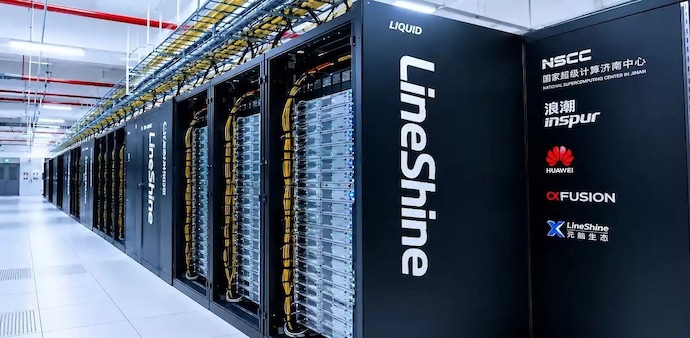
Named LineShine, the system clocks a sustained processing speed of 2.2 exaflops, rendering it approximately 20% faster than its counterpart at the Lawrence Livermore National Laboratory in California. The milestone returns Beijing to the summit of public supercomputing metrics for the first time since 2017, altering the trajectory of the ongoing technological standoff between the two countries.
Shift in global dominance
What makes the machine a notable pivot point is its underlying architecture. For years, Washington has implemented a tightening web of export controls specifically calibrated to block Chinese entities from purchasing frontier graphics processing units (GPUs) like those built by Nvidia.
Rather than attempting to source restricted components through third-party workarounds, developers at the National Supercomputing Centre in Shenzhen abandoned the standard hybrid configuration that pairs central processing units (CPUs) with heavy GPU clusters.
Instead, LineShine runs entirely on domestically designed LX2 CPUs. To match the heavy throughput needed for massive calculations, the system relies on specialized, homegrown high-bandwidth memory pipelines capable of shifting data roughly ten times faster than conventional processors, linking up to two million ports across 100,000 nodes. A fully liquid-cooled layout sustains the hardware during peak workloads.
'A historic leap', says China
In an online statement, China's National Supercomputing Centre described the development as the “result of breakthroughs across a series of core technological bottlenecks.”
The center added that LineShine's achievements “mark a historic leap for China's supercomputing sector in overcoming foreign technology restrictions and building an independently controlled hardware and software ecosystem,”
The machine is already deployed across several fields, including climate modeling, engineering simulations, ocean science, molecular drug discovery, and neuroscience research.
However, technology analysts urge nuance when evaluating what the ranking means for broader artificial intelligence capabilities. The TOP500 benchmarks assess machines using traditional mathematical simulations rather than modern AI training workloads.
Moreover, massive clusters built by Western commercial cloud infrastructure providers — such as Google, Microsoft, and Amazon — frequently choose not to benchmark their systems for the public list due to commercial sensitivity or security protocols, leaving the absolute boundaries of global technical supremacy obscured.
The global leaderboard for raw computing power shifted during an award ceremony in Hamburg, Germany. As the biannual TOP500 ranking was unveiled at the ISC computing conference, the reigning American champion, El Capitan, was pushed down to the second tier. Stepping into the top spot was a new machine operating out of China's southern technology hub of Shenzhen.
Named LineShine, the system clocks a sustained processing speed of 2.2 exaflops, rendering it approximately 20% faster than its counterpart at the Lawrence Livermore National Laboratory in California. The milestone returns Beijing to the summit of public supercomputing metrics for the first time since 2017, altering the trajectory of the ongoing technological standoff between the two countries.
Shift in global dominance
What makes the machine a notable pivot point is its underlying architecture. For years, Washington has implemented a tightening web of export controls specifically calibrated to block Chinese entities from purchasing frontier graphics processing units (GPUs) like those built by Nvidia.
Rather than attempting to source restricted components through third-party workarounds, developers at the National Supercomputing Centre in Shenzhen abandoned the standard hybrid configuration that pairs central processing units (CPUs) with heavy GPU clusters.
Instead, LineShine runs entirely on domestically designed LX2 CPUs. To match the heavy throughput needed for massive calculations, the system relies on specialized, homegrown high-bandwidth memory pipelines capable of shifting data roughly ten times faster than conventional processors, linking up to two million ports across 100,000 nodes. A fully liquid-cooled layout sustains the hardware during peak workloads.
'A historic leap', says China
In an online statement, China's National Supercomputing Centre described the development as the “result of breakthroughs across a series of core technological bottlenecks.”
The center added that LineShine's achievements “mark a historic leap for China's supercomputing sector in overcoming foreign technology restrictions and building an independently controlled hardware and software ecosystem,”
The machine is already deployed across several fields, including climate modeling, engineering simulations, ocean science, molecular drug discovery, and neuroscience research.
However, technology analysts urge nuance when evaluating what the ranking means for broader artificial intelligence capabilities. The TOP500 benchmarks assess machines using traditional mathematical simulations rather than modern AI training workloads.
Moreover, massive clusters built by Western commercial cloud infrastructure providers — such as Google, Microsoft, and Amazon — frequently choose not to benchmark their systems for the public list due to commercial sensitivity or security protocols, leaving the absolute boundaries of global technical supremacy obscured.