
China launches solid-fuel rocket with 9 payloads in open waters: Commercial space race hits far sea
Developed by ORIENSPACE, Gravity-1 holds the distinction of being the world's first medium-lift launch vehicle using all-solid-propellant strap-on motors. The 30-meter, 405-ton rocket delivers 600 tonnes of liftoff thrust and was assembled at the Oriental Aerospace Port in Haiyang.
- Jul 23, 2026,
- Updated Jul 23, 2026 3:23 PM IST
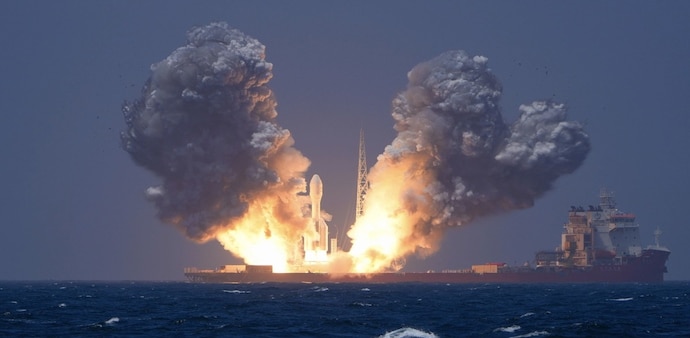
At 10:54 a.m. on Wednesday, ignition exhaust erupted over the open waters of the East China Sea as the Gravity-1 rocket roared off a mobile deck, piercing the sky and successfully deploying nine satellites into orbit alongside an experimental payload.
Directed by the Taiyuan Satellite Launch Center, the liftoff marked China's first far-sea launch of a private commercial rocket and the third sea-based mission for the Gravity-1 platform, as per a Global Times report.
Developed by ORIENSPACE, Gravity-1 holds the distinction of being the world's first medium-lift launch vehicle using all-solid-propellant strap-on motors.
The 30-meter, 405-ton rocket delivers 600 tonnes of liftoff thrust and was assembled at the Oriental Aerospace Port in Haiyang, East China's Shandong Province — the nation's premier commercial maritime launch base. It carries a payload capacity of 6.5 tons to low Earth orbit and 4.2 tons to a 500-km sun-synchronous orbit.
Beyond satellite deployment, the deep-sea mission served as a technical stress test. Press releases from the Haiyang aerospace industry development center confirmed the operation verified the solid-propellant booster configuration under rough maritime conditions, while proving the rocket can remain in extended pre-launch readiness at sea.
The secondary objectives centered on an array of specialized payloads:
- Dongpo Series (13, 14, 17-20): Six satellites — two optical and four synthetic aperture radar (SAR) — joined four existing units in orbit. The expanded constellation will support remote-sensing applications across Southwest China, including land mapping, disaster response, agriculture, forestry, and water management.
- Xiguang-2 01: Developed by Xiopm SPACE, this AI computing satellite combines hyperspectral quantitative remote sensing with real-time onboard data processing, eliminating the delay of sending raw data to ground stations for analysis.
- Tianyi-49: Integrates AI and commercial space tech to provide Earth observation data for mineral exploration, urban planning, and environmental monitoring.
- Lilac-3: Designed to conduct in-orbit demonstrations of an ultra-flat satellite platform featuring integrated structural and thermal controls alongside next-generation attitude control systems.
The successful far-sea launch reinforces China's flexible multi-site sea-launch capability, enabling operators to choose launch sites nationwide based on mission requirements.
At 10:54 a.m. on Wednesday, ignition exhaust erupted over the open waters of the East China Sea as the Gravity-1 rocket roared off a mobile deck, piercing the sky and successfully deploying nine satellites into orbit alongside an experimental payload.
Directed by the Taiyuan Satellite Launch Center, the liftoff marked China's first far-sea launch of a private commercial rocket and the third sea-based mission for the Gravity-1 platform, as per a Global Times report.
Developed by ORIENSPACE, Gravity-1 holds the distinction of being the world's first medium-lift launch vehicle using all-solid-propellant strap-on motors.
The 30-meter, 405-ton rocket delivers 600 tonnes of liftoff thrust and was assembled at the Oriental Aerospace Port in Haiyang, East China's Shandong Province — the nation's premier commercial maritime launch base. It carries a payload capacity of 6.5 tons to low Earth orbit and 4.2 tons to a 500-km sun-synchronous orbit.
Beyond satellite deployment, the deep-sea mission served as a technical stress test. Press releases from the Haiyang aerospace industry development center confirmed the operation verified the solid-propellant booster configuration under rough maritime conditions, while proving the rocket can remain in extended pre-launch readiness at sea.
The secondary objectives centered on an array of specialized payloads:
- Dongpo Series (13, 14, 17-20): Six satellites — two optical and four synthetic aperture radar (SAR) — joined four existing units in orbit. The expanded constellation will support remote-sensing applications across Southwest China, including land mapping, disaster response, agriculture, forestry, and water management.
- Xiguang-2 01: Developed by Xiopm SPACE, this AI computing satellite combines hyperspectral quantitative remote sensing with real-time onboard data processing, eliminating the delay of sending raw data to ground stations for analysis.
- Tianyi-49: Integrates AI and commercial space tech to provide Earth observation data for mineral exploration, urban planning, and environmental monitoring.
- Lilac-3: Designed to conduct in-orbit demonstrations of an ultra-flat satellite platform featuring integrated structural and thermal controls alongside next-generation attitude control systems.
The successful far-sea launch reinforces China's flexible multi-site sea-launch capability, enabling operators to choose launch sites nationwide based on mission requirements.