
China’s secret weapon against deserts? A bacteria that creates fertile soil in less than a year
Field trials have produced some remarkable results. In certain experimental plots, vegetation has successfully taken root within months of treatment. Researchers reported that the transformed land was capable of supporting grasses, shrubs, and some agricultural crops.
- May 31, 2026,
- Updated May 31, 2026 10:30 AM IST
As countries around the world grapple with desertification, water scarcity, and declining agricultural productivity, China is experimenting with an unlikely ally in its battle against barren landscapes: bacteria.
In several arid regions, Chinese researchers have been developing a technology that uses naturally occurring microorganisms to transform loose desert sand into soil capable of supporting vegetation. The results have drawn global attention, with some test sites reportedly showing dramatic improvements in soil quality and plant growth within less than a year.
Challenge of desertification
Desertification is one of the biggest environmental threats facing dryland regions. According to international estimates, vast areas of productive land are lost every year due to soil degradation, overgrazing, climate change, and unsustainable farming practices.
China has long been on the frontlines of this challenge. The country is home to massive desert regions, including the Gobi and Taklamakan deserts, which have historically expanded into surrounding grasslands and agricultural zones. Dust storms originating from these regions have also affected major cities, including Beijing.
To combat the problem, China has spent decades planting shelterbelts, restoring grasslands, and developing innovative land-reclamation technologies. The latest effort focuses on harnessing microbes already found in nature.
How bacteria can create soil
The technique relies on special bacteria capable of producing sticky biological substances that bind loose sand particles together.
Scientists cultivate these microorganisms and introduce them into desert sand along with nutrients and water. As the bacteria multiply, they secrete natural compounds that act like a biological glue. This process helps form a crust-like structure that stabilises the sand and improves its ability to retain moisture.
Over time, the treated sand begins to behave more like soil. It becomes less vulnerable to wind erosion, holds water more effectively, and creates conditions suitable for plant roots and beneficial microorganisms.
Researchers describe the process as accelerating what nature would normally take decades or even centuries to achieve.
Fertile land in less than a year
Field trials have produced some remarkable results. In certain experimental plots, vegetation has successfully taken root within months of treatment. Researchers reported that the transformed land was capable of supporting grasses, shrubs, and some agricultural crops in roughly 10 months.
The newly stabilised soil retained significantly more water than untreated desert sand, reducing irrigation requirements and increasing the survival rates of planted vegetation.
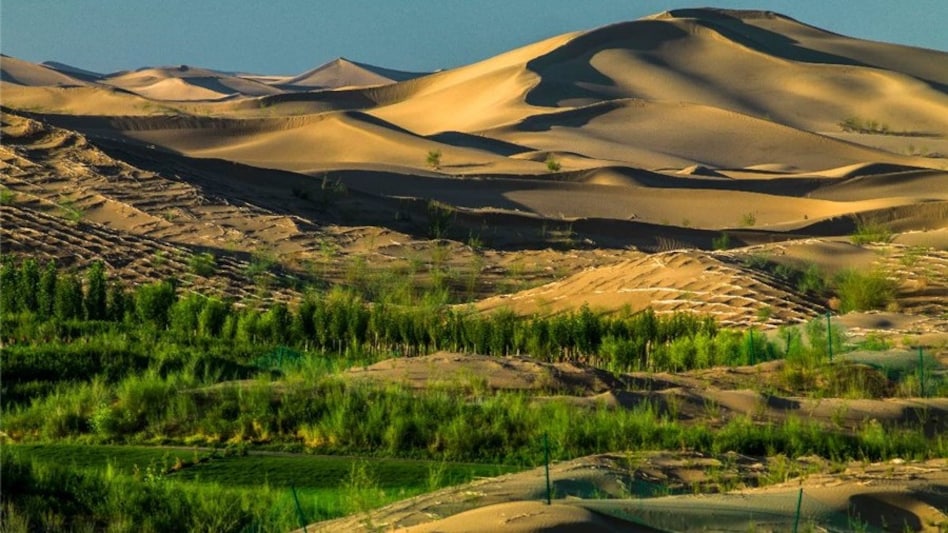
Images from trial sites have shown formerly barren stretches of sand covered with patches of green vegetation, highlighting the technology's potential for large-scale ecological restoration.
Why the technology matters
Traditional desert restoration projects often require years of intensive planting, irrigation, and maintenance before meaningful results become visible. Biological soil-building methods could potentially shorten that timeline dramatically.
If deployed at scale, the approach could offer several benefits:
- Stabilising shifting sand dunes
- Reducing dust storms
- Restoring degraded ecosystems
- Expanding land available for agriculture
- Improving carbon sequestration through vegetation growth
- Supporting rural communities in arid regions
The technology could also prove valuable in regions beyond China, including parts of Africa, the Middle East, Central Asia, and India, where desertification threatens livelihoods and food security.
Despite the promising results, scientists caution that transforming deserts is not as simple as spraying bacteria onto sand.
Long-term success depends on factors such as water availability, local climate conditions, soil chemistry, and the choice of vegetation. Maintaining restored land can also be difficult in regions facing extreme temperatures and prolonged droughts.
As countries around the world grapple with desertification, water scarcity, and declining agricultural productivity, China is experimenting with an unlikely ally in its battle against barren landscapes: bacteria.
In several arid regions, Chinese researchers have been developing a technology that uses naturally occurring microorganisms to transform loose desert sand into soil capable of supporting vegetation. The results have drawn global attention, with some test sites reportedly showing dramatic improvements in soil quality and plant growth within less than a year.
Challenge of desertification
Desertification is one of the biggest environmental threats facing dryland regions. According to international estimates, vast areas of productive land are lost every year due to soil degradation, overgrazing, climate change, and unsustainable farming practices.
China has long been on the frontlines of this challenge. The country is home to massive desert regions, including the Gobi and Taklamakan deserts, which have historically expanded into surrounding grasslands and agricultural zones. Dust storms originating from these regions have also affected major cities, including Beijing.
To combat the problem, China has spent decades planting shelterbelts, restoring grasslands, and developing innovative land-reclamation technologies. The latest effort focuses on harnessing microbes already found in nature.
How bacteria can create soil
The technique relies on special bacteria capable of producing sticky biological substances that bind loose sand particles together.
Scientists cultivate these microorganisms and introduce them into desert sand along with nutrients and water. As the bacteria multiply, they secrete natural compounds that act like a biological glue. This process helps form a crust-like structure that stabilises the sand and improves its ability to retain moisture.
Over time, the treated sand begins to behave more like soil. It becomes less vulnerable to wind erosion, holds water more effectively, and creates conditions suitable for plant roots and beneficial microorganisms.
Researchers describe the process as accelerating what nature would normally take decades or even centuries to achieve.
Fertile land in less than a year
Field trials have produced some remarkable results. In certain experimental plots, vegetation has successfully taken root within months of treatment. Researchers reported that the transformed land was capable of supporting grasses, shrubs, and some agricultural crops in roughly 10 months.
The newly stabilised soil retained significantly more water than untreated desert sand, reducing irrigation requirements and increasing the survival rates of planted vegetation.
Images from trial sites have shown formerly barren stretches of sand covered with patches of green vegetation, highlighting the technology's potential for large-scale ecological restoration.
Why the technology matters
Traditional desert restoration projects often require years of intensive planting, irrigation, and maintenance before meaningful results become visible. Biological soil-building methods could potentially shorten that timeline dramatically.
If deployed at scale, the approach could offer several benefits:
- Stabilising shifting sand dunes
- Reducing dust storms
- Restoring degraded ecosystems
- Expanding land available for agriculture
- Improving carbon sequestration through vegetation growth
- Supporting rural communities in arid regions
The technology could also prove valuable in regions beyond China, including parts of Africa, the Middle East, Central Asia, and India, where desertification threatens livelihoods and food security.
Despite the promising results, scientists caution that transforming deserts is not as simple as spraying bacteria onto sand.
Long-term success depends on factors such as water availability, local climate conditions, soil chemistry, and the choice of vegetation. Maintaining restored land can also be difficult in regions facing extreme temperatures and prolonged droughts.