
Forget mosquito coils: China is mass-producing a laser that hunts mosquitoes in the air
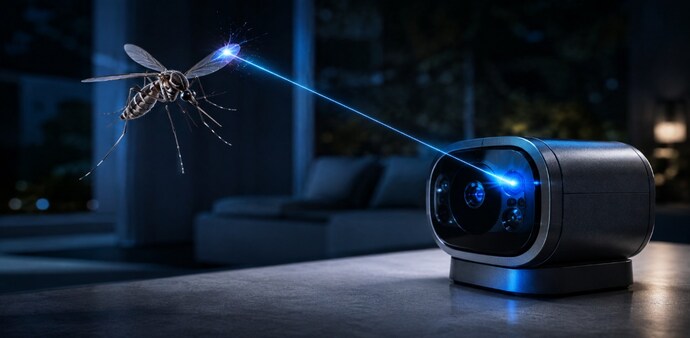
The system is available in two versions: infrared and blue-laser.
- Aug 20, 2026,
- Updated Aug 20, 2026 10:00 AM IST
A device built to hunt mosquitoes in the air is now moving from the prototype stage to mass production in China. Developed by Photon Matrix Lab, the portable laser system uses sensors, artificial intelligence and a precision laser to detect and disable mosquitoes while they are still flying, according to media reports.
The Photon Matrix portable laser-based mosquito defense system is marketed as an automated, chemical-free “mosquito air defense” device. The company says it can detect and physically disable mosquitoes and other small flying insects mid-flight.
Mass production of the system began in August 2026, according to Photon Matrix. The company has also launched an official web store for direct sales.
How the laser mosquito killer works
The system is available in two versions: infrared and blue-laser.
It combines several technologies to identify and track insects. LiDAR is used for spatial scanning and distance measurement, while millimeter-wave radar detects movement. An Artificial Intelligence (AI) vision module then confirms whether the detected object is a small flying target.
Must Read: China moves to replace Microsoft Windows from state agencies to cut US tech dependency
Once a mosquito is identified, a galvanometer (galvo)-controlled laser locks onto it and fires a short pulse. According to the manufacturer, the laser is typically aimed at the insect’s wings, disabling it and causing it to fall.
The portable device scans a roughly 90-degree horizontal plane. When it detects a qualifying insect, it calculates its position and directs the laser pulse toward the target.
The technology may sound unusual, but its basic operating sequence has a familiar counterpart in modern military systems: detect, track, aim and destroy.
From mosquitoes to drones
Laser-based weapons are increasingly being developed as an alternative to conventional ammunition and missiles, particularly for dealing with drones and other low-cost aerial threats.
The underlying concept is similar to the Photon Matrix system, although the scale and power are vastly different. Consumer mosquito killers use relatively low-power lasers to damage insect wings at short range. Military high-energy lasers (HELs), by contrast, can deliver tens to hundreds of kilowatts of energy, allowing them to heat, melt or structurally damage critical components of drones, rockets and missiles.
One of the major attractions is cost. A laser engagement can cost less than a dollar per shot, while conventional interceptors can run into millions of dollars. A PAC-3 MSE, for example, costs nearly $4 million per unit, according to US Army budget data.
China’s growing laser arsenal
China has developed several laser systems aimed at countering aerial threats.
One is the Low-Altitude Laser Defending System (LASS), popularly known as the Silent Hunter. It is a 30–100 kW electrically powered, fiber-optic laser weapon designed to neutralize low-flying drones.
The system was allegedly spotted in Russia last year. Another Chinese-origin system, ‘Shen Nung’ or ‘Shennong’, was seen protecting former Iranian Supreme Leader Ayatollah Ali Khamenei in 2024. Its radar can identify drones from up to 5 kilometers away and the system has a power range of 10-20 kW.
China has also tested laser technology for naval applications. A laser weapon was spotted on the country’s Type 071 Amphibious Assault Ship in August 2024, appearing to be in the late stages of testing.
Another system, the OW5 laser weapon, is a low-altitude, vehicle-mounted, high-mobility anti-drone device designed to protect convoys and key sites. It combines radar and opto-electronics for rapid target detection and tracking and can operate independently or alongside other systems.
China unveiled the LY-1, a ship-borne laser air defense system, during its Victory Day Parade in September 2025. Its turret-mounted design has also raised the possibility of adapting the system for ground-based applications.
The US and UK are also developing laser weapons
The United States has developed several high-energy laser systems.
Among them is the High Energy Laser with Integrated Optical-Dazzler and Surveillance (HELIOS), a 60+ kW-class system developed by Lockheed Martin. The USS Preble, the first warship equipped with HELIOS, successfully test-fired its high-energy laser against a drone in February 2025.
The US has also developed the P-HEL (Palletized High Energy Laser), a 20 kW-class laser mounted on a transportable pallet. It can be rapidly deployed to fixed locations and is designed to detect, track and engage small drones by focusing laser energy on critical components.
The UK has its own system, the DragonFire laser-directed energy weapon (LDEW), which is designed for installation on warships. The 50-kilowatt (kW) class weapon uses a turret for precision aiming and is intended to counter mortar rounds, drones and missiles. It also includes an electro-optical camera and a secondary, lower-power laser for target acquisition and tracking.
Operating the laser typically costs less than £10 per shot.
Must Read: Tech layoffs weigh on India’s real estate market as housing sales fall 6% in Q2
Israel and Russia have their own systems
Israel has developed the Iron Beam, a 100–150 kW solid-state fiber laser capable of focusing its beam to a coin-sized spot at a distance of 10 kilometers.
The system works alongside Iron Dome and uses artificial intelligence (AI) to determine whether a missile interceptor or a laser should be used against an incoming threat.
Russia, meanwhile, has developed systems including Peresvet and Zadira.
Peresvet is a ground-based laser weapon intended for air defense and anti-satellite (ASAT) warfare. It is primarily designed to protect mobile intercontinental ballistic missile (ICBM) launchers and to dazzle or blind optical-electronic reconnaissance satellites.
Zadira is designed for the thermal destruction of targets, particularly drones, rather than simply dazzling their sensors. It is believed to have a power between 50 and 100 kW.
France has also developed HELMA-P (High Energy Laser for Multiple Applications – Power), a 2–10 kW laser system designed to destroy drones and other aerial threats. It combines a laser emitter and a two-axis turret with optical sensors and can be operated by one person through a human-machine interface.
The French Defense Procurement Agency (DGA) has also ordered a demonstration of the SYDERAL laser weapon system, designed for short-range air defense and anti-drone warfare.
Germany is joining the race as well. Reports from July 2026 said Rheinmetall and MBDA would develop a high-energy laser weapon for the German Navy, building on their earlier work on a laser demonstrator. The system is expected to become operational in 2029.
A device built to hunt mosquitoes in the air is now moving from the prototype stage to mass production in China. Developed by Photon Matrix Lab, the portable laser system uses sensors, artificial intelligence and a precision laser to detect and disable mosquitoes while they are still flying, according to media reports.
The Photon Matrix portable laser-based mosquito defense system is marketed as an automated, chemical-free “mosquito air defense” device. The company says it can detect and physically disable mosquitoes and other small flying insects mid-flight.
Mass production of the system began in August 2026, according to Photon Matrix. The company has also launched an official web store for direct sales.
How the laser mosquito killer works
The system is available in two versions: infrared and blue-laser.
It combines several technologies to identify and track insects. LiDAR is used for spatial scanning and distance measurement, while millimeter-wave radar detects movement. An Artificial Intelligence (AI) vision module then confirms whether the detected object is a small flying target.
Must Read: China moves to replace Microsoft Windows from state agencies to cut US tech dependency
Once a mosquito is identified, a galvanometer (galvo)-controlled laser locks onto it and fires a short pulse. According to the manufacturer, the laser is typically aimed at the insect’s wings, disabling it and causing it to fall.
The portable device scans a roughly 90-degree horizontal plane. When it detects a qualifying insect, it calculates its position and directs the laser pulse toward the target.
The technology may sound unusual, but its basic operating sequence has a familiar counterpart in modern military systems: detect, track, aim and destroy.
From mosquitoes to drones
Laser-based weapons are increasingly being developed as an alternative to conventional ammunition and missiles, particularly for dealing with drones and other low-cost aerial threats.
The underlying concept is similar to the Photon Matrix system, although the scale and power are vastly different. Consumer mosquito killers use relatively low-power lasers to damage insect wings at short range. Military high-energy lasers (HELs), by contrast, can deliver tens to hundreds of kilowatts of energy, allowing them to heat, melt or structurally damage critical components of drones, rockets and missiles.
One of the major attractions is cost. A laser engagement can cost less than a dollar per shot, while conventional interceptors can run into millions of dollars. A PAC-3 MSE, for example, costs nearly $4 million per unit, according to US Army budget data.
China’s growing laser arsenal
China has developed several laser systems aimed at countering aerial threats.
One is the Low-Altitude Laser Defending System (LASS), popularly known as the Silent Hunter. It is a 30–100 kW electrically powered, fiber-optic laser weapon designed to neutralize low-flying drones.
The system was allegedly spotted in Russia last year. Another Chinese-origin system, ‘Shen Nung’ or ‘Shennong’, was seen protecting former Iranian Supreme Leader Ayatollah Ali Khamenei in 2024. Its radar can identify drones from up to 5 kilometers away and the system has a power range of 10-20 kW.
China has also tested laser technology for naval applications. A laser weapon was spotted on the country’s Type 071 Amphibious Assault Ship in August 2024, appearing to be in the late stages of testing.
Another system, the OW5 laser weapon, is a low-altitude, vehicle-mounted, high-mobility anti-drone device designed to protect convoys and key sites. It combines radar and opto-electronics for rapid target detection and tracking and can operate independently or alongside other systems.
China unveiled the LY-1, a ship-borne laser air defense system, during its Victory Day Parade in September 2025. Its turret-mounted design has also raised the possibility of adapting the system for ground-based applications.
The US and UK are also developing laser weapons
The United States has developed several high-energy laser systems.
Among them is the High Energy Laser with Integrated Optical-Dazzler and Surveillance (HELIOS), a 60+ kW-class system developed by Lockheed Martin. The USS Preble, the first warship equipped with HELIOS, successfully test-fired its high-energy laser against a drone in February 2025.
The US has also developed the P-HEL (Palletized High Energy Laser), a 20 kW-class laser mounted on a transportable pallet. It can be rapidly deployed to fixed locations and is designed to detect, track and engage small drones by focusing laser energy on critical components.
The UK has its own system, the DragonFire laser-directed energy weapon (LDEW), which is designed for installation on warships. The 50-kilowatt (kW) class weapon uses a turret for precision aiming and is intended to counter mortar rounds, drones and missiles. It also includes an electro-optical camera and a secondary, lower-power laser for target acquisition and tracking.
Operating the laser typically costs less than £10 per shot.
Must Read: Tech layoffs weigh on India’s real estate market as housing sales fall 6% in Q2
Israel and Russia have their own systems
Israel has developed the Iron Beam, a 100–150 kW solid-state fiber laser capable of focusing its beam to a coin-sized spot at a distance of 10 kilometers.
The system works alongside Iron Dome and uses artificial intelligence (AI) to determine whether a missile interceptor or a laser should be used against an incoming threat.
Russia, meanwhile, has developed systems including Peresvet and Zadira.
Peresvet is a ground-based laser weapon intended for air defense and anti-satellite (ASAT) warfare. It is primarily designed to protect mobile intercontinental ballistic missile (ICBM) launchers and to dazzle or blind optical-electronic reconnaissance satellites.
Zadira is designed for the thermal destruction of targets, particularly drones, rather than simply dazzling their sensors. It is believed to have a power between 50 and 100 kW.
France has also developed HELMA-P (High Energy Laser for Multiple Applications – Power), a 2–10 kW laser system designed to destroy drones and other aerial threats. It combines a laser emitter and a two-axis turret with optical sensors and can be operated by one person through a human-machine interface.
The French Defense Procurement Agency (DGA) has also ordered a demonstration of the SYDERAL laser weapon system, designed for short-range air defense and anti-drone warfare.
Germany is joining the race as well. Reports from July 2026 said Rheinmetall and MBDA would develop a high-energy laser weapon for the German Navy, building on their earlier work on a laser demonstrator. The system is expected to become operational in 2029.