
Future of 6th gen fighter jets starts with the engine: Why Variable Cycle tech is the next big leap
Modern fifth-generation fighters rely on low-bypass turbofan engines that produce enormous thrust, enabling rapid acceleration, sustained supersonic flight and exceptional manoeuvrability. However, these advantages come at a cost.
- Aug 2, 2026,
- Updated Aug 2, 2026 7:27 PM IST
The battle for air superiority is entering a new phase. While stealth, artificial intelligence and advanced sensors continue to dominate discussions around sixth-generation fighter jets, engineers believe the technology that may ultimately determine their success is buried beneath the aircraft's skin.
At the heart of this transformation is the Variable Cycle Engine (VCE), an advanced propulsion system designed to overcome one of military aviation's oldest engineering compromises — balancing speed with efficiency.
Unlike conventional fighter engines that are optimised for a specific operating range, Variable Cycle Engines can adapt to different flight conditions. The result is a propulsion system capable of delivering high thrust during combat while significantly improving fuel efficiency during long-range missions, making it one of the defining technologies for the next generation of combat aircraft.
Why current fighter engines have limitations
Modern fifth-generation fighters rely on low-bypass turbofan engines that produce enormous thrust, enabling rapid acceleration, sustained supersonic flight and exceptional manoeuvrability. However, these advantages come at a cost.
Such engines consume fuel at a high rate, particularly during extended high-speed operations. To increase range, aircraft often need additional fuel, which can add weight or reduce stealth advantages. Designers have long faced the difficult task of balancing combat performance with endurance.
Commercial aircraft solve this challenge using high-bypass turbofan engines that prioritise fuel economy. But these engines are too large and inefficient for high-speed combat, leaving military aviation searching for a solution that can perform effectively across vastly different flight profiles.
How Variable Cycle Engines work
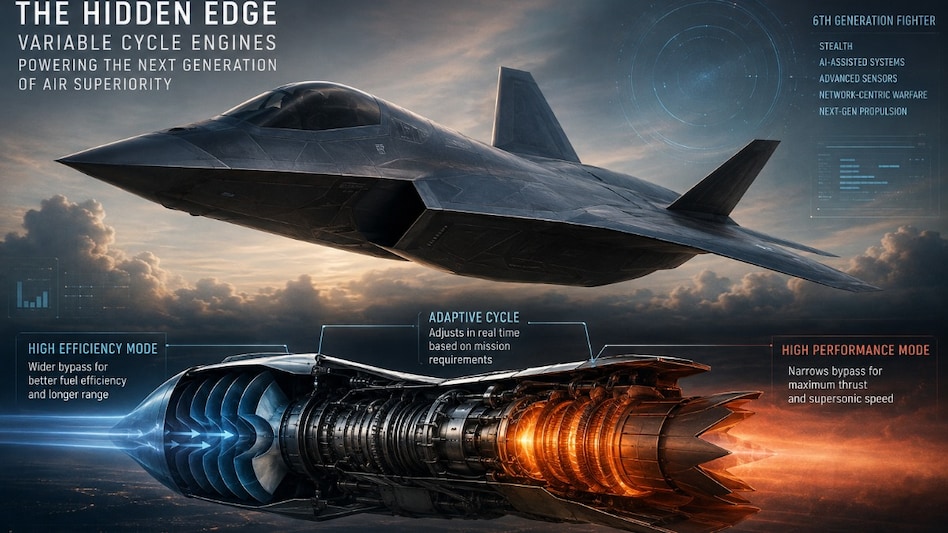
A Variable Cycle Engine is designed to change the way air moves through the engine while the aircraft is in flight.
During cruising or long-range missions, the engine directs more air around the core, behaving like a fuel-efficient high-bypass turbofan. When the aircraft requires maximum performance during combat, interception or rapid acceleration, it shifts to a low-bypass configuration, producing much higher thrust.
This ability to continuously adjust its operating mode allows the engine to deliver both efficiency and performance without forcing pilots to compromise between range and speed.
Why sixth-generation fighters need adaptive propulsion
Future combat aircraft are expected to carry significantly more sophisticated onboard systems than today's fighters.
Advanced radar arrays, electronic warfare suites, artificial intelligence-powered mission systems, secure communications and possibly directed-energy weapons will all require far greater electrical power and more effective cooling.
Variable Cycle Engines are designed to meet these demands by generating additional electrical power while improving thermal management. They can also increase operational range, allowing aircraft to remain in contested airspace for longer periods without sacrificing combat capability.
Faster flight with greater efficiency
One of the most promising advantages of adaptive propulsion is its ability to improve supercruise — the capability to sustain supersonic speeds without relying heavily on afterburners.
Traditional afterburners dramatically increase fuel consumption and generate large infrared signatures that make aircraft easier to detect. By optimising airflow for different flight conditions, Variable Cycle Engines can maintain high performance while consuming less fuel and reducing thermal emissions.
This combination of speed, endurance and reduced detectability could provide future fighter aircraft with a significant operational advantage.
The engineering challenge
Developing a Variable Cycle Engine is far from straightforward. The technology requires complex airflow control systems, movable internal components and advanced materials capable of enduring extreme temperatures and mechanical stress. Engineers must ensure the engine can seamlessly switch between different operating modes without compromising reliability or performance.
These technical challenges make Variable Cycle Engines among the most ambitious propulsion systems ever developed for military aircraft.
There is still no single definition of what constitutes a sixth-generation fighter, but adaptive propulsion has emerged as one of its most important building blocks alongside advanced stealth, autonomous systems and next-generation sensors.
The battle for air superiority is entering a new phase. While stealth, artificial intelligence and advanced sensors continue to dominate discussions around sixth-generation fighter jets, engineers believe the technology that may ultimately determine their success is buried beneath the aircraft's skin.
At the heart of this transformation is the Variable Cycle Engine (VCE), an advanced propulsion system designed to overcome one of military aviation's oldest engineering compromises — balancing speed with efficiency.
Unlike conventional fighter engines that are optimised for a specific operating range, Variable Cycle Engines can adapt to different flight conditions. The result is a propulsion system capable of delivering high thrust during combat while significantly improving fuel efficiency during long-range missions, making it one of the defining technologies for the next generation of combat aircraft.
Why current fighter engines have limitations
Modern fifth-generation fighters rely on low-bypass turbofan engines that produce enormous thrust, enabling rapid acceleration, sustained supersonic flight and exceptional manoeuvrability. However, these advantages come at a cost.
Such engines consume fuel at a high rate, particularly during extended high-speed operations. To increase range, aircraft often need additional fuel, which can add weight or reduce stealth advantages. Designers have long faced the difficult task of balancing combat performance with endurance.
Commercial aircraft solve this challenge using high-bypass turbofan engines that prioritise fuel economy. But these engines are too large and inefficient for high-speed combat, leaving military aviation searching for a solution that can perform effectively across vastly different flight profiles.
How Variable Cycle Engines work
A Variable Cycle Engine is designed to change the way air moves through the engine while the aircraft is in flight.
During cruising or long-range missions, the engine directs more air around the core, behaving like a fuel-efficient high-bypass turbofan. When the aircraft requires maximum performance during combat, interception or rapid acceleration, it shifts to a low-bypass configuration, producing much higher thrust.
This ability to continuously adjust its operating mode allows the engine to deliver both efficiency and performance without forcing pilots to compromise between range and speed.
Why sixth-generation fighters need adaptive propulsion
Future combat aircraft are expected to carry significantly more sophisticated onboard systems than today's fighters.
Advanced radar arrays, electronic warfare suites, artificial intelligence-powered mission systems, secure communications and possibly directed-energy weapons will all require far greater electrical power and more effective cooling.
Variable Cycle Engines are designed to meet these demands by generating additional electrical power while improving thermal management. They can also increase operational range, allowing aircraft to remain in contested airspace for longer periods without sacrificing combat capability.
Faster flight with greater efficiency
One of the most promising advantages of adaptive propulsion is its ability to improve supercruise — the capability to sustain supersonic speeds without relying heavily on afterburners.
Traditional afterburners dramatically increase fuel consumption and generate large infrared signatures that make aircraft easier to detect. By optimising airflow for different flight conditions, Variable Cycle Engines can maintain high performance while consuming less fuel and reducing thermal emissions.
This combination of speed, endurance and reduced detectability could provide future fighter aircraft with a significant operational advantage.
The engineering challenge
Developing a Variable Cycle Engine is far from straightforward. The technology requires complex airflow control systems, movable internal components and advanced materials capable of enduring extreme temperatures and mechanical stress. Engineers must ensure the engine can seamlessly switch between different operating modes without compromising reliability or performance.
These technical challenges make Variable Cycle Engines among the most ambitious propulsion systems ever developed for military aircraft.
There is still no single definition of what constitutes a sixth-generation fighter, but adaptive propulsion has emerged as one of its most important building blocks alongside advanced stealth, autonomous systems and next-generation sensors.