
Hubble vs Roman: How NASA’s new space telescope will change our view of the universe
Hubble is built to study individual objects or relatively small regions of the sky in great detail. Roman, meanwhile, will survey enormous stretches of the universe while maintaining image quality comparable to Hubble in near-infrared wavelengths.
- Aug 16, 2026,
- Updated Aug 16, 2026 1:42 PM IST
For more than three decades, the Hubble Space Telescope has transformed our view of the cosmos, turning distant galaxies, nebulae and exploding stars into objects that can be studied in extraordinary detail. Now, NASA is preparing to add a very different kind of telescope to that legacy: the Nancy Grace Roman Space Telescope.
Roman is sometimes described as Hubble’s successor. But that is not quite right. NASA sees the two observatories as complementary — one designed to zoom in, the other to scan the universe on a much larger scale.
So, what is the biggest difference?
The simplest way to understand Hubble and Roman is to think of them as a zoom lens and a wide-angle lens. Hubble is built to study individual objects or relatively small regions of the sky in great detail. Roman, meanwhile, will survey enormous stretches of the universe while maintaining image quality comparable to Hubble in near-infrared wavelengths.
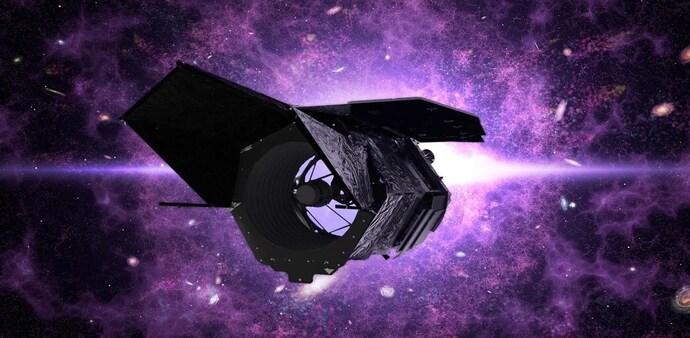
Both telescopes have a primary mirror measuring 2.4 metres (7.9 feet) across. But their optical designs are different. Roman's three-mirror system gives it a much shorter focal length, allowing it to see a vastly larger portion of the sky at once.
The result is striking: Roman's field of view will be at least 100 times larger than Hubble's. NASA estimates that during its first five years, Roman will image about 50 times as much sky as Hubble covered in 30 years.
Hubble sees more wavelengths
Another major difference is the type of light the telescopes are designed to detect. Hubble observes ultraviolet, visible and near-infrared light. That broad range has allowed it to study everything from star formation and galaxies to planetary atmospheres and black holes.
Roman will concentrate on visible and near-infrared wavelengths, with its instruments optimised particularly for infrared observations. This makes it especially useful for surveying huge populations of distant galaxies and stars and for studying objects whose light is difficult to detect in visible wavelengths.
In other words, Roman is not being built to replace Hubble's ultraviolet and detailed visible-light capabilities.
Why does Roman need such a huge field of view?
This is where Roman could transform astronomy. Many of the biggest questions in modern cosmology cannot be answered by studying a handful of galaxies or stars. Scientists need enormous datasets containing millions or even billions of objects.
Roman's Wide Field Instrument will be able to survey huge areas of sky rapidly. NASA says the instrument will measure light from a billion galaxies over the mission's lifetime. That scale matters for studying dark matter and dark energy, two of the biggest mysteries in modern physics.
Dark matter cannot be seen directly, but its gravitational influence affects how galaxies and other structures move. By surveying huge portions of the universe, Roman will help map these effects on an unprecedented scale.
Dark energy is even more mysterious. Hubble observations helped reveal that the expansion of the universe is accelerating. Roman will examine vast numbers of galaxies and exploding stars to investigate how that acceleration has changed over cosmic history.
Roman will also hunt for planets
Roman will have another important job: finding and studying planets beyond our solar system.
Its Wide Field Instrument will conduct a large survey of the Milky Way, while its Coronagraph Instrument will demonstrate technology designed to directly image exoplanets by blocking the overwhelming light of their parent stars.
This is different from Hubble's approach. Hubble can study exoplanet atmospheres using techniques such as transit spectroscopy, analysing the starlight that passes through a planet's atmosphere when it moves in front of its star. Roman's coronagraph, meanwhile, is designed to suppress starlight and reveal much fainter objects orbiting nearby stars.
Where will the two telescopes operate?
Their locations are also dramatically different. Hubble orbits roughly 483 kilometres above Earth, an arrangement that was originally chosen partly because astronauts could reach it for servicing missions.
Roman will operate much farther away, around 1.5 million kilometres from Earth near the second Sun-Earth Lagrange point, or L2. The region provides a cold and relatively stable environment that is particularly useful for infrared astronomy.
Does this mean Roman will make Hubble obsolete? No. That is perhaps the most important point.
NASA explicitly describes Roman as a telescope that will build upon and complement Hubble, rather than replace it. Roman will conduct large surveys and identify interesting targets, while Hubble can then zoom in on selected objects with its specialised ultraviolet and visible-light capabilities.
The same applies to the James Webb Space Telescope. Webb is designed to observe deeper into infrared wavelengths with a much larger 6.5-metre mirror, while Roman will sacrifice some of that reach for an enormous field of view and rapid surveys.
The three telescopes therefore occupy different niches: Roman maps the cosmic landscape, Hubble examines it in detail across ultraviolet and visible wavelengths, and Webb probes deeper into the infrared.
For more than three decades, the Hubble Space Telescope has transformed our view of the cosmos, turning distant galaxies, nebulae and exploding stars into objects that can be studied in extraordinary detail. Now, NASA is preparing to add a very different kind of telescope to that legacy: the Nancy Grace Roman Space Telescope.
Roman is sometimes described as Hubble’s successor. But that is not quite right. NASA sees the two observatories as complementary — one designed to zoom in, the other to scan the universe on a much larger scale.
So, what is the biggest difference?
The simplest way to understand Hubble and Roman is to think of them as a zoom lens and a wide-angle lens. Hubble is built to study individual objects or relatively small regions of the sky in great detail. Roman, meanwhile, will survey enormous stretches of the universe while maintaining image quality comparable to Hubble in near-infrared wavelengths.
Both telescopes have a primary mirror measuring 2.4 metres (7.9 feet) across. But their optical designs are different. Roman's three-mirror system gives it a much shorter focal length, allowing it to see a vastly larger portion of the sky at once.
The result is striking: Roman's field of view will be at least 100 times larger than Hubble's. NASA estimates that during its first five years, Roman will image about 50 times as much sky as Hubble covered in 30 years.
Hubble sees more wavelengths
Another major difference is the type of light the telescopes are designed to detect. Hubble observes ultraviolet, visible and near-infrared light. That broad range has allowed it to study everything from star formation and galaxies to planetary atmospheres and black holes.
Roman will concentrate on visible and near-infrared wavelengths, with its instruments optimised particularly for infrared observations. This makes it especially useful for surveying huge populations of distant galaxies and stars and for studying objects whose light is difficult to detect in visible wavelengths.
In other words, Roman is not being built to replace Hubble's ultraviolet and detailed visible-light capabilities.
Why does Roman need such a huge field of view?
This is where Roman could transform astronomy. Many of the biggest questions in modern cosmology cannot be answered by studying a handful of galaxies or stars. Scientists need enormous datasets containing millions or even billions of objects.
Roman's Wide Field Instrument will be able to survey huge areas of sky rapidly. NASA says the instrument will measure light from a billion galaxies over the mission's lifetime. That scale matters for studying dark matter and dark energy, two of the biggest mysteries in modern physics.
Dark matter cannot be seen directly, but its gravitational influence affects how galaxies and other structures move. By surveying huge portions of the universe, Roman will help map these effects on an unprecedented scale.
Dark energy is even more mysterious. Hubble observations helped reveal that the expansion of the universe is accelerating. Roman will examine vast numbers of galaxies and exploding stars to investigate how that acceleration has changed over cosmic history.
Roman will also hunt for planets
Roman will have another important job: finding and studying planets beyond our solar system.
Its Wide Field Instrument will conduct a large survey of the Milky Way, while its Coronagraph Instrument will demonstrate technology designed to directly image exoplanets by blocking the overwhelming light of their parent stars.
This is different from Hubble's approach. Hubble can study exoplanet atmospheres using techniques such as transit spectroscopy, analysing the starlight that passes through a planet's atmosphere when it moves in front of its star. Roman's coronagraph, meanwhile, is designed to suppress starlight and reveal much fainter objects orbiting nearby stars.
Where will the two telescopes operate?
Their locations are also dramatically different. Hubble orbits roughly 483 kilometres above Earth, an arrangement that was originally chosen partly because astronauts could reach it for servicing missions.
Roman will operate much farther away, around 1.5 million kilometres from Earth near the second Sun-Earth Lagrange point, or L2. The region provides a cold and relatively stable environment that is particularly useful for infrared astronomy.
Does this mean Roman will make Hubble obsolete? No. That is perhaps the most important point.
NASA explicitly describes Roman as a telescope that will build upon and complement Hubble, rather than replace it. Roman will conduct large surveys and identify interesting targets, while Hubble can then zoom in on selected objects with its specialised ultraviolet and visible-light capabilities.
The same applies to the James Webb Space Telescope. Webb is designed to observe deeper into infrared wavelengths with a much larger 6.5-metre mirror, while Roman will sacrifice some of that reach for an enormous field of view and rapid surveys.
The three telescopes therefore occupy different niches: Roman maps the cosmic landscape, Hubble examines it in detail across ultraviolet and visible wavelengths, and Webb probes deeper into the infrared.