
ISRO's Aditya-L1 detects uneven solar eruption, could improve space weather forecasts
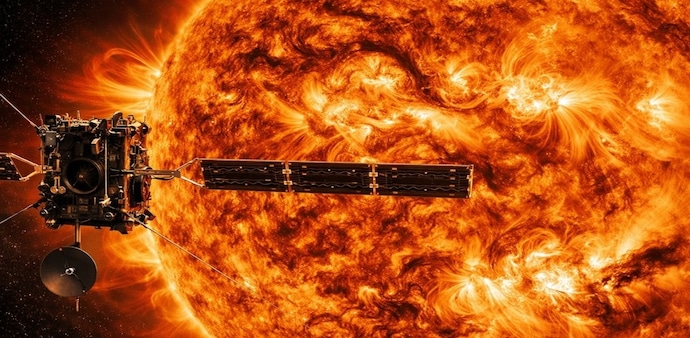
A coronal mass ejection is a massive burst of hot, magnetised plasma released from the Sun’s outer atmosphere, known as the corona
- Nov 5, 2026,
- Updated Nov 5, 2026 4:48 PM IST
India’s first space-based solar observatory, Aditya-L1, has helped scientists uncover new details about how powerful solar eruptions expand near the Sun, challenging the long-standing assumption that these events spread uniformly like spherical bubbles. The findings could improve scientists’ understanding of space weather and help refine predictions of solar storms that may affect Earth.
According to the Indian Space Research Organisation (ISRO), scientists from the Indian Institute of Astrophysics (IIA), Bengaluru, combined observations from Aditya-L1’s Visible Emission Line Coronagraph (VELC), images captured by NASA’s Solar Dynamics Observatory (SDO), and three-dimensional modelling to reconstruct the structure and movement of a solar eruption.
READ THIS: India's GPS rival gets a boost as ISRO places NVS-03 into orbit. Why it matters?
The study, published in The Astrophysical Journal Letters, examined a coronal mass ejection (CME) observed on August 5, 2024. Researchers found that the eruption expanded unevenly, developing an asymmetric shape instead of spreading equally in all directions.
How Aditya-L1 captured the solar eruption
A coronal mass ejection is a massive burst of hot, magnetised plasma released from the Sun’s outer atmosphere, known as the corona. When directed towards Earth, these eruptions can trigger space-weather disturbances that may affect satellites, communication networks and other technological infrastructure.
Understanding their speed, direction and expansion is crucial to predicting their potential impact. However, conventional coronagraphs primarily capture the movement of solar eruptions across the sky, making it difficult to measure how quickly the plasma moves towards or away from an observer.
Aditya-L1’s VELC instrument addresses this limitation through a technique called Doppler spectroscopy. It measures shifts in the wavelength of light emitted by moving plasma. Material moving towards an observer produces a blue shift, while material moving away produces a red shift.
DON'T MISS: 4 launch pads by 2029: ISRO lays out India’s next big space expansion plan
During the August 2024 event, VELC detected distinct blue- and red-shifted emission features, revealing plasma moving in opposite directions along the observer’s line of sight. When combined with NASA’s imaging data, these observations provided a more complete picture of the eruption’s three-dimensional structure.
Why the discovery matters
The research team developed a three-dimensional geometric and kinematic model to explain the observations. A model assuming uniform expansion could not reproduce the recorded spectral patterns. However, a model incorporating a tilted structure and uneven sideways expansion closely matched the data.
According to ISRO, the asymmetric shape of a CME can influence how it interacts with the solar wind, potentially affecting its speed as it travels through space. This could make predicting its arrival time at Earth more challenging.
More accurate observations of solar eruptions could eventually strengthen space-weather forecasting, helping satellite operators and other agencies better prepare for potential disturbances.
What comes next?
Researchers plan to apply the technique to additional solar eruptions to determine how reliably VELC can reconstruct their movement and geometry. The study demonstrates how combining spectroscopy, imaging and modelling can reveal information that conventional two-dimensional observations may miss.
Launched in September 2023, Aditya-L1 operates near the Sun-Earth L1 point, approximately 1.5 million kilometres from Earth. Its continuous observations offer scientists a valuable opportunity to study solar activity and better understand how eruptions evolve before travelling through interplanetary space.