
Making bad decisions? These 5 lessons from insects could help you choose better
Some of these behaviours have even inspired algorithms used in transport, logistics and telecommunications.
- Aug 13, 2026,
- Updated Aug 13, 2026 8:00 AM IST
Making good decisions is not always easy. We often spend a lot of time thinking about our choices, only to end up making the wrong call. Surprisingly, insects may have a few lessons for us.
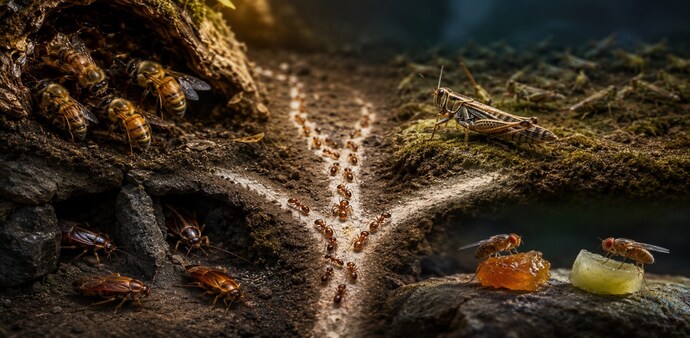
From ants finding the best route to honeybees choosing a new home, insects have developed simple ways to deal with difficult decisions. Some of these behaviours have even inspired algorithms used in transport, logistics and telecommunications.
Here are five lessons we can learn from them.
1. Ants: Give the best option time to emerge
Ants have to choose the best places to find food. Instead of having one ant make the decision, many ants explore different routes.
As they travel, they leave pheromone trails. Shorter and more efficient routes are reinforced because ants return faster and leave stronger trails. Over time, more ants follow the strongest route while weaker options disappear.
Speaking to the BBC, Marco Dorigo, co-director of the artificial intelligence lab of the Université Libre de Bruxelles, said: “The main lesson… is that efficient collective decision-making can emerge without centralised control," says Marco Dorigo, co-director of the artificial intelligence lab of the Université Libre de Bruxelles, in Belgium. "[Ants are] simple individuals with limited capabilities and only local information, yet they are able to collectively solve complex coordination problems."
Don't Miss: 60% of world's wild Asian elephants live in India: Why their survival matters
2. Honeybees: Listen to different opinions
Honeybees also rely on group decision-making when they need to find a new home.
Scout bees search for possible nesting sites and return to the colony. They use a "waggle dance" to tell other bees about the quality and location of a site. Other bees then check those options themselves.
Eventually, enough bees support one location and the colony reaches a decision.
The lesson is simple: instead of rushing to agree, give different options a fair chance before making a group decision.
3. Locusts: It is okay to pause
A study of marching locusts found that a short period of indecision can help a group change direction.
Christian (Kit) Yates, professor of mathematical biology at the University of Bath, studied groups of locusts and found that when some became neutral instead of following a direction, the swarm could move away from an existing consensus.
Yates also tested 19 humans and found that allowing people to abstain helped groups reach a decision more "quickly and cleanly".
"With fewer active votes in play, the same small nudge – a brief local cluster moving the other way, a noisy bit of information, a couple of people switching allegiance – produces a larger proportional effect on the group's direction," says Yates.
Sometimes, stepping back and pausing can help people rethink a decision.
Must Read: The journey of N Chandrasekaran - From humble beginnings to Ratan Tata's most trusted lieutenant
4. Cockroaches: Different personalities can help
Cockroaches may not seem like good team players, but their differences can actually help a group decide faster.
Researcher Isaac Planas-Sitjà found that groups with a mix of bold and timid cockroaches made collective decisions faster than groups where all behaved in the same way.
"I was very surprised. I expected to see some trend, but not such a clear and repeatable pattern," says Planas-Sitjà.
The lesson: a group does not always benefit from everyone thinking and behaving in exactly the same way.
5. Fruit flies: Know what affects your judgement
Fruit flies can weigh risks, rewards and even their own condition before making choices.
They take longer to choose between similar smells and can choose bitter but nutritious food over something tasty but less nutritious. Their decisions also change when they are hungry or stressed.
This offers a useful lesson for humans: our mood, stress and past experiences can affect how we judge situations.
Sometimes, understanding our own state before making a decision can be just as important as looking at the choices in front of us.
Making good decisions is not always easy. We often spend a lot of time thinking about our choices, only to end up making the wrong call. Surprisingly, insects may have a few lessons for us.
From ants finding the best route to honeybees choosing a new home, insects have developed simple ways to deal with difficult decisions. Some of these behaviours have even inspired algorithms used in transport, logistics and telecommunications.
Here are five lessons we can learn from them.
1. Ants: Give the best option time to emerge
Ants have to choose the best places to find food. Instead of having one ant make the decision, many ants explore different routes.
As they travel, they leave pheromone trails. Shorter and more efficient routes are reinforced because ants return faster and leave stronger trails. Over time, more ants follow the strongest route while weaker options disappear.
Speaking to the BBC, Marco Dorigo, co-director of the artificial intelligence lab of the Université Libre de Bruxelles, said: “The main lesson… is that efficient collective decision-making can emerge without centralised control," says Marco Dorigo, co-director of the artificial intelligence lab of the Université Libre de Bruxelles, in Belgium. "[Ants are] simple individuals with limited capabilities and only local information, yet they are able to collectively solve complex coordination problems."
Don't Miss: 60% of world's wild Asian elephants live in India: Why their survival matters
2. Honeybees: Listen to different opinions
Honeybees also rely on group decision-making when they need to find a new home.
Scout bees search for possible nesting sites and return to the colony. They use a "waggle dance" to tell other bees about the quality and location of a site. Other bees then check those options themselves.
Eventually, enough bees support one location and the colony reaches a decision.
The lesson is simple: instead of rushing to agree, give different options a fair chance before making a group decision.
3. Locusts: It is okay to pause
A study of marching locusts found that a short period of indecision can help a group change direction.
Christian (Kit) Yates, professor of mathematical biology at the University of Bath, studied groups of locusts and found that when some became neutral instead of following a direction, the swarm could move away from an existing consensus.
Yates also tested 19 humans and found that allowing people to abstain helped groups reach a decision more "quickly and cleanly".
"With fewer active votes in play, the same small nudge – a brief local cluster moving the other way, a noisy bit of information, a couple of people switching allegiance – produces a larger proportional effect on the group's direction," says Yates.
Sometimes, stepping back and pausing can help people rethink a decision.
Must Read: The journey of N Chandrasekaran - From humble beginnings to Ratan Tata's most trusted lieutenant
4. Cockroaches: Different personalities can help
Cockroaches may not seem like good team players, but their differences can actually help a group decide faster.
Researcher Isaac Planas-Sitjà found that groups with a mix of bold and timid cockroaches made collective decisions faster than groups where all behaved in the same way.
"I was very surprised. I expected to see some trend, but not such a clear and repeatable pattern," says Planas-Sitjà.
The lesson: a group does not always benefit from everyone thinking and behaving in exactly the same way.
5. Fruit flies: Know what affects your judgement
Fruit flies can weigh risks, rewards and even their own condition before making choices.
They take longer to choose between similar smells and can choose bitter but nutritious food over something tasty but less nutritious. Their decisions also change when they are hungry or stressed.
This offers a useful lesson for humans: our mood, stress and past experiences can affect how we judge situations.
Sometimes, understanding our own state before making a decision can be just as important as looking at the choices in front of us.