
NASA’s asteroid crash test left a crater almost as big as the space rock itself. Here’s what new images show
Scientists say large asteroids can cause global devastation, while an asteroid around the size of Dimorphos could potentially wipe out a city.
- Nov 26, 2026,
- Updated Nov 26, 2026 3:28 PM IST
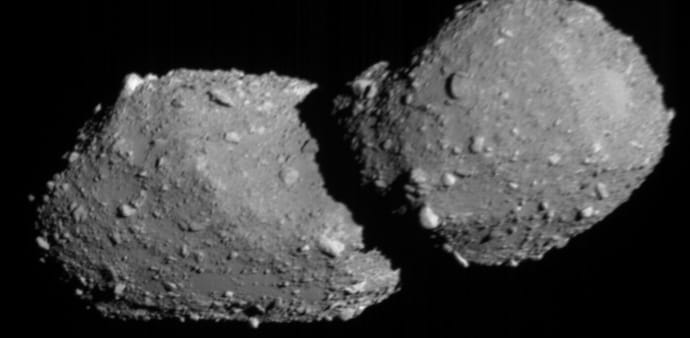
NASA’s asteroid defence test has left a crater almost as large as the space rock itself, with new images showing the damage caused when a spacecraft deliberately slammed into the asteroid Dimorphos in 2022, BBC reported on Tuesday.
The images were captured by the European Space Agency’s Hera spacecraft, which has reached the asteroid system to study what happened after NASA’s Dart spacecraft hit Dimorphos at 14,000mph (22,000km/h).
Dimorphos, which is about 150m (500ft) wide, was not a threat to Earth. NASA chose it as part of a planetary defence test to find out whether humans could change the path of an asteroid.
Before the impact, Dimorphos took 11 hours and 55 minutes to orbit its larger companion, Didymos. After the crash, its orbital period became about 33 minutes shorter.
The impact also sent debris stretching about 6,200 miles (10,000km), which was spotted by telescopes in space and on Earth.
"The crater is almost as large as the body itself, which is really, really spectacular," said Dr Sabina Raducan, a planetary scientist on the Hera science team.
Don't Miss: Voyager 1 reaches 1 light-day from Earth, a first for any human-made object. Here’s what we know so far
Hera investigates the crash site
Hera will spend the next six months studying Dimorphos and Didymos in greater detail. One of its main goals is to measure the mass of Dimorphos and understand how effective the Dart impact was.
"It would help us to predict what would happen if we had to hit another asteroid," said Prof Simon Green, a planetary scientist on Hera's science team.
The impact also changed how Dimorphos moves. Before the crash, it always showed the same face to Didymos. It is now tumbling through space.
"Now it's very, very chaotic - it's tumbling. Imagine a barrel that you throw down the stairs, and the barrel is rolling and it's moving, and basically that's what Dimorphos does right now around Didymos," Raducan said.
Why asteroid defence matters
Scientists say large asteroids can cause global devastation, while an asteroid around the size of Dimorphos could potentially wipe out a city.
"We all know what happened to the dinosaurs, right? And we don't want that to happen to us," said Carolyn Ernst of Johns Hopkins Applied Physics Laboratory.
The next major step will be NASA's NEO Surveyor, a space telescope planned for launch in 2027 to search for potentially hazardous asteroids. Scientists are also preparing to study Apophis, a 450m (1,480ft) asteroid that will pass about 32,000km (20,000 miles) above Earth in 2029.