
Pangea Ultima: New supercontinent could make 92% of Earth’s land uninhabitable for humans. Here's when
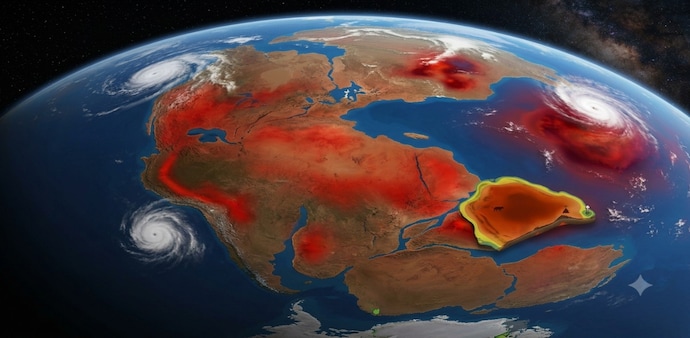
A 2023 study modelling Pangea Ultima found that elevated carbon dioxide, stronger solar radiation and the climatic effects of a supercontinent could push large parts of the planet beyond the physiological limits of mammals.
- Sep 8, 2026,
- Updated Sep 8, 2026 1:00 AM IST
Earth’s continents may look permanent on a human timescale, but over hundreds of millions of years they are constantly being reshaped by tectonic forces. One possible future map is already being modelled by scientists and it could create a planet dramatically less hospitable to mammals.
Around 250 million years from now, Earth’s continents are expected to converge into a new supercontinent known as Pangea Ultima. The exact configuration remains uncertain, with several possible supercontinent scenarios proposed, but the climate consequences of a giant, consolidated landmass could be severe.
A second Pangea takes shape
The original Pangea formed roughly 300 million years ago before breaking apart and eventually giving rise to the continents seen today. The process is not over. Earth’s tectonic plates continue to move, slowly bringing major landmasses together.
In the Pangea Ultima scenario, an Afro-Eurasian landmass could eventually collide with the Americas, producing a vast supercontinent surrounded by ocean.
Scientists stress that this is a deep-time projection rather than a precise forecast. Other possible futures include Novopangea, Aurica and Amasia, each based on different assumptions about how today’s tectonic plates will move.
But whichever configuration eventually emerges, bringing huge amounts of land together would fundamentally alter Earth’s climate.
Why a supercontinent could become dangerously hot
The problem is not simply that there would be more land. A supercontinent would create a much more continental climate, meaning regions far from the moderating influence of oceans could experience much larger temperature swings.
At the same time, Earth’s Sun will gradually become brighter. Researchers estimate that roughly 250 million years from now, solar energy reaching Earth could be about 2.5% higher than today. That additional energy would compound the warming produced by changes in atmospheric carbon dioxide and the geography of the planet.
A 2023 study modelling Pangea Ultima examined these factors together. It found that elevated carbon dioxide, stronger solar radiation and the climatic effects of a supercontinent could push large parts of the planet beyond the physiological limits of mammals.
Up to 92% of land could become hostile
The modelling produced a stark picture. Under some conditions, as much as 92% of Earth’s land surface could become unsuitable for mammals.
The biggest threats would be extreme heat and dryness. Vast interior regions of the supercontinent could become intensely hot, while areas away from the oceans would lose the moderating influence of maritime climates.
The researchers found that even projected background atmospheric CO₂ levels — not necessarily anything resembling today’s human-driven emissions — could contribute to conditions hostile to mammalian life when combined with the future Sun and continental geography.
That does not mean Earth would become a dead planet.
Earth would remain habitable for some life
The study focuses particularly on mammals and their physiological limits, rather than declaring the end of all life. Organisms with different heat tolerances, water requirements and metabolic systems could potentially survive in regions that become unsuitable for mammals.
The researchers also emphasise that the eventual climate will depend on several interacting factors, including atmospheric carbon dioxide, volcanic activity, weathering and the precise arrangement of continents.
In other words, Pangea Ultima would not simply turn Earth into another Venus. Instead, it could produce a planet where habitable zones become increasingly fragmented and difficult for large terrestrial animals to occupy.
A warning from deep time
The scenario is so far into the future that no present-day human society would experience it. Yet the research offers an unusual perspective on Earth’s habitability.
The planet’s climate is shaped not only by what happens in the atmosphere today, but also by forces operating over geological timescales. Continental drift can alter ocean circulation, rainfall, temperatures and the carbon cycle, while the Sun itself steadily grows brighter.
The eventual fate of Pangea Ultima therefore illustrates a broader point: Earth’s present geography and climate are temporary states in a planet that is constantly changing.
Earth’s continents may look permanent on a human timescale, but over hundreds of millions of years they are constantly being reshaped by tectonic forces. One possible future map is already being modelled by scientists and it could create a planet dramatically less hospitable to mammals.
Around 250 million years from now, Earth’s continents are expected to converge into a new supercontinent known as Pangea Ultima. The exact configuration remains uncertain, with several possible supercontinent scenarios proposed, but the climate consequences of a giant, consolidated landmass could be severe.
A second Pangea takes shape
The original Pangea formed roughly 300 million years ago before breaking apart and eventually giving rise to the continents seen today. The process is not over. Earth’s tectonic plates continue to move, slowly bringing major landmasses together.
In the Pangea Ultima scenario, an Afro-Eurasian landmass could eventually collide with the Americas, producing a vast supercontinent surrounded by ocean.
Scientists stress that this is a deep-time projection rather than a precise forecast. Other possible futures include Novopangea, Aurica and Amasia, each based on different assumptions about how today’s tectonic plates will move.
But whichever configuration eventually emerges, bringing huge amounts of land together would fundamentally alter Earth’s climate.
Why a supercontinent could become dangerously hot
The problem is not simply that there would be more land. A supercontinent would create a much more continental climate, meaning regions far from the moderating influence of oceans could experience much larger temperature swings.
At the same time, Earth’s Sun will gradually become brighter. Researchers estimate that roughly 250 million years from now, solar energy reaching Earth could be about 2.5% higher than today. That additional energy would compound the warming produced by changes in atmospheric carbon dioxide and the geography of the planet.
A 2023 study modelling Pangea Ultima examined these factors together. It found that elevated carbon dioxide, stronger solar radiation and the climatic effects of a supercontinent could push large parts of the planet beyond the physiological limits of mammals.
Up to 92% of land could become hostile
The modelling produced a stark picture. Under some conditions, as much as 92% of Earth’s land surface could become unsuitable for mammals.
The biggest threats would be extreme heat and dryness. Vast interior regions of the supercontinent could become intensely hot, while areas away from the oceans would lose the moderating influence of maritime climates.
The researchers found that even projected background atmospheric CO₂ levels — not necessarily anything resembling today’s human-driven emissions — could contribute to conditions hostile to mammalian life when combined with the future Sun and continental geography.
That does not mean Earth would become a dead planet.
Earth would remain habitable for some life
The study focuses particularly on mammals and their physiological limits, rather than declaring the end of all life. Organisms with different heat tolerances, water requirements and metabolic systems could potentially survive in regions that become unsuitable for mammals.
The researchers also emphasise that the eventual climate will depend on several interacting factors, including atmospheric carbon dioxide, volcanic activity, weathering and the precise arrangement of continents.
In other words, Pangea Ultima would not simply turn Earth into another Venus. Instead, it could produce a planet where habitable zones become increasingly fragmented and difficult for large terrestrial animals to occupy.
A warning from deep time
The scenario is so far into the future that no present-day human society would experience it. Yet the research offers an unusual perspective on Earth’s habitability.
The planet’s climate is shaped not only by what happens in the atmosphere today, but also by forces operating over geological timescales. Continental drift can alter ocean circulation, rainfall, temperatures and the carbon cycle, while the Sun itself steadily grows brighter.
The eventual fate of Pangea Ultima therefore illustrates a broader point: Earth’s present geography and climate are temporary states in a planet that is constantly changing.