
'Russia stood by India': ISRO chief V Narayanan recalls Moscow's role in space journey
The ISRO chief also spoke about India's efforts to acquire cryogenic engine technology, which is essential for launching heavier payloads into space
- Nov 7, 2026,
- Updated Nov 7, 2026 3:25 AM IST
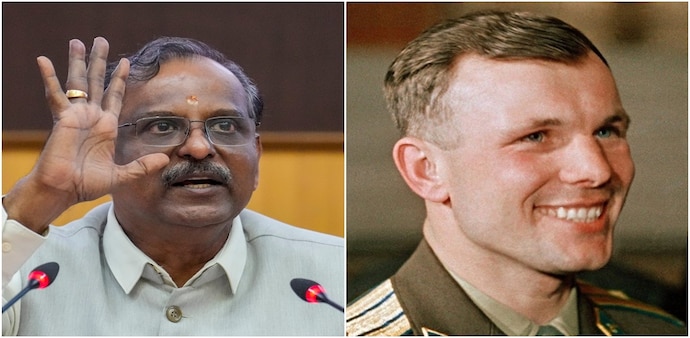
The Chairman of the Indian Space Research Organisation (ISRO), V Narayanan, on November 5 thanked Russia for its longstanding support to India's space programme, recalling the country's contribution to key milestones in India's journey towards becoming a major space power.
Narayanan made the remarks while unveiling a statue of Soviet cosmonaut Yuri Gagarin, the first human to travel into space, at the Periyar Science and Technology Centre in Chennai. The event was attended by Valery Khodzhaev, Consul General of the Russian Federation in Chennai, and other officials.
READ THIS: ISRO's Aditya-L1 detects uneven solar eruption, could improve space weather forecasts
Recalling the historical ties between India and Russia in space exploration, Narayanan highlighted Moscow's contribution to India's early satellite programme and human spaceflight ambitions. He said that Russia and the former Soviet Union had supported India at crucial stages when several countries were reluctant to share advanced space technologies.
Russia's contribution to India's space journey
Narayanan recalled that India's first satellite, Aryabhata, was launched in 1975 with the assistance of the Soviet Union. He also highlighted Russia's role in India's first human spaceflight milestone, when Indian astronaut Rakesh Sharma travelled aboard the Soviet Soyuz T-11 spacecraft in 1984.
The ISRO chief also spoke about India's efforts to acquire cryogenic engine technology, which is essential for launching heavier payloads into space. He said several countries had refused to provide the technology, citing restrictions under the Missile Technology Control Regime (MTCR).
"However, Russia was ready to provide us that cryogenic technology. I was also part of the team that went to Russia to acquire the technology. But, due to certain geopolitical circumstances, it could not materialise," Narayanan said.
Despite the proposed technology transfer not materialising, India eventually developed its own cryogenic engine technology, marking a significant achievement in its efforts to strengthen indigenous launch capabilities.
India makes progress in space exploration
Narayanan pointed to India's growing capabilities, including the Chandrayaan-3 mission's successful landing near the Moon's south polar region, the Mars Orbiter Mission and the launch of 104 satellites in a single mission aboard the PSLV-C37 rocket in February 2017.
ALSO READ: India's GPS rival gets a boost as ISRO places NVS-03 into orbit. Why it matters?
These achievements reflect India's progress from relying on international assistance in its early years to developing advanced technologies and undertaking complex space missions independently.
The ISRO chief also highlighted Russia's continued support for India's ambitious Gaganyaan human spaceflight programme. The mission aims to demonstrate India's capability to send astronauts into low Earth orbit using indigenous systems.
The unveiling of Gagarin's statue also served as a tribute to the pioneering achievements of human spaceflight. Gagarin became the first human to travel into space on April 12, 1961, aboard the Vostok 1 spacecraft.