
SpaceX sets November 13 target for historic feat, Musk highlights 'critical breakthrough'
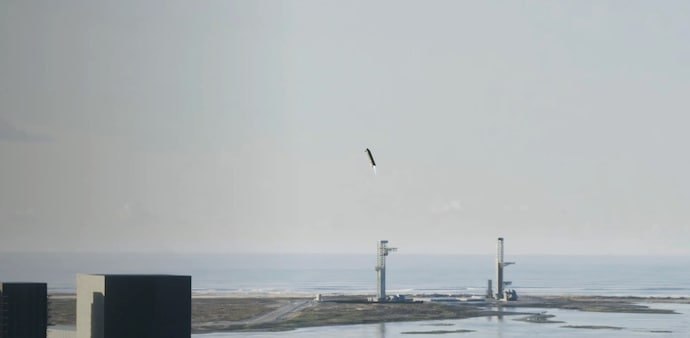
In previous test flights, SpaceX successfully demonstrated catching the massive Super Heavy booster using the "chopstick" mechanical arms — nicknamed Mechazilla — attached to the launch tower at Starbase in Texas.
- Nov 7, 2026,
- Updated Nov 7, 2026 8:19 AM IST
SpaceX is preparing for its most audacious test flight yet, targeting a November 13 launch for Starship Flight 15. According to SpaceX Vice President of Launch Kiko Dontchev, the upcoming mission aims to push the boundaries of aerospace engineering by attempting to catch both the Super Heavy booster and the upper-stage Starship spacecraft back at the launch tower using its mechanical arms.
SpaceX boss Elon Musk has described Starship Flight 15 as a “profound technology milestone” in rocket science and space exploration. "SpaceX will attempt to catch both the Super Heavy booster and Starship on the upcoming flight. If both are successful, it will mark the first time that all parts of an orbital rocket return to Earth intact. This is the critical breakthrough needed to make life multiplanetary," he wrote in a post on X (formally twitter).
Rapid and complete rocket reusability sits at the center of Musk's long-term strategy to dramatically lower the cost of spaceflight and pave the way for human missions to the Moon and Mars.
Mechanics of a dual catch
During a standard launch profile, the Super Heavy booster provides the initial thrust before separating from the Starship spacecraft high in the atmosphere. In previous test flights, SpaceX successfully demonstrated catching the massive Super Heavy booster using the "chopstick" mechanical arms — nicknamed Mechazilla — attached to the launch tower at Starbase in Texas.
Flight 15 aims to take that mechanism a step further. After stage separation, the Super Heavy booster will execute a boostback burn to return directly to the pad. Once the booster is captured, the pad infrastructure will clear to prepare for the return of the upper stage. If successful, returning both vehicle components to the launch site intact will demonstrate full system operational recovery in a single mission.
Thermal & re-entry challenges
Catching the upper-stage Starship poses significantly higher technical hurdles than recovering the booster. While the booster operates primarily at suborbital speeds and lower altitudes, the Starship spacecraft must endure hypersonic atmospheric re-entry from orbit. The upper stage faces extreme thermal loads, reaching thousands of degrees Celsius, which requires thousands of heat-shield tiles to maintain structural integrity.
To execute a precise tower catch, Starship must survive re-entry intact, perform a belly-flop maneuver to bleed off velocity, restart its Raptor engines, and flip vertical to align with the chopstick arms. Controlling an upper stage through hypersonic re-entry down to a precision hover at the pad represents one of the most difficult dynamic guidance challenges in space exploration.
Achieving full reusability is the cornerstone of SpaceX's architecture for deep-space exploration. Traditional launch systems discard their primary stages in the ocean, incurring massive hardware replacement costs for every flight. By recovering both stages directly at the launch pad, SpaceX intends to turn rocket operations into something resembling commercial airline turnarounds: inspect, refuel, and launch again.