
Spain's unstable volcano raises megatsunami fears: Could 65-foot waves hit the US East Coast?
Cumbre Vieja is an active volcanic ridge located on La Palma, part of Spain's Canary Islands in the Atlantic Ocean, off the northwestern coast of Africa. The volcano has a history of eruptions, most recently in 2021, when lava flows damaged homes, infrastructure and large areas of land on the island.
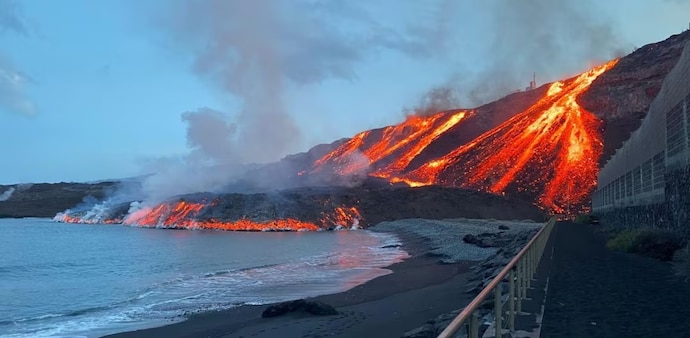
- Nov 8, 2026,
- Updated Nov 8, 2026 2:00 AM IST
A volcanic collapse thousands of kilometres away could potentially trigger a massive tsunami across the Atlantic Ocean, threatening parts of the US East Coast, including Florida and other coastal regions. Scientists have warned that a section of the Cumbre Vieja volcano on Spain's Canary Islands could eventually collapse into the ocean, generating waves powerful enough to cross the Atlantic and reach North America.
The warning has renewed attention on the long-debated possibility of a volcanic megatsunami originating from La Palma, one of the Canary Islands. According to volcanologist Professor Bill McGuire, such an event could generate waves reaching approximately 65 feet (20 metres) along parts of the US coastline, potentially arriving within nine hours of the collapse.
However, scientists stress that the scenario is not an imminent threat. The timing, scale and eventual consequences of such a collapse remain uncertain, with the possibility that it could occur centuries or even thousands of years from now.
What is the Cumbre Vieja volcano and why is it a concern?
Cumbre Vieja is an active volcanic ridge located on La Palma, part of Spain's Canary Islands in the Atlantic Ocean, off the northwestern coast of Africa. The volcano has a history of eruptions, most recently in 2021, when lava flows damaged homes, infrastructure and large areas of land on the island.
The concern centres on the stability of a section of the volcano's western flank. Researchers have investigated whether a future volcanic eruption could destabilise this section, causing a massive volume of rock to slide into the Atlantic Ocean.
If a sufficiently large landslide occurred, the sudden displacement of seawater could generate an enormous tsunami. Unlike conventional tsunamis triggered by underwater earthquakes, these waves would originate from the collapse of a volcanic island's flank.
How could a volcanic collapse trigger a megatsunami?
The megatsunami hypothesis gained international attention following a 2001 research paper by geophysicists Steven Ward and Simon Day. Their study examined a hypothetical collapse of Cumbre Vieja's western flank, estimating that between 150 and 500 cubic kilometres of rock could enter the Atlantic Ocean.
The researchers modelled how such a landslide could displace enormous quantities of water and generate waves capable of travelling across the Atlantic. Under the most extreme scenario, waves reaching the American coastline could measure between 10 and 25 metres.
The latest warning from McGuire revisits this possibility, arguing that geological evidence, including enormous boulders found along the Bahamas coastline, could point to powerful prehistoric tsunamis originating in the Canary Islands.
Such evidence has fuelled the debate over whether a future volcanic collapse could produce destructive waves thousands of kilometres from their source.
How long would the tsunami take to reach the US?
One of the most concerning aspects of the hypothetical scenario is the speed at which a tsunami could travel across the Atlantic. According to the warning, waves generated by a major collapse could reach parts of the US East Coast within approximately nine hours.
Florida and other coastal regions along the eastern seaboard could potentially face significant exposure under the most severe projections.
However, the actual impact would depend on several factors, including the volume of rock involved, the speed and nature of the collapse, ocean-floor topography and the characteristics of the resulting waves.
The height of a tsunami in the open ocean also does not necessarily translate into the same height when it reaches a coastline. Local geography and coastal conditions can substantially influence wave behaviour and inundation.
Why scientists disagree over the megatsunami threat
The possibility of a transatlantic megatsunami has remained controversial within the scientific community.
The US Geological Survey (USGS), in a 2021 assessment, challenged the original megatsunami hypothesis, arguing that the initial modelling relied on an unrealistic assumption: that an enormous section of the volcano would collapse as one massive, rapidly moving block.
Subsequent investigations of underwater geological formations suggest that volcanic flank collapses generally happen in multiple stages rather than through a single catastrophic landslide.
Researchers have also developed more sophisticated tsunami models that account for wave dispersion, ocean-floor depth and the interaction between landslide material and seawater.
According to the USGS, updated simulations suggest that even a worst-case collapse of La Palma could produce maximum wave heights of approximately 1-2 metres (3-7 feet) along the eastern coasts of the Americas.
The agency also pointed out that geological evidence of deposits from such enormous transatlantic tsunamis has not been identified along the eastern coastlines of North and South America.
A 2025 assessment of tsunami hazards along the US East Coast also examined hypothetical Cumbre Vieja flank-collapse scenarios, highlighting the importance of modelling different potential sources and their consequences.