
Worried about pesticide residue on fruits? This new wash removes up to 96% and also slows spoilage
Some pesticides can move into plant tissue while the fruit is growing.
- Sep 9, 2026,
- Updated Sep 9, 2026 2:00 AM IST
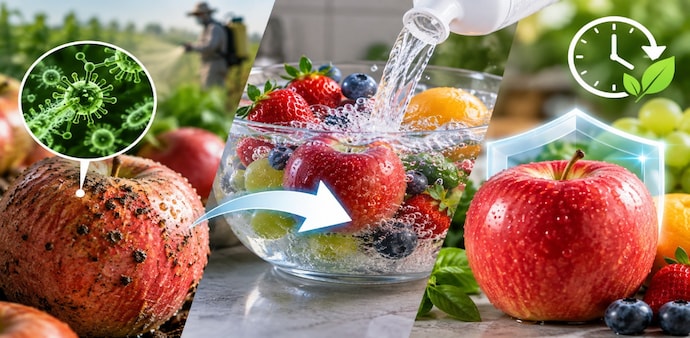
A new fruit wash developed by researchers at the University of British Columbia is aiming to tackle two everyday problems at once: pesticide residue on fresh produce and fruit that goes bad before it can be eaten, scitechdaily reported on Monday.
The biodegradable formulation has been shown to remove large amounts of surface pesticide residue while also helping fruits retain moisture and stay fresh for longer.
For Indian households, where fruits and vegetables are washed almost as soon as they reach the kitchen, the research offers an interesting look at what a more advanced produce-washing method could eventually offer.
However, the formulation is not yet ready to replace the simple running-water rinse recommended for consumers.
The researchers developed the wash using starch nanoparticles, tannic acid and iron. Tests showed that it could remove more than 85% of thiabendazole from apple surfaces. By comparison, tap water removed 48%, baking soda removed 65% and native starch removed 61%.
The wash also removed 93% of acetamiprid and 89% of imidacloprid residues from apple surfaces.
Don't Miss: 'Team Tukaram Mundhe': Preity Zinta backs Maharashtra’s strict FDA chief, here's why
How does the fruit wash work?
The formulation combines plant-based materials with iron to create a fine network around starch particles. During washing, the structure interacts with certain pesticide molecules on the surface of the fruit and helps remove them.
After washing, the same formulation can form a thin coating on the fruit. The researchers say this layer is not intended to behave like a heavy wax coating. Instead, it acts as a light surface film that helps slow moisture loss and deterioration.
That could be particularly useful for fruits that lose their quality quickly after purchase. Grapes, for instance, can shrivel as they lose water, while cut apples can turn brown within a short time.
Grapes lost less weight in testing
The researchers tested the formulation for its ability to extend the freshness of produce.
Over 15 days, untreated grapes lost around 45% of their weight. Grapes treated with the wash lost 21%.
Fresh-cut apples also showed a difference. Their weight loss over 48 hours fell from 17% in untreated samples to 9% after treatment.
The treated grapes also maintained a fresher appearance, while apple slices browned more slowly.
The coating additionally showed an ability to slow oxidation and inhibited a test bacterium in laboratory experiments. However, these results do not mean the formulation has already cleared the safety testing required for use by consumers.
It does not remove all pesticide exposure
One important point is that the wash was tested against pesticide residues present on the surface of fruits.
Some pesticides can move into plant tissue while the fruit is growing. Such residues are much harder to remove after harvest.
This means the formulation should not be viewed as a way to eliminate all pesticide exposure. Its demonstrated benefit so far is reducing certain residues present on the surface.
What does this mean for consumers?
The researchers see post-harvest processing facilities as a more realistic first use for the technology. Such facilities can better control the concentration of the wash, treatment time, water use and disposal.
The estimated raw-material cost is less than US$0.032 per apple.
Must Read: Delhi to get new PG rules, safety standards within 1.5 months: Education Minister Ashish Sood
The team is also working on a household spray formulation, which could eventually make the technology more relevant for consumers. But more testing is needed before that happens.
The wash needs to be tested across a wider range of fruits and vegetables and under commercial conditions. It would also need to go through the relevant regulatory processes before it could be introduced for real-world consumer use.
For now, the research points towards a different approach to keeping fresh produce safe and usable for longer: instead of simply washing away surface residues, a future produce treatment could clean the fruit and leave behind a protective layer that slows deterioration.
A new fruit wash developed by researchers at the University of British Columbia is aiming to tackle two everyday problems at once: pesticide residue on fresh produce and fruit that goes bad before it can be eaten, scitechdaily reported on Monday.
The biodegradable formulation has been shown to remove large amounts of surface pesticide residue while also helping fruits retain moisture and stay fresh for longer.
For Indian households, where fruits and vegetables are washed almost as soon as they reach the kitchen, the research offers an interesting look at what a more advanced produce-washing method could eventually offer.
However, the formulation is not yet ready to replace the simple running-water rinse recommended for consumers.
The researchers developed the wash using starch nanoparticles, tannic acid and iron. Tests showed that it could remove more than 85% of thiabendazole from apple surfaces. By comparison, tap water removed 48%, baking soda removed 65% and native starch removed 61%.
The wash also removed 93% of acetamiprid and 89% of imidacloprid residues from apple surfaces.
Don't Miss: 'Team Tukaram Mundhe': Preity Zinta backs Maharashtra’s strict FDA chief, here's why
How does the fruit wash work?
The formulation combines plant-based materials with iron to create a fine network around starch particles. During washing, the structure interacts with certain pesticide molecules on the surface of the fruit and helps remove them.
After washing, the same formulation can form a thin coating on the fruit. The researchers say this layer is not intended to behave like a heavy wax coating. Instead, it acts as a light surface film that helps slow moisture loss and deterioration.
That could be particularly useful for fruits that lose their quality quickly after purchase. Grapes, for instance, can shrivel as they lose water, while cut apples can turn brown within a short time.
Grapes lost less weight in testing
The researchers tested the formulation for its ability to extend the freshness of produce.
Over 15 days, untreated grapes lost around 45% of their weight. Grapes treated with the wash lost 21%.
Fresh-cut apples also showed a difference. Their weight loss over 48 hours fell from 17% in untreated samples to 9% after treatment.
The treated grapes also maintained a fresher appearance, while apple slices browned more slowly.
The coating additionally showed an ability to slow oxidation and inhibited a test bacterium in laboratory experiments. However, these results do not mean the formulation has already cleared the safety testing required for use by consumers.
It does not remove all pesticide exposure
One important point is that the wash was tested against pesticide residues present on the surface of fruits.
Some pesticides can move into plant tissue while the fruit is growing. Such residues are much harder to remove after harvest.
This means the formulation should not be viewed as a way to eliminate all pesticide exposure. Its demonstrated benefit so far is reducing certain residues present on the surface.
What does this mean for consumers?
The researchers see post-harvest processing facilities as a more realistic first use for the technology. Such facilities can better control the concentration of the wash, treatment time, water use and disposal.
The estimated raw-material cost is less than US$0.032 per apple.
Must Read: Delhi to get new PG rules, safety standards within 1.5 months: Education Minister Ashish Sood
The team is also working on a household spray formulation, which could eventually make the technology more relevant for consumers. But more testing is needed before that happens.
The wash needs to be tested across a wider range of fruits and vegetables and under commercial conditions. It would also need to go through the relevant regulatory processes before it could be introduced for real-world consumer use.
For now, the research points towards a different approach to keeping fresh produce safe and usable for longer: instead of simply washing away surface residues, a future produce treatment could clean the fruit and leave behind a protective layer that slows deterioration.