
100-foot red carpet welcome: Trump gives Xi rare tarmac reception; trade talks, AI on agenda
Xi Jinping's three-day state visit will put trade, rare earths, artificial intelligence, Iran and Taiwan at the centre of his talks with US President Donald Trump. The visit marks his first return to Washington in 11 years.
- Sep 24, 2026,
- Updated Sep 24, 2026 6:47 AM IST
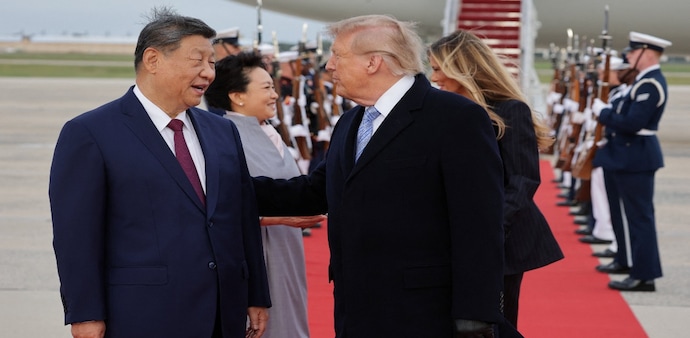
As Air China’s aircraft rolled to a stop at Joint Base Andrews, a 100-foot red carpet rolled out across the tarmac, flanked by a 21-person military honor guard and platoons representing every arm of the armed services. Two B-1 bombers roared overhead in a flyover, cutting through the mild 63-degree air, while military bands played national anthems.
Standing near the aircraft’s stairs were President Donald Trump and First Lady Melania Trump, waiting to deliver a rare planeside welcome to Chinese President Xi Jinping and his wife, Peng Liyuan.
Stepping off the staircase, Xi was greeted directly by Trump, who slipped off one of his gloves to shake hands. Trump leaned in, slapped Xi on the back, and shared a brief, inaudible exchange before the leaders stood together for the formal presentation of flags.
“I think they appreciate it, tremendous people,” Trump told reporters upon returning to the White House on Wednesday evening.
In a written statement issued upon landing, Xi framed the relationship around mutual benefit, stating that China and the US “should be partners, not rivals. Achieving the great rejuvenation of the Chinese nation and making America great again can go hand in hand and the two countries can contribute to each other’s success, thereby benefiting the wider world.”
Xi Jinping's three-day state visit will put trade, rare earths, artificial intelligence, Iran and Taiwan at the centre of his talks with US President Donald Trump. The visit marks his first return to Washington in 11 years. The Chinese president will be in the US from September 23 to September 25.
Secretary of State Marco Rubio underscored the necessity of direct engagement between the global powers, noting that the US and China represent “the two largest economies in the world” and “probably the two most powerful militaries in the world.”
Diplomatic Itinerary
Xi’s three-day schedule carries the full ceremonial weight of an official state visit:
- September 23: Arrival at Joint Base Andrews with planeside greeting by President Trump.
- September 24: Formal White House arrival ceremony on the State Floor, troop review in the Rose Garden, bilateral meetings in the Oval Office and Cabinet Room, followed by a state dinner in the East Room.
- September 25: Private tea party hosted by Donald and Melania Trump, a guided tour of the National Archives, and formal departure from Joint Base Andrews.
Silicon Valley Joins the guest list
Thursday night’s state dinner in the White House East Room has become a centerpiece of the visit, drawing intense interest from corporate America. Trump characterised the event as “a very tough ticket,” telling reporters in the Oval Office that “thousands of people would love to be at that dinner.”
The high-profile guest list highlights the central role of commercial and technological competition, featuring prominent American technology leaders including: Elon Musk (Tesla, SpaceX), Satya Nadella (Microsoft), Jensen Huang (Nvidia), Sam Altman (OpenAI), Tim Cook (Apple), Sundar Pichai (Alphabet/Google), Cristiano Amon (Qualcomm), Michael Dell (Dell Technologies) among others.
Xi is accompanied by a delegation of Chinese business executives, including leadership from electric vehicle manufacturer BYD.
Trade truce and strategic leverage
The immediate economic task facing both administrations is navigating the imminent expiration of their tariff truce on November 10. Without an extension or permanent agreement, automated tariff escalations threaten to disrupt global commerce. Preparatory negotiations led by US Treasury Secretary Scott Bessent and Chinese Vice Premier He Lifeng in New York established the deadline as the focal point of the summit.
While Washington is pressing Beijing over industrial overcapacity, China holds powerful leverage through its dominant position in critical mineral supply chains — controlling over 70% of global rare earth extraction and 90% of magnet processing. These materials are essential for electric vehicles, defense systems, and renewable energy technology.
In return for rare earth access, Beijing is seeking relief from US export restrictions on advanced semiconductors and chip-manufacturing equipment.
AI risk & technological competition
Beyond traditional manufacturing — where China posted a $1.2 trillion global trade surplus last year — technological parity in artificial intelligence and aerospace has pushed frontier technology into the diplomatic forefront. Domestic Chinese AI firms are rapidly approaching Silicon Valley standards, while commercial space companies in Beijing are developing reusable orbital rockets.
Amid this competition, both governments are discussing potential bilateral mechanisms designed to allow rapid communication in the event of serious AI-related security incidents.
As Air China’s aircraft rolled to a stop at Joint Base Andrews, a 100-foot red carpet rolled out across the tarmac, flanked by a 21-person military honor guard and platoons representing every arm of the armed services. Two B-1 bombers roared overhead in a flyover, cutting through the mild 63-degree air, while military bands played national anthems.
Standing near the aircraft’s stairs were President Donald Trump and First Lady Melania Trump, waiting to deliver a rare planeside welcome to Chinese President Xi Jinping and his wife, Peng Liyuan.
Stepping off the staircase, Xi was greeted directly by Trump, who slipped off one of his gloves to shake hands. Trump leaned in, slapped Xi on the back, and shared a brief, inaudible exchange before the leaders stood together for the formal presentation of flags.
“I think they appreciate it, tremendous people,” Trump told reporters upon returning to the White House on Wednesday evening.
In a written statement issued upon landing, Xi framed the relationship around mutual benefit, stating that China and the US “should be partners, not rivals. Achieving the great rejuvenation of the Chinese nation and making America great again can go hand in hand and the two countries can contribute to each other’s success, thereby benefiting the wider world.”
Xi Jinping's three-day state visit will put trade, rare earths, artificial intelligence, Iran and Taiwan at the centre of his talks with US President Donald Trump. The visit marks his first return to Washington in 11 years. The Chinese president will be in the US from September 23 to September 25.
Secretary of State Marco Rubio underscored the necessity of direct engagement between the global powers, noting that the US and China represent “the two largest economies in the world” and “probably the two most powerful militaries in the world.”
Diplomatic Itinerary
Xi’s three-day schedule carries the full ceremonial weight of an official state visit:
- September 23: Arrival at Joint Base Andrews with planeside greeting by President Trump.
- September 24: Formal White House arrival ceremony on the State Floor, troop review in the Rose Garden, bilateral meetings in the Oval Office and Cabinet Room, followed by a state dinner in the East Room.
- September 25: Private tea party hosted by Donald and Melania Trump, a guided tour of the National Archives, and formal departure from Joint Base Andrews.
Silicon Valley Joins the guest list
Thursday night’s state dinner in the White House East Room has become a centerpiece of the visit, drawing intense interest from corporate America. Trump characterised the event as “a very tough ticket,” telling reporters in the Oval Office that “thousands of people would love to be at that dinner.”
The high-profile guest list highlights the central role of commercial and technological competition, featuring prominent American technology leaders including: Elon Musk (Tesla, SpaceX), Satya Nadella (Microsoft), Jensen Huang (Nvidia), Sam Altman (OpenAI), Tim Cook (Apple), Sundar Pichai (Alphabet/Google), Cristiano Amon (Qualcomm), Michael Dell (Dell Technologies) among others.
Xi is accompanied by a delegation of Chinese business executives, including leadership from electric vehicle manufacturer BYD.
Trade truce and strategic leverage
The immediate economic task facing both administrations is navigating the imminent expiration of their tariff truce on November 10. Without an extension or permanent agreement, automated tariff escalations threaten to disrupt global commerce. Preparatory negotiations led by US Treasury Secretary Scott Bessent and Chinese Vice Premier He Lifeng in New York established the deadline as the focal point of the summit.
While Washington is pressing Beijing over industrial overcapacity, China holds powerful leverage through its dominant position in critical mineral supply chains — controlling over 70% of global rare earth extraction and 90% of magnet processing. These materials are essential for electric vehicles, defense systems, and renewable energy technology.
In return for rare earth access, Beijing is seeking relief from US export restrictions on advanced semiconductors and chip-manufacturing equipment.
AI risk & technological competition
Beyond traditional manufacturing — where China posted a $1.2 trillion global trade surplus last year — technological parity in artificial intelligence and aerospace has pushed frontier technology into the diplomatic forefront. Domestic Chinese AI firms are rapidly approaching Silicon Valley standards, while commercial space companies in Beijing are developing reusable orbital rockets.
Amid this competition, both governments are discussing potential bilateral mechanisms designed to allow rapid communication in the event of serious AI-related security incidents.