
100% tariffs: Trump warns Europe over looming digital services taxes, EU vows swift response
While the UK has levied a 2% digital services tax since 2020, European Union leaders have recently intensified discussions around an EU-wide digital tax to help fund its €2 trillion long-term budget commitments and repay post-pandemic loans.
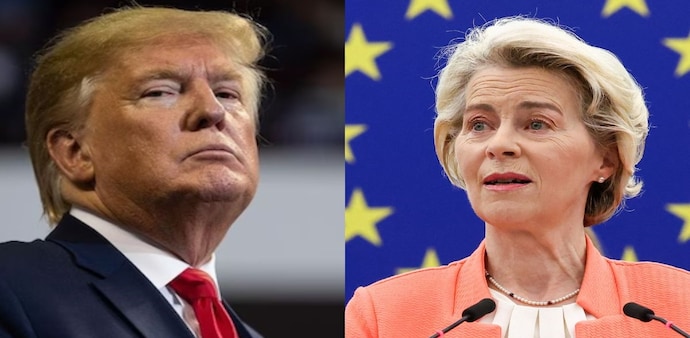
- Jun 27, 2026,
- Updated Jun 27, 2026 2:36 PM IST
Escalating his administration's global trade offensive against foreign regulation of American technology giants, President Donald Trump issued a sweeping warning on Friday, threatening to slap immediate 100% tariffs on any country that moves forward with a digital services tax.
The warning, delivered in a characteristically blunt directive on Truth Social, explicitly singled out European nations currently debating new fiscal frameworks aimed at taxing the local revenues of dominant U.S. tech firms.
In a post on his social platform, Truth Social, Trump wrote, "Numerous European Countries have been discussing the imminent implementation of a Digital Services Tax on American Companies. Some of these Countries are close to actually doing this. Please let this statement serve to represent that any Country that imposes such a Tax will immediately be met with a 100% TARIFF on any and all Goods sent to the United States of America. This TARIFF will supersede Trade Deals made with the Country, whether implemented, signed, or not. Additionally, the 100% TARIFF will be immediately imposed, if they proceed. Thank you for your attention to this matter. President DONALD J. TRUMP"
The declaration drops directly into an already delicate window for transatlantic commerce. The White House had previously established a July 4 deadline for the United States and the European Union to implement a heavily negotiated trade agreement designed to cap duties on most EU exports at 15%.
That package, tentatively brokered last year by European Commission President Ursula von der Leyen and finalized by the bloc in May, notably left digital services taxes outside the scope of the agreement. Trump's latest ultimatum effectively places that entire stabilization effort in immediate jeopardy.
Brussels responded swiftly to the threat, signaling that the 27-member bloc would not back down from its regulatory goals.
"Unilateral measures targeting such legitimate policies are unjustified. If pursued, the EU will respond swiftly and decisively to defend its rights and regulatory autonomy," said Olof Gill, a spokesperson for the European Commission. Gill defended the proposed digital frameworks, describing the taxation of technology corporations as "non-discriminatory" and noting that the rules apply equally to "all large companies, regardless of their origin."
The clash marks a major escalation in a multi-year battle over how multinational tech companies are taxed when operating across borders without a physical corporate presence. While the UK has levied a 2% digital services tax since 2020, European Union leaders have recently intensified discussions around an EU-wide digital tax to help fund its €2 trillion long-term budget commitments and repay post-pandemic loans. Estimates suggest an allied European digital tax could generate upwards of €40 billion annually.
White House officials indicated that the administration is preparing to execute the counter-tariffs under Section 301 of the Trade Act of 1974, which permits the executive branch to retaliate against foreign trade practices deemed unfair or discriminatory toward American commerce.
Escalating his administration's global trade offensive against foreign regulation of American technology giants, President Donald Trump issued a sweeping warning on Friday, threatening to slap immediate 100% tariffs on any country that moves forward with a digital services tax.
The warning, delivered in a characteristically blunt directive on Truth Social, explicitly singled out European nations currently debating new fiscal frameworks aimed at taxing the local revenues of dominant U.S. tech firms.
In a post on his social platform, Truth Social, Trump wrote, "Numerous European Countries have been discussing the imminent implementation of a Digital Services Tax on American Companies. Some of these Countries are close to actually doing this. Please let this statement serve to represent that any Country that imposes such a Tax will immediately be met with a 100% TARIFF on any and all Goods sent to the United States of America. This TARIFF will supersede Trade Deals made with the Country, whether implemented, signed, or not. Additionally, the 100% TARIFF will be immediately imposed, if they proceed. Thank you for your attention to this matter. President DONALD J. TRUMP"
The declaration drops directly into an already delicate window for transatlantic commerce. The White House had previously established a July 4 deadline for the United States and the European Union to implement a heavily negotiated trade agreement designed to cap duties on most EU exports at 15%.
That package, tentatively brokered last year by European Commission President Ursula von der Leyen and finalized by the bloc in May, notably left digital services taxes outside the scope of the agreement. Trump's latest ultimatum effectively places that entire stabilization effort in immediate jeopardy.
Brussels responded swiftly to the threat, signaling that the 27-member bloc would not back down from its regulatory goals.
"Unilateral measures targeting such legitimate policies are unjustified. If pursued, the EU will respond swiftly and decisively to defend its rights and regulatory autonomy," said Olof Gill, a spokesperson for the European Commission. Gill defended the proposed digital frameworks, describing the taxation of technology corporations as "non-discriminatory" and noting that the rules apply equally to "all large companies, regardless of their origin."
The clash marks a major escalation in a multi-year battle over how multinational tech companies are taxed when operating across borders without a physical corporate presence. While the UK has levied a 2% digital services tax since 2020, European Union leaders have recently intensified discussions around an EU-wide digital tax to help fund its €2 trillion long-term budget commitments and repay post-pandemic loans. Estimates suggest an allied European digital tax could generate upwards of €40 billion annually.
White House officials indicated that the administration is preparing to execute the counter-tariffs under Section 301 of the Trade Act of 1974, which permits the executive branch to retaliate against foreign trade practices deemed unfair or discriminatory toward American commerce.