
A family needed a home. Alabama students had 72,000 discarded carpet tiles and a very different idea
The concept was assigned by studio co-founder Sambo Mockbee for a charity house for Lucy and Anderson Harris and their children.
- Sep 1, 2026,
- Updated Sep 1, 2026 5:00 AM IST
What if discarded carpet tiles could become the walls of a home and help create a private place of prayer at the same time? In Alabama’s Hale County, an experimental house built more than two decades ago continues to show how design can respond to material constraints while putting a family’s needs at the centre.
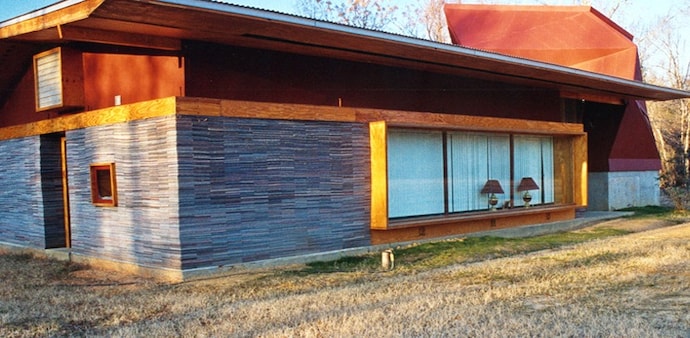
Known as the Lucy Carpet House, the home was completed in 2002 by six students working with Rural Studio, Auburn University’s off-campus design-build program.
The concept was assigned by studio co-founder Sambo Mockbee for a charity house for Lucy and Anderson Harris and their children, according to a report by The Times of India.
The house contains 72,000 individual stacked carpet tiles, compressed into its walls with a heavy wooden-ring beam. It includes a bedroom above and a tornado shelter below, reflecting the need for buildings in the region to withstand severe weather.
The project was funded by Interface Carpet, which contributed $30,000 and 72,000 pounds of post-consumer carpet tiles. The tiles had been kept in storage for 7 years to ensure they no longer off-gassed before being used in the house.
Don't Miss: Healthy makeover: Zomato bans synthetic dairy dishes, warns restaurants over menu transparency
Using the recycled tiles for the walls helped the student team make the most of the limited budget. That left enough resources to provide Lucy with the one feature she specifically wanted: a place to pray.
A prayer tower open to the sky
Lucy’s bedroom forms a sculptural tower that opens directly to the sky. From her bed, she can look upward while light and shadows move across the tower’s faceted surfaces, creating a changing interior experience.
The house is one example of the broader philosophy behind Rural Studio. In 1993, two Auburn professors arrived in Hale County, where Newbern was then little more than a collection of dusty streets and churches and many residents lived in precarious older homes.
Their proposition was straightforward: students would live in the community, learn through hands-on work and help strengthen its civic infrastructure. Since then, Rural Studio has completed more than 200 projects and educated more than 1,200 students in Alabama’s Black Belt.
Learning by building
Each year, around four dozen students are invited to take part in the context-based service-learning curriculum. They live and work alongside local residents, developing solutions together rather than designing in isolation.
The program asks students to consider not simply what can be built, but what should be built. Their projects are also expected to withstand the realities of the region, including the tornadoes of "Dixie Alley" and the extremes of summer and winter.
"We encourage aspiring young architects to address the ethical responsibility for the social, political, and environmental consequences of what they design and build," said Andrew Freear, Rural Studio Director.
A focus on affordable housing
Rural Studio’s work has also increasingly focused on the challenge of affordable housing. In 2004, it launched the 20K Initiative, directing students toward the development of single-family detached homes that could keep material and labour costs within an affordable range.
The initiative, along with other research undertaken by the studio, has contributed to a growing body of knowledge around scalable approaches to housing affordability. Its more recent Front Porch Initiative is taking that work further by partnering with housing providers and other organisations.
Through housing designs refined from the 20K Initiative as well as novel financing mechanisms being developed with partners, Rural Studio aims to fundamentally shift models and practices for affordable housing.
Reviving a rural community
The work in Newbern is rooted in a community facing challenges familiar to many rural areas. As older generations leave or die and younger families move toward cities in search of jobs and opportunity, small communities can struggle to maintain the civic infrastructure needed to keep residents connected to their towns.
For generations, there was little civic infrastructure to keep people rooted, and local leaders now seek out the services of Rural Studio to arrest their town’s decline.
Over more than three decades, Rural Studio students have worked on projects intended to address some of those needs. Their work includes creating the large Lions Park in nearby Greensboro, converting a former bank building into Newbern Library, which became the town’s first public place with high-speed internet, and building Newbern’s town hall using cypress logs.
From student projects to a wider housing effort
Today, the program runs the Front Porch Initiative, working with housing providers and organisations nationwide to scale its high-performance, affordable rural housing designs into commercial reality.
The Lucy Carpet House remains a distinctive example of the studio’s approach. Its walls, built from thousands of recycled carpet tiles, show how limited resources can be turned into an architectural solution while keeping the needs of the people who will live there at the heart of the design.
What if discarded carpet tiles could become the walls of a home and help create a private place of prayer at the same time? In Alabama’s Hale County, an experimental house built more than two decades ago continues to show how design can respond to material constraints while putting a family’s needs at the centre.
Known as the Lucy Carpet House, the home was completed in 2002 by six students working with Rural Studio, Auburn University’s off-campus design-build program.
The concept was assigned by studio co-founder Sambo Mockbee for a charity house for Lucy and Anderson Harris and their children, according to a report by The Times of India.
The house contains 72,000 individual stacked carpet tiles, compressed into its walls with a heavy wooden-ring beam. It includes a bedroom above and a tornado shelter below, reflecting the need for buildings in the region to withstand severe weather.
The project was funded by Interface Carpet, which contributed $30,000 and 72,000 pounds of post-consumer carpet tiles. The tiles had been kept in storage for 7 years to ensure they no longer off-gassed before being used in the house.
Don't Miss: Healthy makeover: Zomato bans synthetic dairy dishes, warns restaurants over menu transparency
Using the recycled tiles for the walls helped the student team make the most of the limited budget. That left enough resources to provide Lucy with the one feature she specifically wanted: a place to pray.
A prayer tower open to the sky
Lucy’s bedroom forms a sculptural tower that opens directly to the sky. From her bed, she can look upward while light and shadows move across the tower’s faceted surfaces, creating a changing interior experience.
The house is one example of the broader philosophy behind Rural Studio. In 1993, two Auburn professors arrived in Hale County, where Newbern was then little more than a collection of dusty streets and churches and many residents lived in precarious older homes.
Their proposition was straightforward: students would live in the community, learn through hands-on work and help strengthen its civic infrastructure. Since then, Rural Studio has completed more than 200 projects and educated more than 1,200 students in Alabama’s Black Belt.
Learning by building
Each year, around four dozen students are invited to take part in the context-based service-learning curriculum. They live and work alongside local residents, developing solutions together rather than designing in isolation.
The program asks students to consider not simply what can be built, but what should be built. Their projects are also expected to withstand the realities of the region, including the tornadoes of "Dixie Alley" and the extremes of summer and winter.
"We encourage aspiring young architects to address the ethical responsibility for the social, political, and environmental consequences of what they design and build," said Andrew Freear, Rural Studio Director.
A focus on affordable housing
Rural Studio’s work has also increasingly focused on the challenge of affordable housing. In 2004, it launched the 20K Initiative, directing students toward the development of single-family detached homes that could keep material and labour costs within an affordable range.
The initiative, along with other research undertaken by the studio, has contributed to a growing body of knowledge around scalable approaches to housing affordability. Its more recent Front Porch Initiative is taking that work further by partnering with housing providers and other organisations.
Through housing designs refined from the 20K Initiative as well as novel financing mechanisms being developed with partners, Rural Studio aims to fundamentally shift models and practices for affordable housing.
Reviving a rural community
The work in Newbern is rooted in a community facing challenges familiar to many rural areas. As older generations leave or die and younger families move toward cities in search of jobs and opportunity, small communities can struggle to maintain the civic infrastructure needed to keep residents connected to their towns.
For generations, there was little civic infrastructure to keep people rooted, and local leaders now seek out the services of Rural Studio to arrest their town’s decline.
Over more than three decades, Rural Studio students have worked on projects intended to address some of those needs. Their work includes creating the large Lions Park in nearby Greensboro, converting a former bank building into Newbern Library, which became the town’s first public place with high-speed internet, and building Newbern’s town hall using cypress logs.
From student projects to a wider housing effort
Today, the program runs the Front Porch Initiative, working with housing providers and organisations nationwide to scale its high-performance, affordable rural housing designs into commercial reality.
The Lucy Carpet House remains a distinctive example of the studio’s approach. Its walls, built from thousands of recycled carpet tiles, show how limited resources can be turned into an architectural solution while keeping the needs of the people who will live there at the heart of the design.