
After 'annihilation' threat for Iran, Donald Trump backs India-Middle East-Europe Corridor
His remarks came as shipping attacks, war-linked disruptions and parallel US-Iran talks sharpened the corridor's strategic relevance.
- Sep 23, 2026,
- Updated Sep 23, 2026 12:14 PM IST
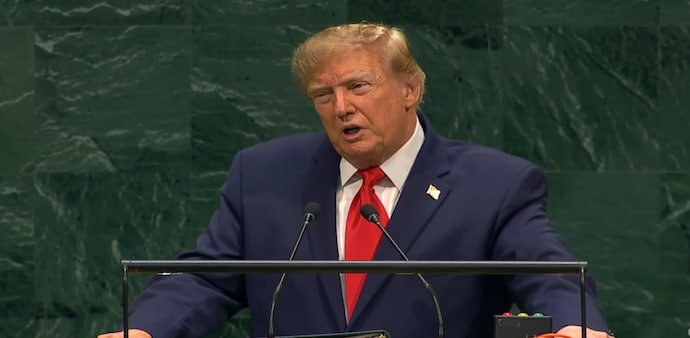
Against the backdrop of continuing strikes across West Asia and disruptions linked to the ongoing war, US President Donald Trump on Tuesday said his administration strongly supports the India-Middle East-Europe Economic Corridor, or IMEC, and stressed the need to move the Middle East’s energy infrastructure away from Iranian checkpoints and other vulnerable routes.
Addressing a meeting with GCC and Arab leaders on the sidelines of the UN General Assembly, Trump said the corridor could create alternative routes for energy and trade at a time when attacks on commercial shipping in neighbouring countries had exposed the risks facing the region.
Trump backs IMEC at UN sidelines
"Iran's terrorist attacks on commercial shipping in neighboring countries have shown the need to shift Middle East energy infrastructure away from the Iranian checkpoints. That's why my administration strongly supports the India-Middle East-Europe Economic Corridor and other places in the form of getting oil out, whether it's pipelines or anything else. Together, we're on the verge of overcoming challenges that have plagued this region for decades," Trump said.
He also described the leaders at the meeting as some of the United States’ closest allies and partners, and said their efforts were aimed at making the region safer and more prosperous.
"It's an honor to be here with some of America's greatest and closest friends, allies, and partners to continue our effort toward a safer and more prosperous Middle East," the US president said.
What the corridor involves
IMEC, unveiled in 2023, comprises an Eastern Corridor linking India with the Gulf region and a Northern Corridor connecting the Gulf with Europe. The project envisages a railway and ship-to-rail transit network, along with road transport routes.
Background information linked Trump’s latest endorsement to his remarks 20 days ago praising a media report about Syria emerging as a corridor to evacuate oil and gas from the Gulf to the Mediterranean Sea. The IMEC route, as outlined in the background, links India’s Mundra port to the UAE’s Fujairah port by sea, and then runs through a pipeline to Saudi Arabia, Jordan and Israel via a solar-powered rail network, before connecting to Europe through ships from Haifa port to Naples and Marseilles.
The background also said the route bypasses both the Strait of Hormuz and the Suez Canal-Red Sea corridor. Fujairah, which lies outside the Strait of Hormuz in the Gulf of Oman, was identified in the background as strategically important and as having been targeted by Iranian missiles.
Iran talks and threat
Trump also said US officials had a "very good" meeting with Iran, even as he threatened to "annihilate" the Islamic Republic if a deal was not reached soon to end the war.
He told reporters that his chief envoys, Steve Witkoff and Jared Kushner, held talks with Iranian officials for about three hours on the sidelines of the annual gathering of world leaders. Trump did not offer many details about the discussions or say what was discussed.
Earlier on Tuesday, US Secretary of State Marco Rubio said Trump was open to meeting Iranian President Masoud Pezeshkian during his visit to New York for the UN General Assembly.
Against the backdrop of continuing strikes across West Asia and disruptions linked to the ongoing war, US President Donald Trump on Tuesday said his administration strongly supports the India-Middle East-Europe Economic Corridor, or IMEC, and stressed the need to move the Middle East’s energy infrastructure away from Iranian checkpoints and other vulnerable routes.
Addressing a meeting with GCC and Arab leaders on the sidelines of the UN General Assembly, Trump said the corridor could create alternative routes for energy and trade at a time when attacks on commercial shipping in neighbouring countries had exposed the risks facing the region.
Trump backs IMEC at UN sidelines
"Iran's terrorist attacks on commercial shipping in neighboring countries have shown the need to shift Middle East energy infrastructure away from the Iranian checkpoints. That's why my administration strongly supports the India-Middle East-Europe Economic Corridor and other places in the form of getting oil out, whether it's pipelines or anything else. Together, we're on the verge of overcoming challenges that have plagued this region for decades," Trump said.
He also described the leaders at the meeting as some of the United States’ closest allies and partners, and said their efforts were aimed at making the region safer and more prosperous.
"It's an honor to be here with some of America's greatest and closest friends, allies, and partners to continue our effort toward a safer and more prosperous Middle East," the US president said.
What the corridor involves
IMEC, unveiled in 2023, comprises an Eastern Corridor linking India with the Gulf region and a Northern Corridor connecting the Gulf with Europe. The project envisages a railway and ship-to-rail transit network, along with road transport routes.
Background information linked Trump’s latest endorsement to his remarks 20 days ago praising a media report about Syria emerging as a corridor to evacuate oil and gas from the Gulf to the Mediterranean Sea. The IMEC route, as outlined in the background, links India’s Mundra port to the UAE’s Fujairah port by sea, and then runs through a pipeline to Saudi Arabia, Jordan and Israel via a solar-powered rail network, before connecting to Europe through ships from Haifa port to Naples and Marseilles.
The background also said the route bypasses both the Strait of Hormuz and the Suez Canal-Red Sea corridor. Fujairah, which lies outside the Strait of Hormuz in the Gulf of Oman, was identified in the background as strategically important and as having been targeted by Iranian missiles.
Iran talks and threat
Trump also said US officials had a "very good" meeting with Iran, even as he threatened to "annihilate" the Islamic Republic if a deal was not reached soon to end the war.
He told reporters that his chief envoys, Steve Witkoff and Jared Kushner, held talks with Iranian officials for about three hours on the sidelines of the annual gathering of world leaders. Trump did not offer many details about the discussions or say what was discussed.
Earlier on Tuesday, US Secretary of State Marco Rubio said Trump was open to meeting Iranian President Masoud Pezeshkian during his visit to New York for the UN General Assembly.