
Can fishing nets shield Pakistan from TTP's drone attacks? Defence experts call it 'immature, cheap ploy'
The move underlines a low-cost but limited response as militants expand their use of commercial drones.
- Oct 6, 2026,
- Updated Oct 6, 2026 12:53 PM IST
Under a sky watched for explosives, Pakistani security posts near the Afghanistan border are now being covered with fishing nets as the army looks for a low-cost way to blunt a growing wave of drone attacks in Khyber Pakhtunkhwa. The move comes amid escalating attacks by the Tehreek-e-Taliban Pakistan, or TTP, and renewed tensions between Pakistan and Afghanistan after nearly three months of uneasy calm. Pakistan has long accused Kabul of giving safe haven to the TTP, also known as the Pakistani Taliban, while Afghanistan has denied the charge. Pakistan has alleged that the TTP has been behind a string of attacks on its security forces, Al Jazeera reported.
TTP drone attacks rattle border districts
It was after one such attack in April in Hangu district, around 30 km from the Afghanistan border, that the Pakistani army decided to go fishing - not for fish, but to catch enemy drones.
On April 16, drones bombarded the Sarki Piyala police checkpost before TTP fighters opened fire on security personnel. One person was killed and dozens were injured.
It was not the first attack on Hangu. Because of its proximity to the Afghan border, the district has become a hotspot for deadly drone strikes and has faced 16 attacks this year. The situation is so serious that, according to the report, Pakistani security personnel do not leave their barracks without security cover.
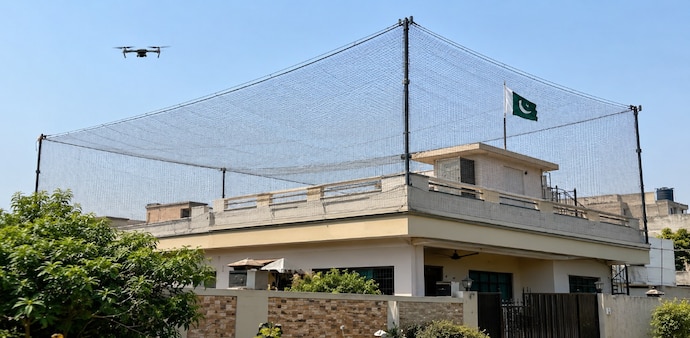
Instead of installing anti-drone systems, Pakistan has turned to fishing nets as a cheaper workaround. The nets have been installed overhead, between the rooftops of checkposts and their perimeter walls. A checkpost can be covered with such nets for about $1,400, or Rs 1.30 lakh, while anti-drone systems can cost anywhere between $5,000 and $5,000,000.
Over the past few months, these fishing nets have been installed in military outposts across five districts along the Afghanistan border: Kohat, Karak, Bannu, Lakki Marwat and Dera Ismail Khan.
Why Pakistan is using fishing nets
The idea behind the netting is to catch a drone's propellers before it can release explosives.
"If a drone comes over the checkpoint, there is a possibility that it could get caught in the net and be defused or stopped," Fayyaz Khan, a police officer, told Al Jazeera.
"Even if a drone does not get caught and explodes above the net, the damage is expected to be much less because most of the shrapnel and fragments would be dispersed in the air rather than falling directly onto the ground," he further said.
However, defence experts have said the nets are far from a complete solution and could create a "false sense of security". "Deploying nets is an immature, cheap ploy because police stations are not necessarily always the target," Imtiaz Gul of the Centre for Research and Security Studies told Al Jazeera.
"The drones are intended to hit prominent locations and generate dramatic optics," he said. Gul said the more pressing need for Pakistan was to intercept these drones as soon as they take to the air.
Pakistan relies on Chinese and Turkish anti-drone systems to guard against rogue UAVs. However, last year's Operation Sindoor exposed their vulnerabilities. To plug the gap, Pakistan has now turned to US-based Powerus, a firm linked to Donald Trump's sons, for its anti-drone system.
Even security personnel acknowledge that the fishing nets are not foolproof. "We cannot say that the netting system provides complete protection," Khan said.
Pakistan Taliban's drone warfare
Behind the concern in Pakistan is the TTP's changing warfare strategy, with cheap drones becoming a key part of its attack toolkit.
In December 2025, the group formed a special drone unit led by Maulvi Saleem Haqqani. It mostly relies on readily available, relatively inexpensive and easy-to-modify commercial drones.
Over the past couple of years, the TTP has steadily improved its use of quadcopter drones. According to research by the Global Network on Extremism and Technology, the TTP is using "Honda motorcycle batteries" to power drones for longer periods.
According to a report in The Dawn, Pakistan has claimed to have foiled 341 drone attacks in Khyber Pakhtunkhwa in the first half of 2026. Another 100 drone attacks have killed around 30 security personnel and injured 90.
Under a sky watched for explosives, Pakistani security posts near the Afghanistan border are now being covered with fishing nets as the army looks for a low-cost way to blunt a growing wave of drone attacks in Khyber Pakhtunkhwa. The move comes amid escalating attacks by the Tehreek-e-Taliban Pakistan, or TTP, and renewed tensions between Pakistan and Afghanistan after nearly three months of uneasy calm. Pakistan has long accused Kabul of giving safe haven to the TTP, also known as the Pakistani Taliban, while Afghanistan has denied the charge. Pakistan has alleged that the TTP has been behind a string of attacks on its security forces, Al Jazeera reported.
TTP drone attacks rattle border districts
It was after one such attack in April in Hangu district, around 30 km from the Afghanistan border, that the Pakistani army decided to go fishing - not for fish, but to catch enemy drones.
On April 16, drones bombarded the Sarki Piyala police checkpost before TTP fighters opened fire on security personnel. One person was killed and dozens were injured.
It was not the first attack on Hangu. Because of its proximity to the Afghan border, the district has become a hotspot for deadly drone strikes and has faced 16 attacks this year. The situation is so serious that, according to the report, Pakistani security personnel do not leave their barracks without security cover.
Instead of installing anti-drone systems, Pakistan has turned to fishing nets as a cheaper workaround. The nets have been installed overhead, between the rooftops of checkposts and their perimeter walls. A checkpost can be covered with such nets for about $1,400, or Rs 1.30 lakh, while anti-drone systems can cost anywhere between $5,000 and $5,000,000.
Over the past few months, these fishing nets have been installed in military outposts across five districts along the Afghanistan border: Kohat, Karak, Bannu, Lakki Marwat and Dera Ismail Khan.
Why Pakistan is using fishing nets
The idea behind the netting is to catch a drone's propellers before it can release explosives.
"If a drone comes over the checkpoint, there is a possibility that it could get caught in the net and be defused or stopped," Fayyaz Khan, a police officer, told Al Jazeera.
"Even if a drone does not get caught and explodes above the net, the damage is expected to be much less because most of the shrapnel and fragments would be dispersed in the air rather than falling directly onto the ground," he further said.
However, defence experts have said the nets are far from a complete solution and could create a "false sense of security". "Deploying nets is an immature, cheap ploy because police stations are not necessarily always the target," Imtiaz Gul of the Centre for Research and Security Studies told Al Jazeera.
"The drones are intended to hit prominent locations and generate dramatic optics," he said. Gul said the more pressing need for Pakistan was to intercept these drones as soon as they take to the air.
Pakistan relies on Chinese and Turkish anti-drone systems to guard against rogue UAVs. However, last year's Operation Sindoor exposed their vulnerabilities. To plug the gap, Pakistan has now turned to US-based Powerus, a firm linked to Donald Trump's sons, for its anti-drone system.
Even security personnel acknowledge that the fishing nets are not foolproof. "We cannot say that the netting system provides complete protection," Khan said.
Pakistan Taliban's drone warfare
Behind the concern in Pakistan is the TTP's changing warfare strategy, with cheap drones becoming a key part of its attack toolkit.
In December 2025, the group formed a special drone unit led by Maulvi Saleem Haqqani. It mostly relies on readily available, relatively inexpensive and easy-to-modify commercial drones.
Over the past couple of years, the TTP has steadily improved its use of quadcopter drones. According to research by the Global Network on Extremism and Technology, the TTP is using "Honda motorcycle batteries" to power drones for longer periods.
According to a report in The Dawn, Pakistan has claimed to have foiled 341 drone attacks in Khyber Pakhtunkhwa in the first half of 2026. Another 100 drone attacks have killed around 30 security personnel and injured 90.