
Canada to impose retaliatory tariffs on the US as trade talks collapse
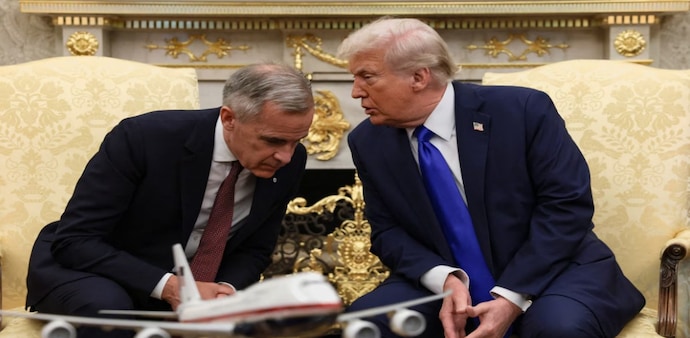
US-Canada: The deterioration in ties follows Carney's decision late on Friday to suspend trade negotiations with the Trump administration.
- Aug 25, 2026,
- Updated Aug 25, 2026 8:09 AM IST
US-Canada trade talks: Canada will announce retaliatory tariffs against the US on Tuesday after trade talks with Washington collapsed and exchanges between the two sides escalated sharply. Prime Minister Mark Carney said the latest US demands were "uneconomic" and "unfair", while President Donald Trump warned Canadian leaders to "fall in line" or face consequences "far WORSE" than existing tariffs.
The deterioration in ties follows Carney's decision late on Friday to suspend trade negotiations with the Trump administration. Early on Saturday, the United States imposed 50 per cent tariffs on about $20 billion worth of Canadian products, and Trump later threatened new 50 per cent tariffs on Canadian vehicles, auto parts and steel, saying they would begin next year.
MUST READ | 'Asked too much, offered too little': Carney on why Canada suspended US trade talks
According to a report in Associated Press, Canada is expected to respond with its own tariff measures, with details to be announced on Tuesday after Labour Day. Finance Minister François-Philippe Champagne and three other Cabinet ministers are also due to set out support measures for workers affected by the tariffs, it said. Carney had said earlier on Monday that Canada may need to move away from matching US tariffs dollar for dollar and instead use more targeted retaliation aimed at protecting Canadian workers and businesses.
Announcing the breakdown in talks, Carney said Canada had worked "intensively and in good faith" with the United States for more than a year to negotiate a new comprehensive trade deal. "While we believed earlier this week that we were moving towards a mutually beneficial agreement, in recent days, the United States proposed new terms that were uneconomic, unfair, and undermined the net benefits for Canada and called into question the reliability of any deal," he said. "In short, they asked too much, and they offered too little." He added: "We cannot accept what the US has offered, and we will not give what they have asked."
Carney said he had instructed Canadian negotiators to return to Ottawa. He said Canada had been willing to negotiate but was not prepared to accept a deal at any price. "Our goal has always been to get the best deal for Canadians, never a deal at any price or on any time frame," he said.
According to Carney, one of Washington's last-minute demands was an attempt to restrict Canada's ability to strike trade agreements with other countries. "The US introduced in the last hours, efforts to restrict our ability to have other trade deals," he said. He added that Canada had secured 20 new deals and economic and security partnerships over the past year, with the prospect of doubling its market access. "We are the partner of choice in many respects for countries around the world, and the Americans wanted to restrict that," Carney said, calling the proposed language "unacceptable".
Carney said the US approach showed an "attitude at the negotiation table that Canada is a subsidiary of the United States" and added that this was "not something we're going to accept". He was blunter in French, saying: "We learned during the negotiations that the Americans want to destroy our major industries, including autos, steel and aluminum. That was one of the main reasons we said no. It was a bad deal." He also cast doubt on the US as a dependable partner, saying Canada was finding reliable partners "everywhere in the world, except in the United States. Except in the United States. And Russia."
Trump responded with more threats on Monday. On social media, he wrote that "Canada has been ripping off the United States of America for years" and criticised what he called the country's "ridiculously high tariffs" on American farmers. He also threatened further tariffs on Canada's auto industry, while Carney said Washington's auto-sector proposals would gradually have the effect of dismantling Canadian production. "This is the most successful automotive partnership in history," Carney said of the deeply integrated Canada-US industry.
The United States blamed Canada for the collapse in talks. US Trade Representative Jamieson Greer said: "Tonight, Canada declined to finalise the trade deal under the terms agreed earlier this week." He added: "Despite the US offer to Canada to receive the best treatment of any major exporter to our market, new demands and walk-backs of other commitments by Canada have upended the careful balance reached in the past days."
Canada had sought concessions on tariffs covering steel, aluminium, autos and lumber. Trump's import taxes affect about 5 per cent of Canada's annual exports to the United States.
US-Canada trade talks: Canada will announce retaliatory tariffs against the US on Tuesday after trade talks with Washington collapsed and exchanges between the two sides escalated sharply. Prime Minister Mark Carney said the latest US demands were "uneconomic" and "unfair", while President Donald Trump warned Canadian leaders to "fall in line" or face consequences "far WORSE" than existing tariffs.
The deterioration in ties follows Carney's decision late on Friday to suspend trade negotiations with the Trump administration. Early on Saturday, the United States imposed 50 per cent tariffs on about $20 billion worth of Canadian products, and Trump later threatened new 50 per cent tariffs on Canadian vehicles, auto parts and steel, saying they would begin next year.
MUST READ | 'Asked too much, offered too little': Carney on why Canada suspended US trade talks
According to a report in Associated Press, Canada is expected to respond with its own tariff measures, with details to be announced on Tuesday after Labour Day. Finance Minister François-Philippe Champagne and three other Cabinet ministers are also due to set out support measures for workers affected by the tariffs, it said. Carney had said earlier on Monday that Canada may need to move away from matching US tariffs dollar for dollar and instead use more targeted retaliation aimed at protecting Canadian workers and businesses.
Announcing the breakdown in talks, Carney said Canada had worked "intensively and in good faith" with the United States for more than a year to negotiate a new comprehensive trade deal. "While we believed earlier this week that we were moving towards a mutually beneficial agreement, in recent days, the United States proposed new terms that were uneconomic, unfair, and undermined the net benefits for Canada and called into question the reliability of any deal," he said. "In short, they asked too much, and they offered too little." He added: "We cannot accept what the US has offered, and we will not give what they have asked."
Carney said he had instructed Canadian negotiators to return to Ottawa. He said Canada had been willing to negotiate but was not prepared to accept a deal at any price. "Our goal has always been to get the best deal for Canadians, never a deal at any price or on any time frame," he said.
According to Carney, one of Washington's last-minute demands was an attempt to restrict Canada's ability to strike trade agreements with other countries. "The US introduced in the last hours, efforts to restrict our ability to have other trade deals," he said. He added that Canada had secured 20 new deals and economic and security partnerships over the past year, with the prospect of doubling its market access. "We are the partner of choice in many respects for countries around the world, and the Americans wanted to restrict that," Carney said, calling the proposed language "unacceptable".
Carney said the US approach showed an "attitude at the negotiation table that Canada is a subsidiary of the United States" and added that this was "not something we're going to accept". He was blunter in French, saying: "We learned during the negotiations that the Americans want to destroy our major industries, including autos, steel and aluminum. That was one of the main reasons we said no. It was a bad deal." He also cast doubt on the US as a dependable partner, saying Canada was finding reliable partners "everywhere in the world, except in the United States. Except in the United States. And Russia."
Trump responded with more threats on Monday. On social media, he wrote that "Canada has been ripping off the United States of America for years" and criticised what he called the country's "ridiculously high tariffs" on American farmers. He also threatened further tariffs on Canada's auto industry, while Carney said Washington's auto-sector proposals would gradually have the effect of dismantling Canadian production. "This is the most successful automotive partnership in history," Carney said of the deeply integrated Canada-US industry.
The United States blamed Canada for the collapse in talks. US Trade Representative Jamieson Greer said: "Tonight, Canada declined to finalise the trade deal under the terms agreed earlier this week." He added: "Despite the US offer to Canada to receive the best treatment of any major exporter to our market, new demands and walk-backs of other commitments by Canada have upended the careful balance reached in the past days."
Canada had sought concessions on tariffs covering steel, aluminium, autos and lumber. Trump's import taxes affect about 5 per cent of Canada's annual exports to the United States.